

An as-found drawing records what the repair team encountered. An as-repaired drawing records what it built. Combining the two by continuously editing one file can erase the evidence that explains why a winding moved, a barrier changed or a lead was reconnected. [1]
For a transformer rebuild, preserve three linked layers: observed condition, engineering change and verified final construction. This is more specific than ordinary revision control. Each layer answers a different physical question.
Keep the faulted state identifiable
The as-found record should identify the unit, dismantling stage, measurement datums and restraint condition. It may include fault deformation, aged material or incomplete access. Those observations are valuable, but they are not automatically the original design dimensions.
Photographs and recovered parts should use the same location identities as the drawing. A photograph labeled upper winding is difficult to connect with a disputed lead. A section and endpoint identity allows the observation to remain useful after the assembly has been rebuilt.
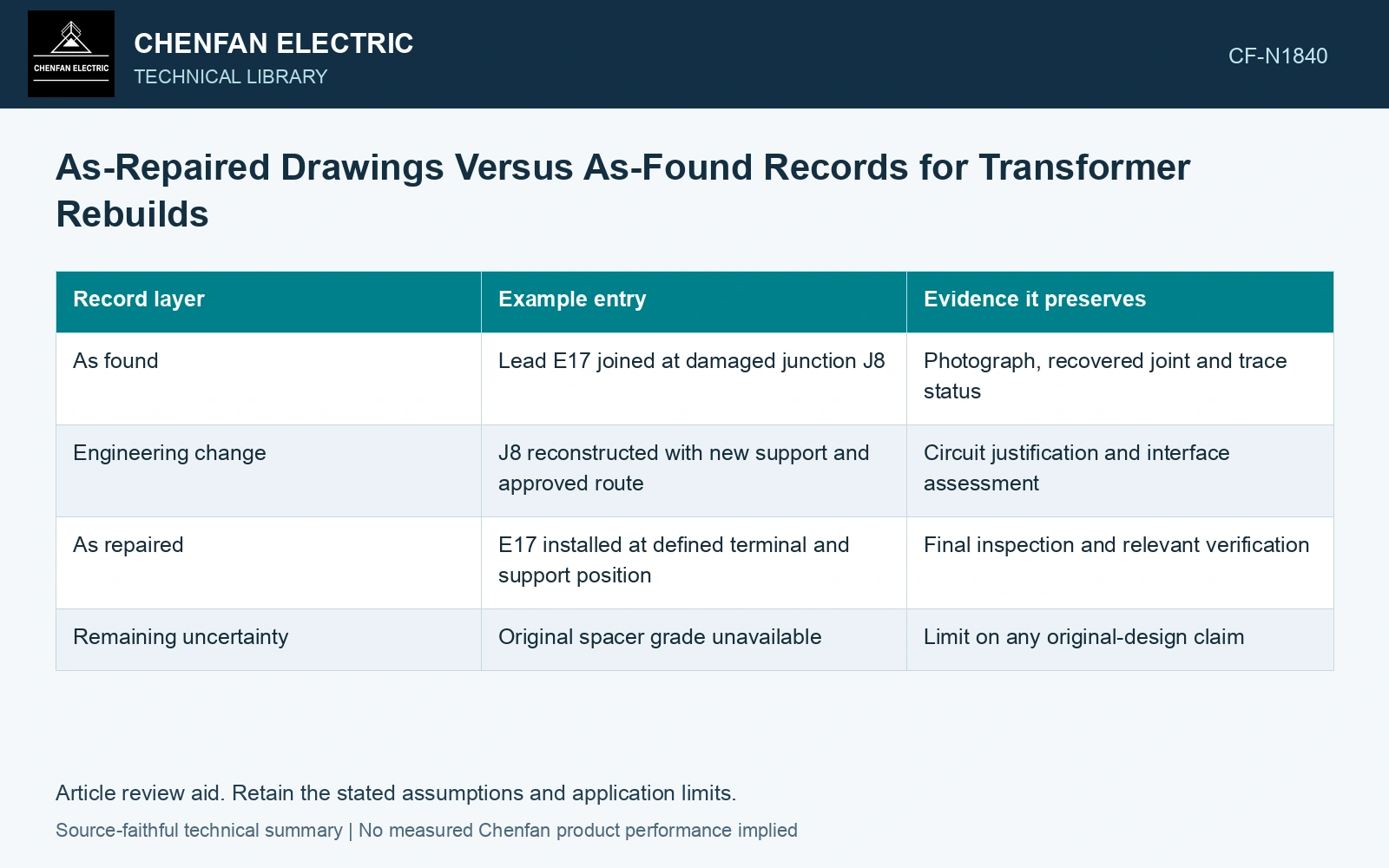
| Record layer | Example entry | Evidence it preserves |
|---|---|---|
| As found | Lead E17 joined at damaged junction J8 | Photograph, recovered joint and trace status |
| Engineering change | J8 reconstructed with new support and approved route | Circuit justification and interface assessment |
| As repaired | E17 installed at defined terminal and support position | Final inspection and relevant verification |
| Remaining uncertainty | Original spacer grade unavailable | Limit on any original-design claim |
Give changes an engineering reason
A changed dimension should point to the problem it solves and the interfaces it affects. For example, replacing a crushed support can change the final winding height and clamping distribution. The change entry should carry those consequences into the mechanical assessment, rather than appearing as a silent correction to the as-found sketch.
Verify the final layer independently of drawing issue
Issuing an as-repaired drawing does not prove that the assembly matches it. Record final dimensions, terminal identities and relevant inspection or test references against the same component locations. When an installed arrangement differs, either correct the assembly or process the difference as another engineering change.
Do not copy an inaccessible dimension into the final layer as measured. It can be a specified dimension, supported by manufacturing evidence, but its status should remain clear. This distinction prevents a future repair team from treating an unverified value as a historic observation.
Compare dimensions only after aligning datums and restraint state. Include the measurement uncertainty and state the conformity decision rule; it is different from the permitted dimensional tolerance. [2]
Reconcile one rebuilt dimension chain
Assumptions: as-found active height is 498 mm in a released winding; the repair specifies 505.0 ± 0.5 mm under a defined 10 kN preload. Final measurement at that preload is 504.0 mm with standard uncertainty 0.10 mm. The deviation is −1.0 mm from the repair target, not +6.0 mm from the released faulted state. With assumed coverage factor 2, the measured interval is 503.8–504.2 mm; even its upper end is below the specified lower limit 504.5 mm. Hold the build as nonconforming under this stated interval rule and inspect the dimension chain/preload interfaces before disposition. Preserve the as-found evidence separately. [2]
References
- U.S. Bureau of Reclamation, FIST Volume 3-31, Transformer Diagnostics, June 2003, section 15.1.
- B. N. Taylor and C. E. Kuyatt, NIST Technical Note 1297, Guidelines for Evaluating and Expressing the Uncertainty of NIST Measurement Results, 1994, sections 5 and 6.