

A feeder cable can run comfortably after rain and become the limiting component during a long dry loading period. The conductor has not changed. The thermal environment has. A rating based on a single wet-soil measurement may miss the condition that develops around the cable itself. [1]
Cable heat can redistribute moisture in susceptible ground. If the region near the cable dries and its thermal resistivity increases, heat has a more difficult path to the surrounding soil. The conductor temperature then rises for the same losses. This feedback should be investigated, not assumed identical for every soil.
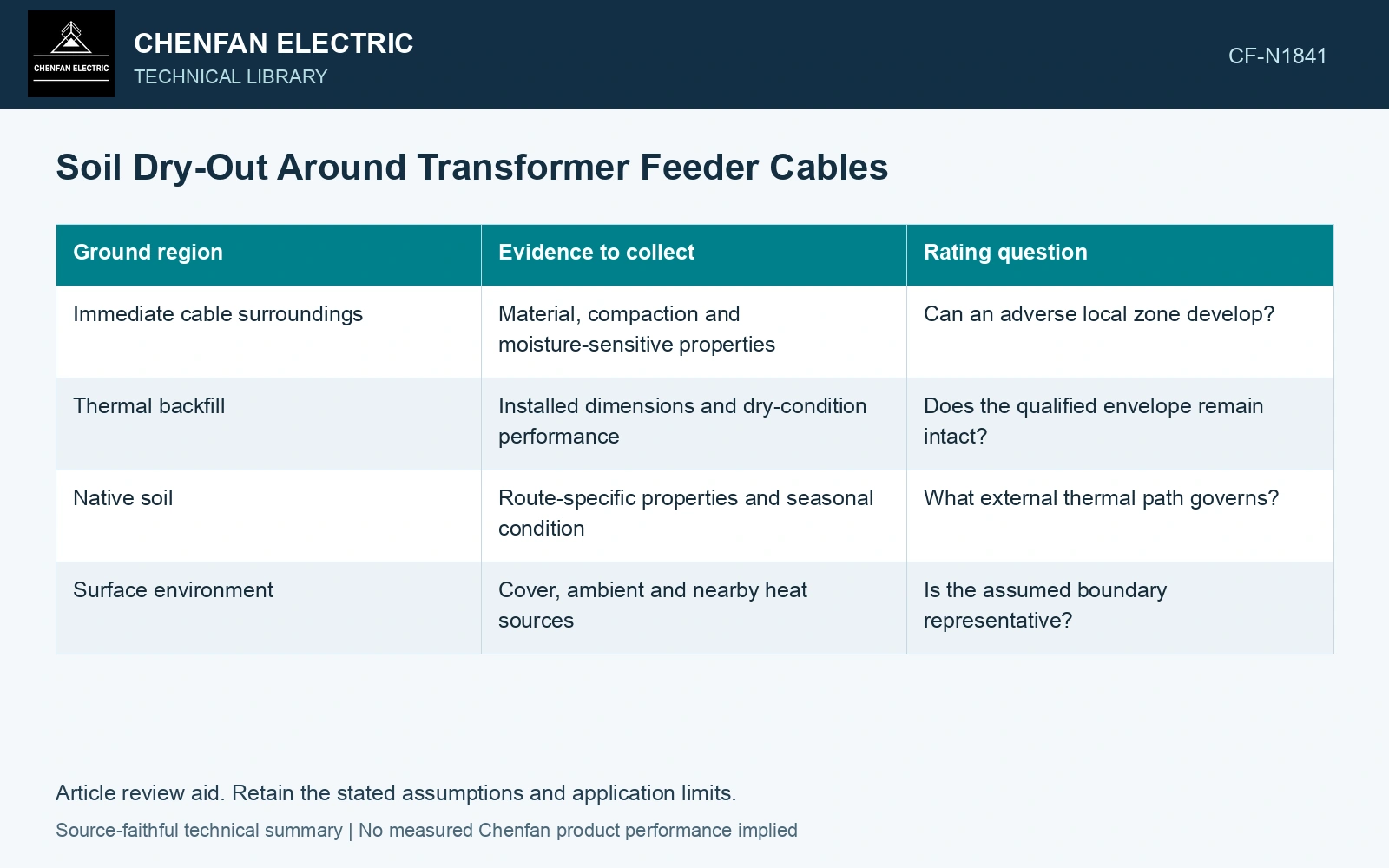
Represent the ground as zones
A simple model separates the cable surroundings into an inner zone influenced by heating and an outer zone closer to the undisturbed condition. Thermal backfill, if present, is another distinct region. The boundaries and properties need site evidence; drawing a dry annulus does not prove its actual extent.
For steady radial conduction through a homogeneous cylindrical layer, thermal resistance per unit length is T = ρth ln(r2/r1)/(2π). T is in kelvin-metres per watt, ρth is thermal resistivity in kelvin-metres per watt, and radii r1 and r2 are in metres. The temperature difference across that layer is approximately qT, where q is heat flow per unit length in watts per metre.
This equation assumes uniform properties, steady radial flow and no additional heat source within the layer. A real buried route includes a ground surface, neighboring circuits and moisture transport, so it is a sensitivity illustration rather than a complete rating method.
| Ground region | Evidence to collect | Rating question |
|---|---|---|
| Immediate cable surroundings | Material, compaction and moisture-sensitive properties | Can an adverse local zone develop? |
| Thermal backfill | Installed dimensions and dry-condition performance | Does the qualified envelope remain intact? |
| Native soil | Route-specific properties and seasonal condition | What external thermal path governs? |
| Surface environment | Cover, ambient and nearby heat sources | Is the assumed boundary representative? |
Test the adverse property range
Compare plausible wet and adverse dry conditions using a verified cable-rating method. Retain which property, region and loading history changes in each case. Avoid a blanket ampacity correction that cannot distinguish a short backfilled section from a long unprotected native-soil section.
IEC 60853-3 specifically addresses partial soil drying and states an initially uniform thermal environment; special backfills with different properties require further consideration. Keep that applicability separate from a simple fixed-annulus sensitivity. [2]
Screen the dry-annulus sensitivity
Assumptions: 20 W/m crosses a fixed annulus from 0.05 m to 0.20 m radius, and the approved allocation for its temperature drop is 8 K. At assumed wet-state resistivity 1 K·m/W, T = ln(4)/(2π) = 0.2206 K·m/W and the drop is 4.41 K. At assumed dry-state resistivity 2.5 K·m/W, T = 0.5516 K·m/W and the drop is 11.03 K, exceeding the allocation by 3.03 K. For the dry annulus, the corresponding loss bound is 8/0.5516 = 14.50 W/m. Reject sustained 20 W/m on that assumed allocation until the dry properties and full route model justify it. This fixed boundary does not predict moisture migration or the dry-zone radius. [3][2]
References
- IEC, IEC 60287-1-1:2023, Electric cables — Calculation of the current rating — Part 1-1: Current rating equations (100 % load factor) and calculation of losses — General.
- IEC, IEC 60853-3:2002, Calculation of the cyclic and emergency current rating of cables — Part 3: Cyclic rating factor for cables of all voltages, with partial drying of the soil.
- U.S. Department of Energy, DOE-HDBK-1012/2-92, Thermodynamics, Heat Transfer, and Fluid Flow, Volume 2, 1992.