

Verify the conductor path and equipment condition when voltage returns after an open-phase event. Another source, winding coupling or a rotating load can energize the measured point, so pair the voltage indication with confirmed circuit continuity and the duty experienced during the interruption. [1] [2]
Identify which path returned
Compare the confirmed post-event source and conductor topology with the intended supply arrangement. Record switch indications separately from evidence about the relevant physical path. A status bit reports its device, not every conductor, fuse or connection beyond it.
Name the observation points and remaining sources. The motor-bus transfer paper shows motor stator voltage persisting after source disconnection during rundown [2]. Such an energized downstream point does not identify a restored upstream conductor. Record inverter and other source states too.
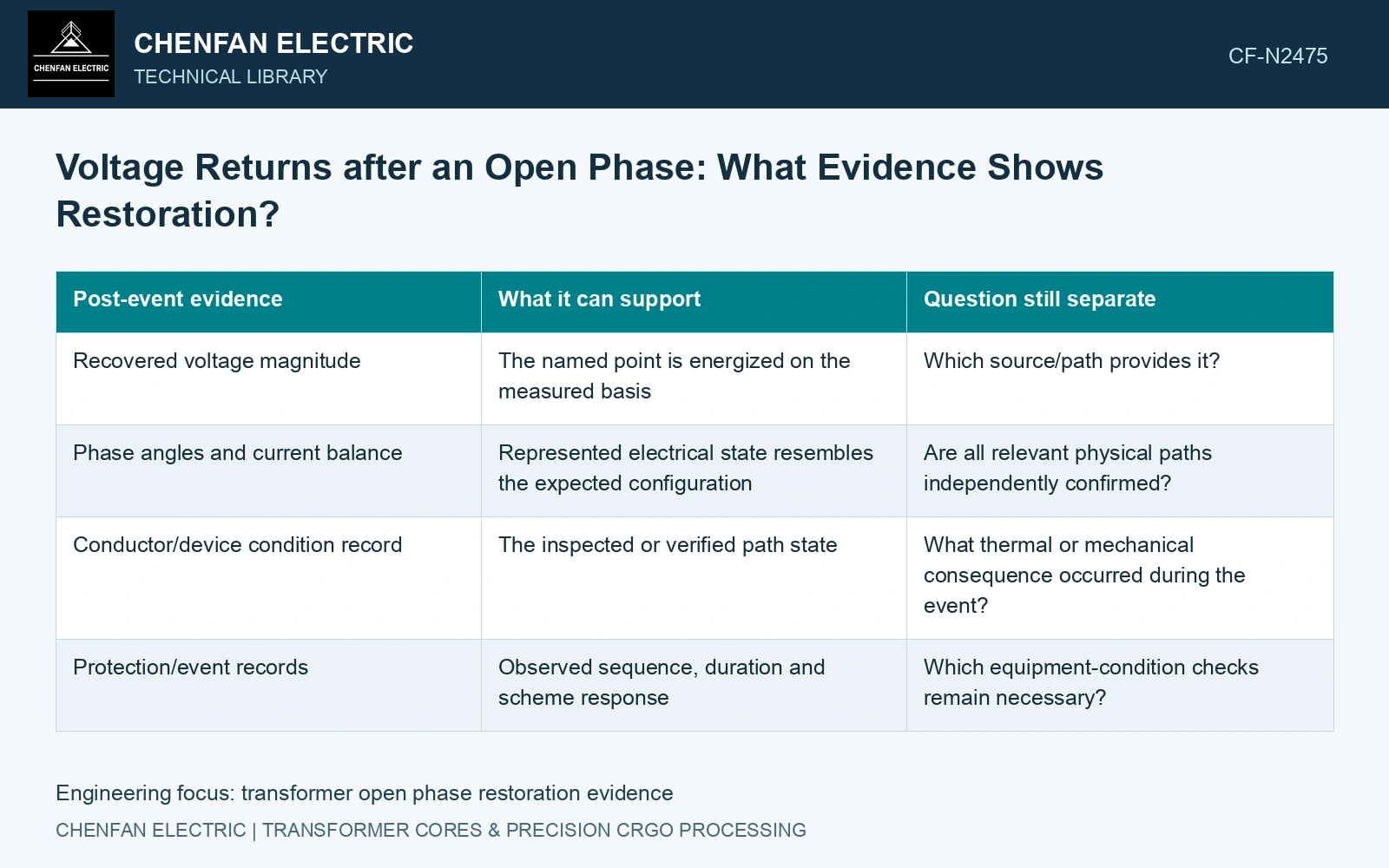
| Post-event evidence | What it can support | Question still separate |
|---|---|---|
| Recovered voltage magnitude | The named point is energized on the measured basis | Which source/path provides it? |
| Phase angles and current balance | Represented electrical state resembles the expected configuration | Are all relevant physical paths independently confirmed? |
| Conductor/device condition record | The inspected or verified path state | What thermal or mechanical consequence occurred during the event? |
| Protection/event records | Observed sequence, duration and scheme response | Which equipment-condition checks remain necessary? |
Examine residual unbalance
Compare all relevant phase quantities on a common time, sign and reference basis. A familiar average voltage can hide abnormal phase angles, a loaded connection or unequal currents. Account for the actual post-event load; a lower load can reduce a symptom without removing its cause. [1]
Check measurement-channel health independently where it affects the conclusion. Recovered displayed values after an instrument change may reflect restoration of the measurement circuit rather than the power circuit. Calculated sequence quantities from those same inputs cannot independently prove channel integrity.
Retain the duty experienced during the event
Preserve duration, winding current, cooling state, alarms and available temperature history for the responsible equipment-condition review. Normal observations afterward do not measure an earlier local temperature; retain the missing interval rather than treating it as confirmed normal duty.
Record permanent-fault and fuse/device-condition findings with the event. Removing a visible open-phase symptom does not establish that the initiating fault disappeared or that every affected component retained its required condition.
Deliver a state record that separates the observed voltage recovery, confirmed conductor path and outstanding equipment-condition evidence. Include the abnormal-duty interval and any unresolved initiating fault, so the responsible operating authority can assess the equipment and the restoration state.
References
- J. LaBlanc, Y. Shah and J. Aultman, Schweitzer Engineering Laboratories, Revisiting Open-Phase Detection for Fuse-Protected Power Transformers, 2024.
- P. Muralimanohar and coauthors, Implementation of a Microprocessor-Based Motor Bus Transfer Scheme, IEEE PCIC, 2016. DOI: 10.1109/PCICON.2016.7589248.