

List the measurements available to the open-phase logic after a neutral-related input is lost. Determine which event distinctions those signals still support, then test the degraded state explicitly. A replacement estimate must be assessed against the information and uncertainty of its remaining inputs. [1]
Inventory signals by their physical boundary
Distinguish a directly measured neutral displacement, three independently referenced phase-to-ground voltages and line-to-line voltages. Their information content differs. Calculated zero-sequence voltage requires a suitable phase-voltage set; line differences alone discard a common reference component. [2]
Record whether an input is absent, invalid, stale or merely below resolution. A held last-valid value is historical information, not a current observation. Quality and timing states belong to the detector input, alongside the electrical value.
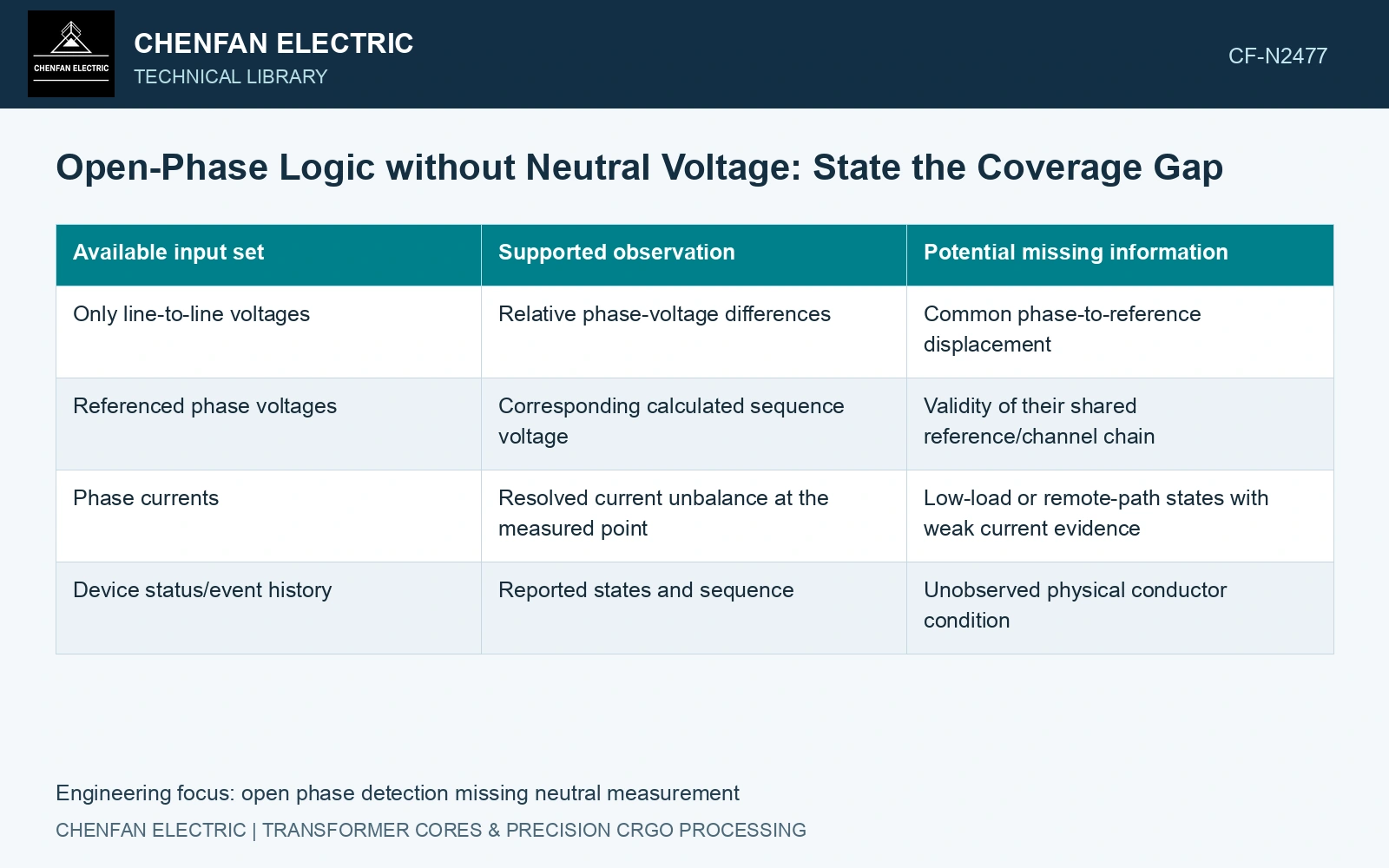
| Available input set | Supported observation | Potential missing information |
|---|---|---|
| Only line-to-line voltages | Relative phase-voltage differences | Common phase-to-reference displacement |
| Referenced phase voltages | Corresponding calculated sequence voltage | Validity of their shared reference/channel chain |
| Phase currents | Resolved current unbalance at the measured point | Low-load or remote-path states with weak current evidence |
| Device status/event history | Reported states and sequence | Unobserved physical conductor condition |
Define indistinguishable cases
Construct offline event pairs that produce the same available observations: for example, a physical common reference change and a shared measurement-reference error when only derived line quantities remain. If the chosen input set cannot separate them, the ambiguity is structural rather than a software-tuning problem. [1]
Also compare power-conductor opening with measurement-channel loss, relevant load unbalance and combined events. Current evidence may discriminate some cases at load but weaken near zero current. A result from the well-observed region cannot establish the degraded region.
Exercise the information transition
Test the actual scheme with the represented signal set before, during and after input-quality loss. Retain its indicated state, alarms, output and restoration of valid information. Specify the required response for each input-quality state in the project’s protection design, then compare it with the tested indications and outputs. [1]
If an estimate replaces a missing input, state its model assumptions and uncertainty. Challenge the cases where those assumptions fail. An estimate fitted to healthy balanced data can look plausible while suppressing the abnormal state the detector is meant to identify.
Deliver a coverage matrix separating independently observed events, assumption-dependent estimates and indistinguishable cases. Use each gap to decide whether an additional measurement, input supervision or a scheme change is required, and verify the revised response through signal loss and recovery.
References
- J. LaBlanc, Y. Shah and J. Aultman, Schweitzer Engineering Laboratories, Revisiting Open-Phase Detection for Fuse-Protected Power Transformers, 2024.
- D. De Ronde, R. VanHatten and A. Wade, Schweitzer Engineering Laboratories, Loss of Effective System Grounding — Best Practices, Protection Challenges, and Solutions, 2015.