

Model electronic-load current from its actual regulation and dropout states when calculating an open-neutral star point. The SEL analysis distinguishes constant-power and constant-current loads from fixed impedances [1]. The following branch-law comparison shows why that distinction matters.
State what the power stage actually controls
Identify the input circuit, regulation objective, stored energy and protection states. A passive rectifier, controlled input and drive with changing mechanical load require their own supported current laws; matching rated watts does not establish identical behaviour.
Retain whether the chosen quantity is AC input power, DC output power or a commanded load. Losses and power factor belong in a real input model. A constant-power approximation is bounded by the voltage, current and control conditions over which regulation is supported.
Compare the branch laws explicitly
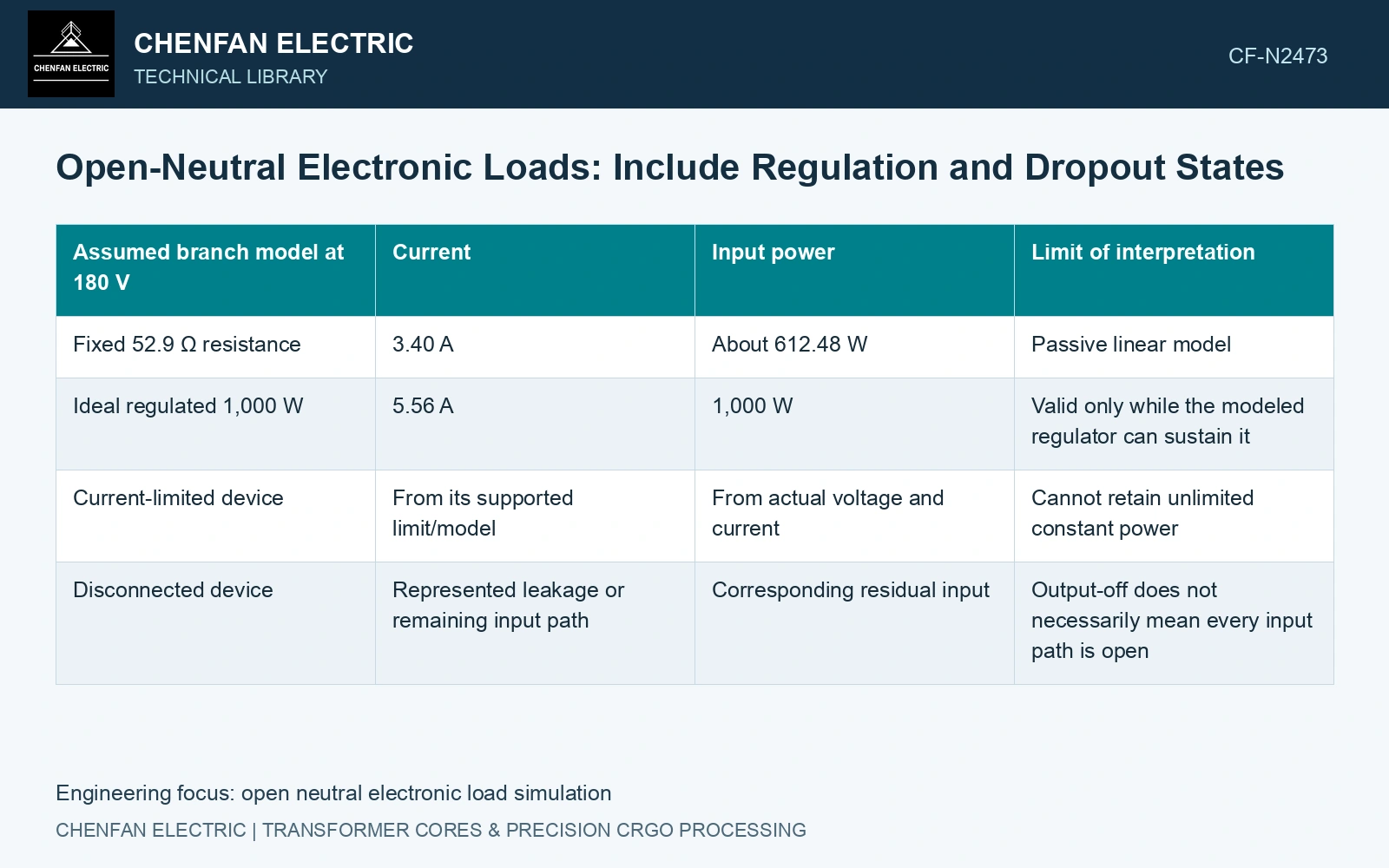
Assume a unity-power-factor 1,000 W RMS branch at 230 V. Using P = V²/R gives 52.9 Ω at that point [2]. The following rows compare separate assumed branch laws at 180 V; they are not measured electronic-device responses.
| Assumed branch model at 180 V | Current | Input power | Limit of interpretation |
|---|---|---|---|
| Fixed 52.9 Ω resistance | 3.40 A | About 612.48 W | Passive linear model |
| Ideal regulated 1,000 W | 5.56 A | 1,000 W | Valid only while the modeled regulator can sustain it |
| Current-limited device | From its supported limit/model | From actual voltage and current | Cannot retain unlimited constant power |
| Disconnected device | Represented leakage or remaining input path | Corresponding residual input | Output-off does not necessarily mean every input path is open |
Solve star-point balance with the changing laws
Replace a fixed admittance with the appropriate branch-current relation, including phase and waveform where relevant. Enforce node balance with the actual neutral and other returns. A constant-admittance star formula cannot retain a pre-event nominal resistance after the chosen load law changes.
For a constant-power approximation, increasing current as voltage falls can materially change the solution. Verify convergence and whether the solution remains inside the regulator’s valid range. A mathematical equilibrium beyond a current limit is not a physically supported operating point.
Retain transitions and stored energy
Include the relevant undervoltage exit, delay, reset and restart state from actual device evidence. Stored energy can separate the input-current transition from the downstream load response. The SEL analysis explicitly distinguishes constant-power and constant-current loads from fixed impedances [1]; use that distinction without assigning a generic dropout threshold to a real device.
Compare the resistor and controlled-load solutions using the device’s regulation range, current limit, dropout and restart data. Mark where their star-point voltages or operating states diverge, and obtain the missing transition data before extending the model through those states.
References
- J. LaBlanc, Y. Shah and J. Aultman, Schweitzer Engineering Laboratories, Revisiting Open-Phase Detection for Fuse-Protected Power Transformers, 2024.
- U.S. Department of Energy, DOE-HDBK-1011/3-92, Electrical Science, Volume 3, June 1992.