

Surface tension, liquid–water interfacial tension and solid wetting measure different interfaces. Keep their phase pairs and preparation states explicit to use each result in the relevant blend assessment. [1]
Calculation basis. Project-specific values and gates in the illustrative screens below are assumptions; cited catalogue values retain their source test conditions.
Name both phases in every result. An air/liquid measurement differs from an oil/water measurement, and a contact angle adds a specific solid surface. Sample contamination, water quality and substrate preparation can influence these measurements.
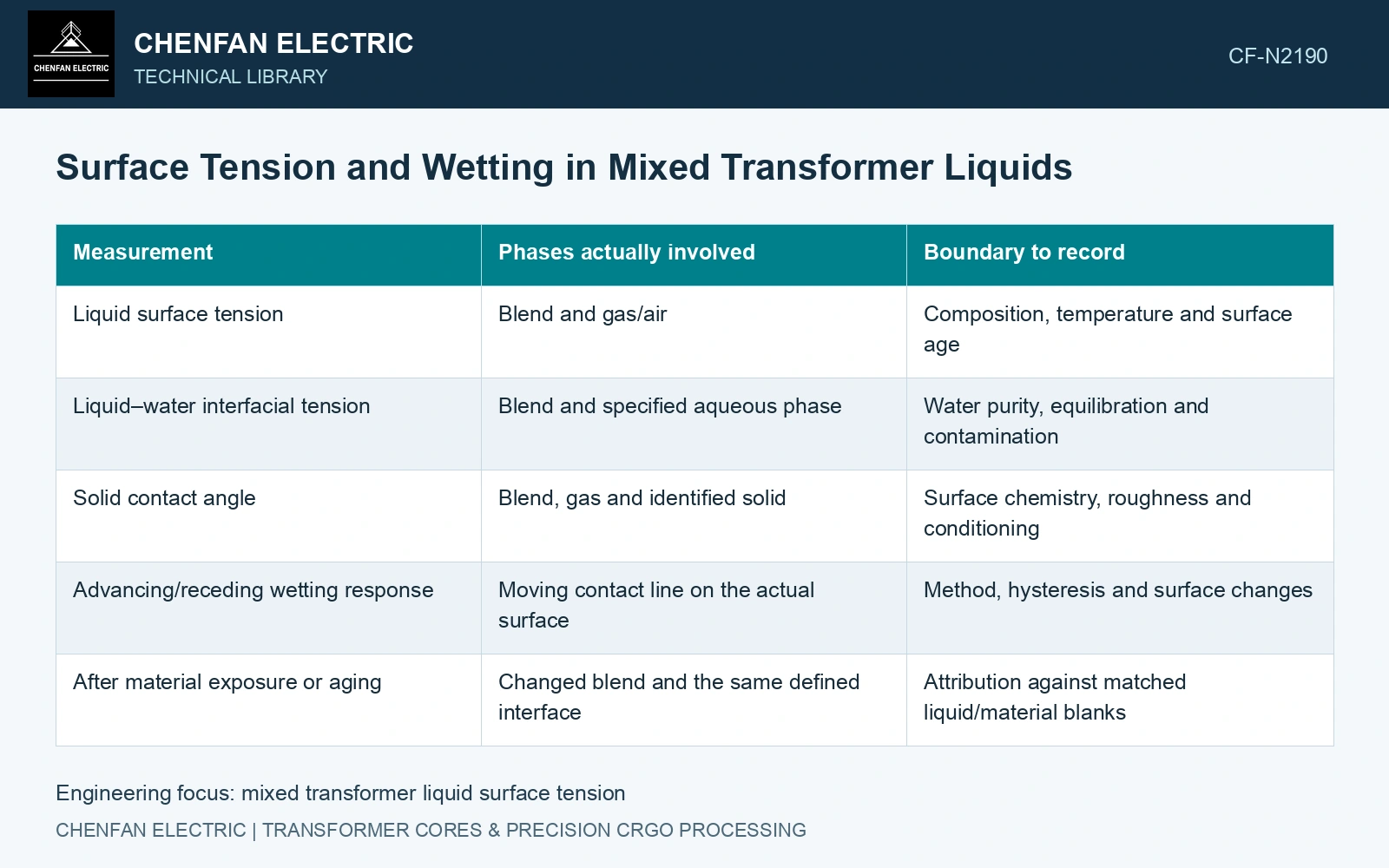
Draw the measurement boundary
| Measurement | Phases actually involved | Boundary to record |
|---|---|---|
| Liquid surface tension | Blend and gas/air | Composition, temperature and surface age |
| Liquid–water interfacial tension | Blend and specified aqueous phase | Water purity, equilibration and contamination |
| Solid contact angle | Blend, gas and identified solid | Surface chemistry, roughness and conditioning |
| Advancing/receding wetting response | Moving contact line on the actual surface | Method, hysteresis and surface changes |
| After material exposure or aging | Changed blend and the same defined interface | Attribution against matched liquid/material blanks |
Separate liquid tension from the solid-contact term
Washburn’s published capillary relation gives L² = γr cosθ·t/(2η) for the stated ideal horizontal cylindrical-capillary boundary [2]. Surface tension γ and contact angle θ enter separately; viscosity η also matters. A liquid-only tension measurement therefore cannot determine penetration into every solid.
Real transformer cellulose can be porous, rough, absorbent and already impregnated. A drop can penetrate or change the surface while the apparent angle is being observed. Treat a measurement on smooth glass as a separate boundary rather than a direct qualification of paper or pressboard wetting.
Keep contamination controls visible
Use cleaned measurement fixtures and a documented sample-handling method. Trace contaminants at an interface can change the result without representing the intended blend chemistry. A changed result after coating or filter exposure should be compared with the matched blank before it is attributed to extraction.
Control temperature and observation timing. Some interfaces evolve as components redistribute near the surface. An immediate reading and an equilibrated reading may answer different questions; report which was used.
Interpret a trend for the actual liquid type
A service trend needs the same method, phase pair and composition basis. A mineral-oil interpretation or numerical threshold is not automatically valid for a natural ester, synthetic ester or blend.
If the engineering question is wetting a specific material, use that material with a suitable observation method and preserve its prior condition. If the question is contamination at the liquid–water interface, retain that narrower boundary.
Resolve inconsistent readings through phase pair, surface state and preparation. Use identified tension and contact-angle measurements to test their respective mechanisms.
Compare penetration time at unchanged surface tension
Qualify the actual contact material under its liquid exposure [3]. Assume a smooth horizontal cylindrical pore of 10 μm radius, penetration length 1 mm, dynamic viscosity 0.050 Pa·s and surface tension 0.030 N/m at one controlled temperature. Neglect gravity, inertia and slip. From the stated model, t = 2ηL²/(γr cosθ) [2].
The time is 0.333 s at θ = 0° and 0.667 s at 60°, a twofold change with unchanged surface tension. Measure wetting and flow on the actual conditioned paper before setting an impregnation schedule: its pore network, absorption and prior liquid differ from the ideal tube.
References
- M. Lyutikova, S. Korobeynikov, U. Mohan Rao and I. Fofana, Mixed Insulating Liquids with Mineral Oil for High Voltage Transformer Applications: A Review, IEEE Transactions on Dielectrics and Electrical Insulation, 2022. DOI: 10.1109/TDEI.2022.3157908.
- E. W. Washburn, The Dynamics of Capillary Flow, Physical Review 17, 1921. DOI: 10.1103/PhysRev.17.273.
- IEC, IEC 63177:2024, Test methods for compatibility of construction materials with electrical insulating liquids.