

Limb–yoke temperature differences can reveal local heat sources, supports or regional oil conditions. Compare those mechanisms with registered sensors and material evidence to direct the next investigation. [1]
Temperature is the result of heat generation and heat removal together. Diagnose the difference before assigning it to the steel.
Compare like locations under like excitation
Confirm voltage, frequency, waveform, active turns and the stage of the thermal test. Identify whether each reading represents steel, a mounting pad, a support or nearby oil. A probe embedded in an insulating element may not track steel temperature directly, especially during a change.
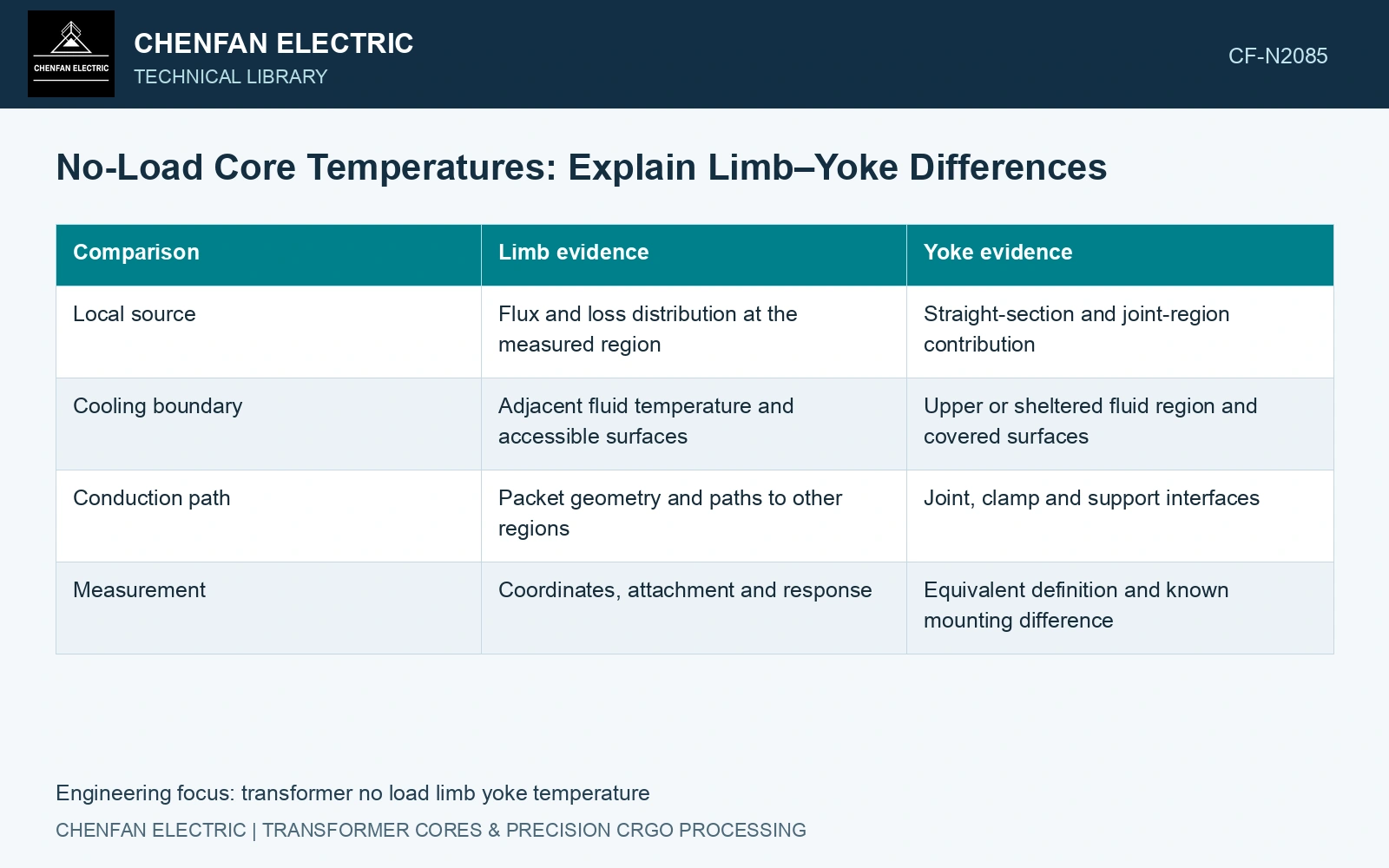
| Comparison | Limb evidence | Yoke evidence |
|---|---|---|
| Local source | Flux and loss distribution at the measured region | Straight-section and joint-region contribution |
| Cooling boundary | Adjacent fluid temperature and accessible surfaces | Upper or sheltered fluid region and covered surfaces |
| Conduction path | Packet geometry and paths to other regions | Joint, clamp and support interfaces |
| Measurement | Coordinates, attachment and response | Equivalent definition and known mounting difference |
A sensor near a yoke joint and another at the centre of an exposed limb are useful measurements, but they are not matched material comparisons. Keep their purposes explicit.
Test source and cooling explanations separately
Use the magnetic calculation or targeted electrical evidence to assess whether a larger local source is credible. Do not infer local watts solely from the measured temperature, because a high thermal resistance can produce the same rise.
Map the receiving fluid and adjacent structures. A higher upper oil temperature can raise the yoke temperature even if its local rise above that oil is smaller. Subtracting one common bulk oil temperature from all steel measurements can conceal this distinction.
A published core temperature-field calculation represents directional heat transfer and validates the particular construction against a temperature-rise test. That modelling approach supports resolving regions with different heat-removal paths instead of fitting one uniform core-temperature node. [2]
Use the time history to refine the diagnosis
Record both locations and their relevant fluid boundaries during heating and cooling. An early local rise followed by gradual equalization is different evidence from a slow rise following the surrounding oil. Check sensor lag before interpreting the timing.
Assume the limb and yoke regions each contain 100 kg of 23ZH90. Its 0.90 W/kg catalogue maximum at 1.7 T and 50 Hz gives a 90 W strip-input screen for each region. [3] If assumed local effective conductances are 6 W/K for the limb and 4 W/K for the yoke, predicted rises are 15 K and 22.5 K despite equal watts. A 7.5 K difference therefore does not prove higher yoke material loss. Compare matched source evidence and local oil boundaries, then test whether changing the yoke cooling path explains the difference before ordering another steel grade.
Limb/yoke packet widths, joint overlaps, support coverage and clamp pressure influence both source and cooling. Keep these construction differences visible instead of hiding them in an average core temperature.
Choose the next action from the heat-source, cooling-path and measurement comparison. Support a suspected steel inconsistency with material identity or magnetic testing at the relevant region.
References
- U.S. Department of Energy, DOE-HDBK-1012/2-92, Thermodynamics, Heat Transfer, and Fluid Flow, Volume 2, 1992.
- Z. Chen, Z. He and S. Wang, Transformer Iron Core Temperature Field Calculation Based on Finite Element Analysis, Energies 18, 6537, 2025. DOI: 10.3390/en18246537.
- Nippon Steel Corporation, Grain-Oriented Electrical Steel Sheets, catalogue D004je, April 2020, specification and typical-property tables.