

Adsorbent selection for blended fluids is a component-balance decision. Measure target removal, required constituent retention and final properties to establish whether the treatment achieves its intended result. [1]
Calculation basis. Project-specific values and gates in the illustrative screens below are assumptions; cited catalogue values retain their source test conditions.
Identify the actual blend and treatment medium. A reclamation result obtained on mineral oil is not automatically valid for an ester-containing matrix. The target contaminant, additive system and material-contact chemistry need their own evidence.
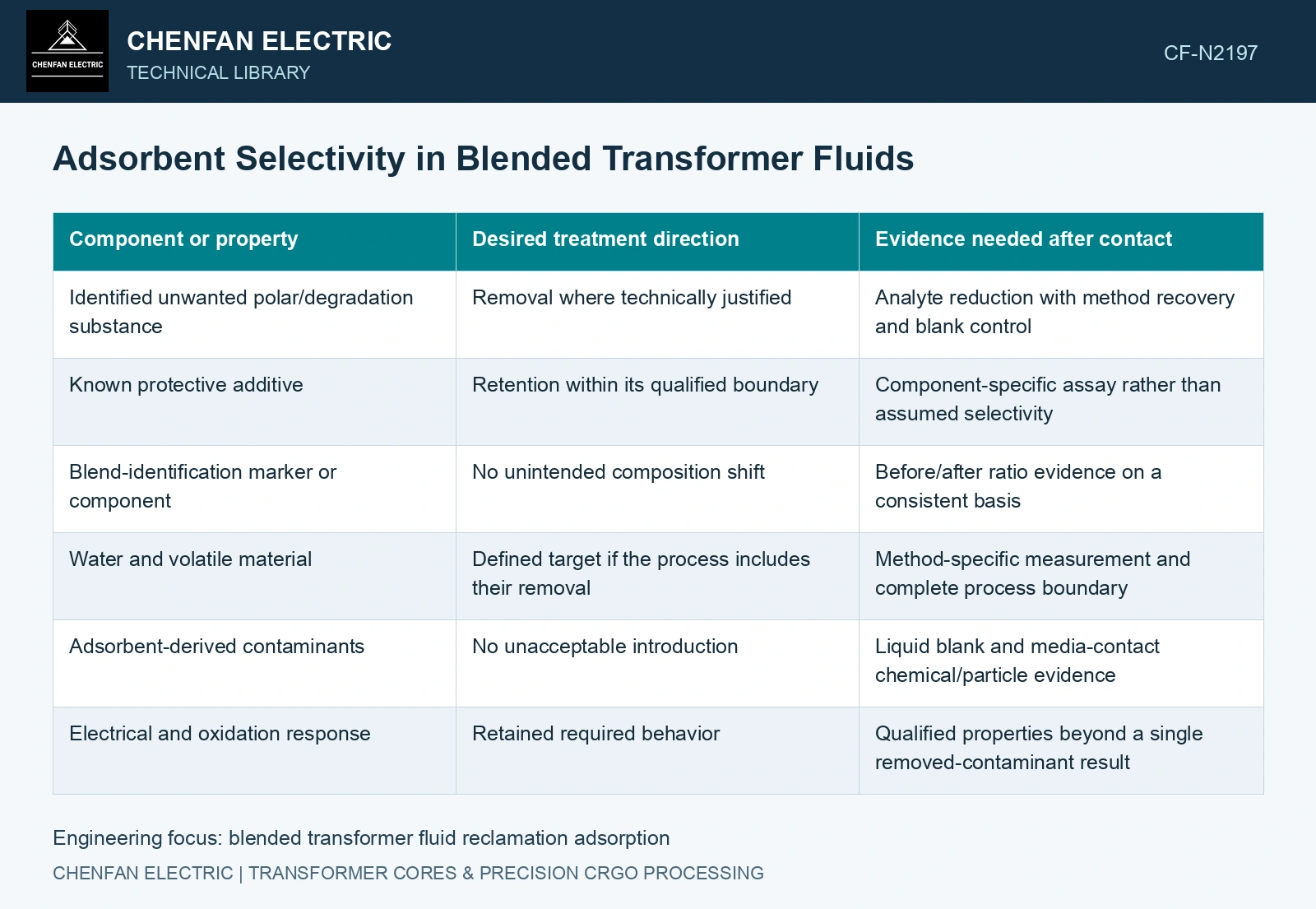
Follow component destinations
| Component or property | Desired treatment direction | Evidence needed after contact |
|---|---|---|
| Identified unwanted polar/degradation substance | Removal where technically justified | Analyte reduction with method recovery and blank control |
| Known protective additive | Retention within its qualified boundary | Component-specific assay rather than assumed selectivity |
| Blend-identification marker or component | No unintended composition shift | Before/after ratio evidence on a consistent basis |
| Water and volatile material | Defined target if the process includes their removal | Method-specific measurement and complete process boundary |
| Adsorbent-derived contaminants | No unacceptable introduction | Liquid blank and media-contact chemical/particle evidence |
| Electrical and oxidation response | Retained required behavior | Qualified properties beyond a single removed-contaminant result |
Compare against a no-treatment control
Use the same liquid batch and documented preparation for treated and untreated samples. Heating, vacuum, filtration or handling can change the liquid independently of adsorption. If these operations are combined, identify the complete process rather than assigning every change to the medium.
A contact screen should record medium dose, liquid quantity, temperature and duration. A flowing bed adds contact distribution, bypass and changing medium condition. A static bottle result does not establish the performance of every operating bed state.
Measure selectivity instead of assuming it
For the same identified analyte and representative liquid basis, an outlet/inlet concentration ratio can describe a measured change. It does not by itself prove adsorption: reaction, dilution, precipitation or analytical matrix effects can produce a similar difference. Where attribution matters, retain the appropriate material and recovery evidence.
Separate the reduction of a target substance from the retention of additives. A lower acidity indicator can coexist with loss of an antioxidant or another changed property. The treatment is not qualified by its most favorable number alone.
Check the resulting liquid as a complete matrix
Verify relevant chemical, electrical and aging behavior under suitable methods for the blend. A visually cleaner liquid is not automatically a recovered dielectric or oxidation system. Composition shifts can also affect later monitoring calibration and material exposure.
Review equipment and component suitability before proposing a service process. Laboratory evidence must be transferred through the actual process and transformer constraints.
Revise treatment when a required constituent moves beyond its supported range. Establish component-specific selectivity and final compatibility before describing the treated blend as restored.
Separate selective adsorption from proportional removal
IEC 63177 addresses construction-material/liquid compatibility; retain that scope when qualifying the actual contact system [2].
Assume a 100 kg blend contains 0.30 kg target oxidation product and 0.20 kg inhibitor. A trial adsorbent removes 0.15 kg of the former and 0.08 kg of the latter: removal fractions are 50% and 40%. The remaining masses are 0.15 kg target substance and 0.12 kg inhibitor. Assume project gates of at most 0.18 kg target substance and at least 0.15 kg inhibitor on this inventory basis: removal passes, but inhibitor retention fails. Reject the treatment as qualified under those assumed gates; revise the process and recheck both constituents and final liquid properties.
References
- M. Lyutikova, S. Korobeynikov, U. Mohan Rao and I. Fofana, Mixed Insulating Liquids with Mineral Oil for High Voltage Transformer Applications: A Review, IEEE Transactions on Dielectrics and Electrical Insulation, 2022. DOI: 10.1109/TDEI.2022.3157908.
- IEC, IEC 63177:2024, Test methods for compatibility of construction materials with electrical insulating liquids.