

A large motor bus is often reduced to one equivalent machine to make a transfer study manageable. The equivalent can be useful, but its inertia should represent a declared property. Adding rated powers is not the same as preserving stored kinetic energy. [1]
Start with each motor and its driven load. Coupling or gear ratio determines how load inertia is referred to the motor shaft. Preserve the actual connected population and operating speed at the event.
Construct an energy equivalent
A rotating component stores kinetic energy Ek = 0.5Jω². J is inertia in kilogram-square metres, ω is angular speed in radians per second and Ek is in joules. For several components, total energy is the sum of their individual energies.
At a chosen equivalent speed ωeq, an energy-preserving equivalent inertia is Jeq = sum(Jkωk²)/ωeq². This expression preserves energy at that defined state. If all speeds share the same referred reference, it reduces to the corresponding inertia sum. It does not establish equivalent electromagnetic dynamics.
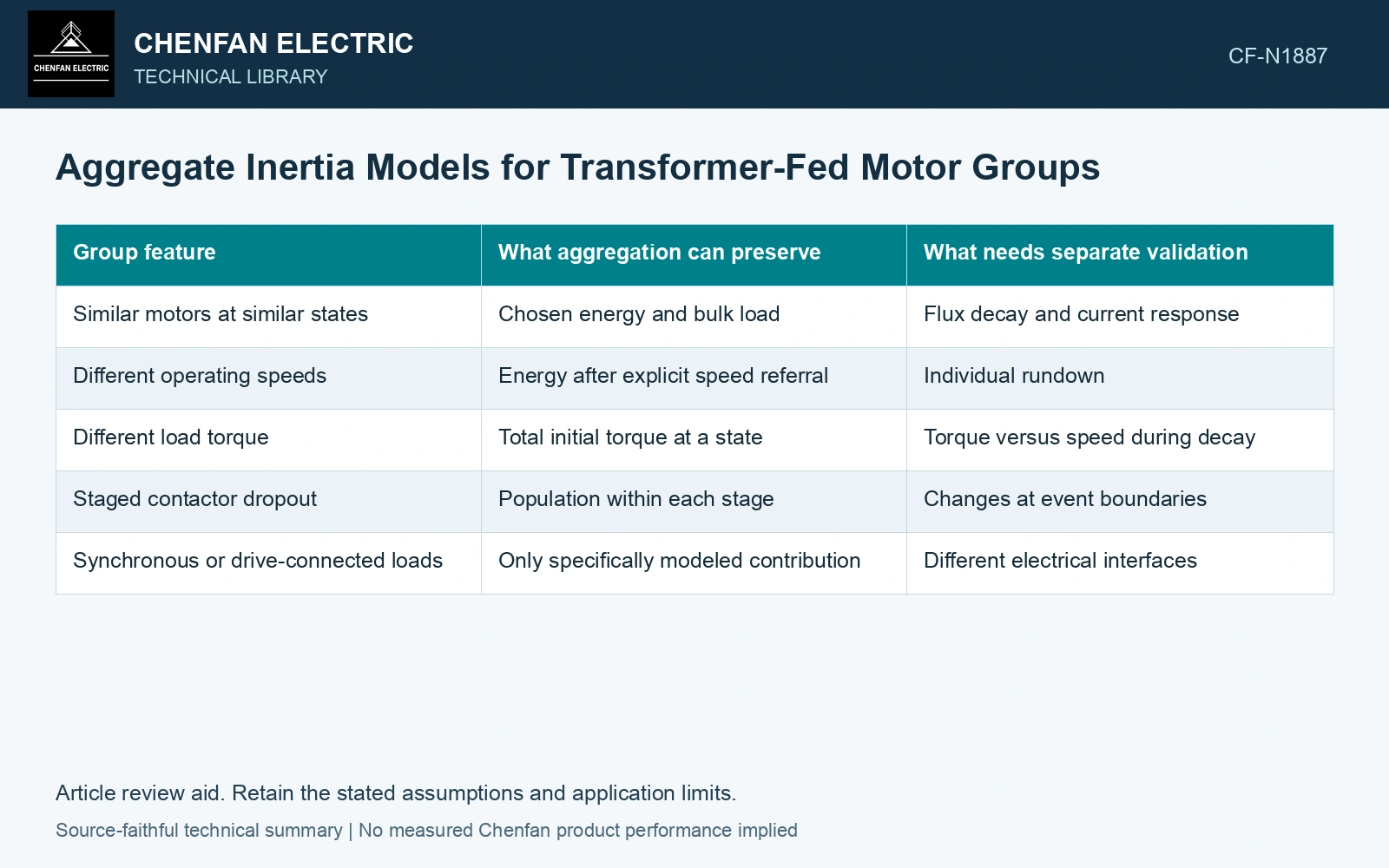
| Group feature | What aggregation can preserve | What needs separate validation |
|---|---|---|
| Similar motors at similar states | Chosen energy and bulk load | Flux decay and current response |
| Different operating speeds | Energy after explicit speed referral | Individual rundown |
| Different load torque | Total initial torque at a state | Torque versus speed during decay |
| Staged contactor dropout | Population within each stage | Changes at event boundaries |
| Synchronous or drive-connected loads | Only specifically modeled contribution | Different electrical interfaces |
Test more than the initial energy
Rundown depends on the torque balance, not inertia alone. A pump group and a constant-torque process can start with similar energy and evolve differently. The aggregate load curve must be compared over the relevant speed range.
Electrical voltage decay adds another requirement. The bus is a coupled network of machines with different magnetic states. Matching initial kinetic energy does not prove that one machine model reproduces the residual voltage or the reconnection current.
Motor-starting assessment also retains the load inertia and changing electrical demand seen by the source. An energy-equivalent group must preserve the recovery quantities used in the source–motor calculation, as well as its initial stored energy. [2]
Build an energy-equivalent inertia
Assume two electrically connected motor groups have inertia 4 kg·m² at 150 rad/s and 2 kg·m² at 100 rad/s. Their total kinetic energy is 55 kJ. Referred to 150 rad/s, the energy-equivalent inertia is 4.889 kg·m², rather than the arithmetic 6 kg·m². Validate torque and voltage decay separately.
Rebuild the equivalent when the population changes
If contactors open or drives trip, the connected population changes. A static equivalent that keeps removed machines can overstate residual voltage support or alter predicted frequency. Treat these events explicitly or show that the approximation remains acceptable for the assessed decision.
References
- P. Muralimanohar, D. Haas, J. R. McClanahan, R. T. Jagaduri and S. Singletary, Implementation of a Microprocessor-Based Motor Bus Transfer Scheme, IEEE PCIC, 2016, DOI: 10.1109/PCICON.2016.7589248.
- G. Olson, Cummins, Specifying & Validating Motor Starting Capability, bulletin 5544188.