

Define light-load open-phase coverage from the signals the installed measurement chain can resolve. As current falls, compare sequence estimates and voltage observations with error, ordinary unbalance and supervisory conditions. [1]
Inspect absolute quantities before their ratio
A negative-to-positive sequence-current ratio can grow when positive-sequence current becomes small. Determine whether both sequence estimates remain resolved by the installed current measurement chain. A ratio formed from noise or offset is not reliable merely because its numerical value exceeds a threshold. [2]
Retain current-transformer ratio, relevant accuracy range, relay input behaviour and the actual operating currents. Compare errors on the same primary or secondary basis. A rated-current accuracy statement cannot automatically represent the near-zero region.
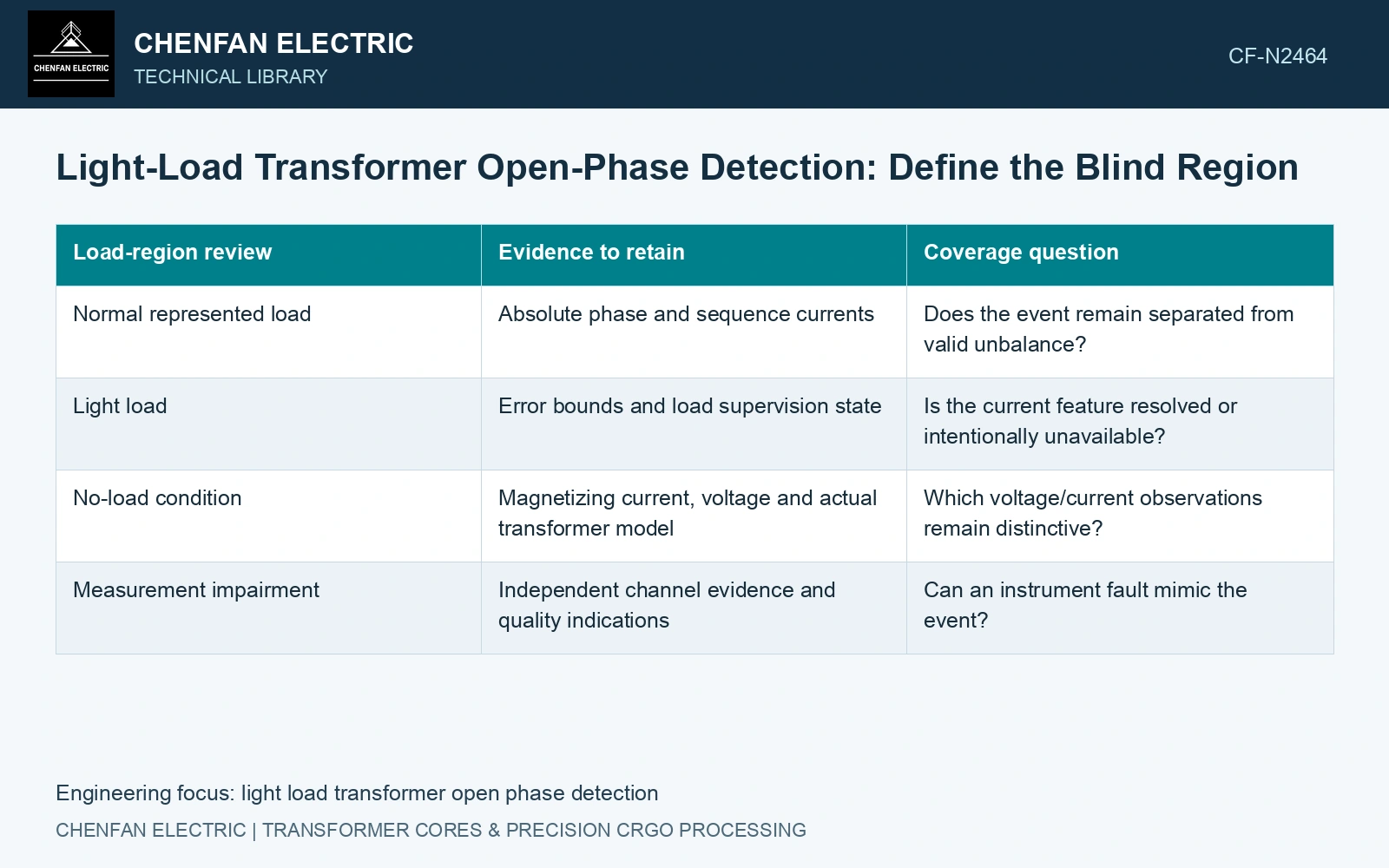
| Load-region review | Evidence to retain | Coverage question |
|---|---|---|
| Normal represented load | Absolute phase and sequence currents | Does the event remain separated from valid unbalance? |
| Light load | Error bounds and load supervision state | Is the current feature resolved or intentionally unavailable? |
| No-load condition | Magnetizing current, voltage and actual transformer model | Which voltage/current observations remain distinctive? |
| Measurement impairment | Independent channel evidence and quality indications | Can an instrument fault mimic the event? |
Revisit the voltage alternative
A transformer can retain coupled voltages after an upstream conductor opens. Specify vector group, grounding, core/magnetizing representation and measurement location for each predicted voltage pattern. A balanced-load ideal pattern does not close all no-load cases. [2]
The SEL open-phase paper discusses the low-load limits of current methods and the effects of load imbalance, concurrent faults and instrument-voltage loss on voltage methods. Its scheme and settings belong to the applications analyzed. Do not copy them into another connection without reviewing the corresponding healthy and abnormal envelopes. [2]
Test the boundary in both directions
As an application verification plan, use offline models and suitable relay inputs to vary load, phase distribution and measurement error independently. Record the minimum resolved signal, supervisory blocking and resulting coverage. The SEL paper identifies low-load limitations [2]; the installed transition requires its own tests.
Include valid low-load unbalance, voltage-transformer channel loss and applicable switching states as security cases. A test that only injects unmistakable open-phase waveforms can demonstrate response while leaving nuisance-operation behaviour unresolved.
Report the current-based region, independently supported voltage region and indistinguishable cases in the coverage matrix. Verify that each added observation separates the intended healthy and abnormal states near the transition, and use that result to define the remaining blind region.
References
- B. N. Taylor and C. E. Kuyatt, NIST Technical Note 1297, Guidelines for Evaluating and Expressing the Uncertainty of NIST Measurement Results, 1994, sections 5 and 6.
- J. LaBlanc, Y. Shah and J. Aultman, Schweitzer Engineering Laboratories, Revisiting Open-Phase Detection for Fuse-Protected Power Transformers, 2024.