

Explain both repeated tests and inherited evidence in a change-impact review. For every retained result, identify the unchanged governing inputs and the observations confirming that they still represent the revised configuration. [1]
Start with the actual difference
Identify the changed feature and all accompanying adjustments. A cooling-controller replacement, for example, can preserve winding geometry while changing cooling actuation. Treating the package as an accessory substitution may hide the timing and fault-state dependencies that determine its thermal effect. [2]
Trace the difference through the quantities each earlier verification covered. Name the original configuration, test boundary and relevant conditions. The presence of a favourable report is not sufficient if it tested another state or omitted the interface now affected.
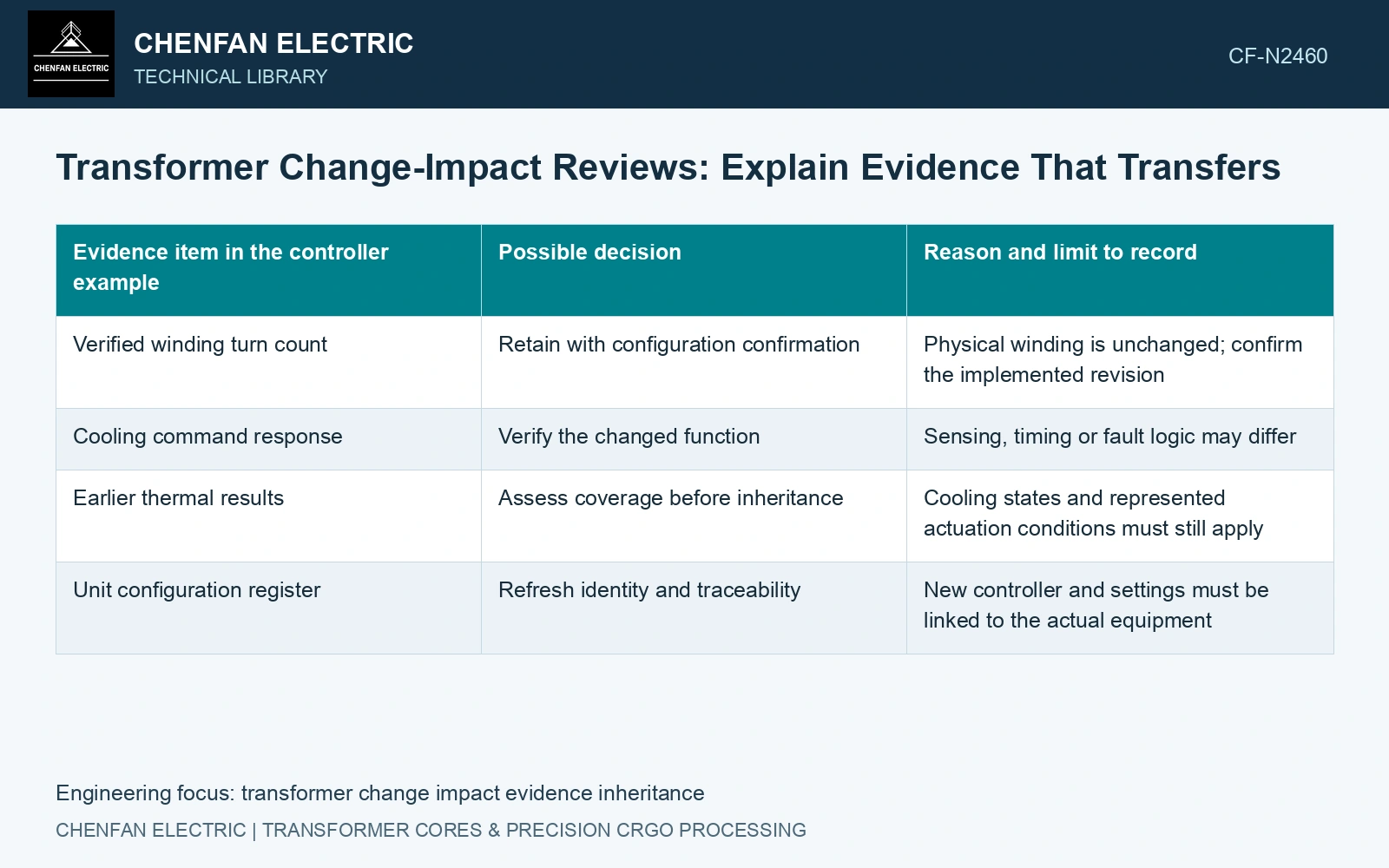
| Evidence item in the controller example | Possible decision | Reason and limit to record |
|---|---|---|
| Verified winding turn count | Retain with configuration confirmation | Physical winding is unchanged; confirm the implemented revision |
| Cooling command response | Verify the changed function | Sensing, timing or fault logic may differ |
| Earlier thermal results | Assess coverage before inheritance | Cooling states and represented actuation conditions must still apply |
| Unit configuration register | Refresh identity and traceability | New controller and settings must be linked to the actual equipment |
Use reasons that can be tested
An inheritance statement should identify unchanged governing inputs, the evidence confirming them and the domain represented by the prior result. If an assumption is newly introduced, assess it directly. Writing no expected effect without showing the dependency analysis makes the decision difficult to reproduce. [1]
Distinguish confirmation of an unchanged configuration from requalification of a changed property. Updating a drawing identifier can refresh traceability without repeating a physical test. Conversely, editing a report heading cannot extend its technical coverage to a new cooling or material state.
Record uncertainty and unresolved dependencies
A comparison that detects no difference supports only the sensitivity and conditions represented. It does not establish zero effect under every duty. State measurement limitations, unrepresented operating states and any consequential model assumptions that remain unresolved. [2]
Assign each open item a decision dependency rather than burying it in a general comment field. The reviewer should be able to see whether it prevents a conclusion, limits the supported configuration or requires a later confirming observation. Document completeness alone cannot make that engineering judgement.
Quantify the cooling delay affected by the new controller
All example inputs are assumptions: the transformer generates 12 kW during a transition; the old controller starts cooling at 30 s and the replacement at 90 s. During the intervening 60 s, assume the old system removes 12 kW and the new one removes none. Their stored-energy difference is (12 − 0) × 60 = 720 kJ. With the same assumed effective heat capacity of 400 kJ/K, the replacement is 1.8 K warmer in this lumped model. These heat-removal assumptions require confirmation, together with actual fan or pump operation [2]. Unchanged winding geometry does not close the controller’s timing dependency [1].
Release the impact matrix with the approved revision, evidence versions and explicit inheritance assumptions. Assign each open dependency its decision effect and confirming action, so a future change can revisit the governing condition directly.
References
- NASA, NASA Systems Engineering Handbook, section 6.5, Configuration Management, official online text.
- U.S. Bureau of Reclamation, FIST Volume 3-30, Transformer Maintenance, 2000.