


Transformer Core Engineering Notes · CF-N291
A transformer efficiency value at one load point does not describe annual energy performance. The result depends on load level, power factor, excitation, losses and time spent in each operating state. Compare offers using the same realistic duty profile, while keeping a simplified energy estimate separate from any jurisdiction-specific efficiency compliance assessment.
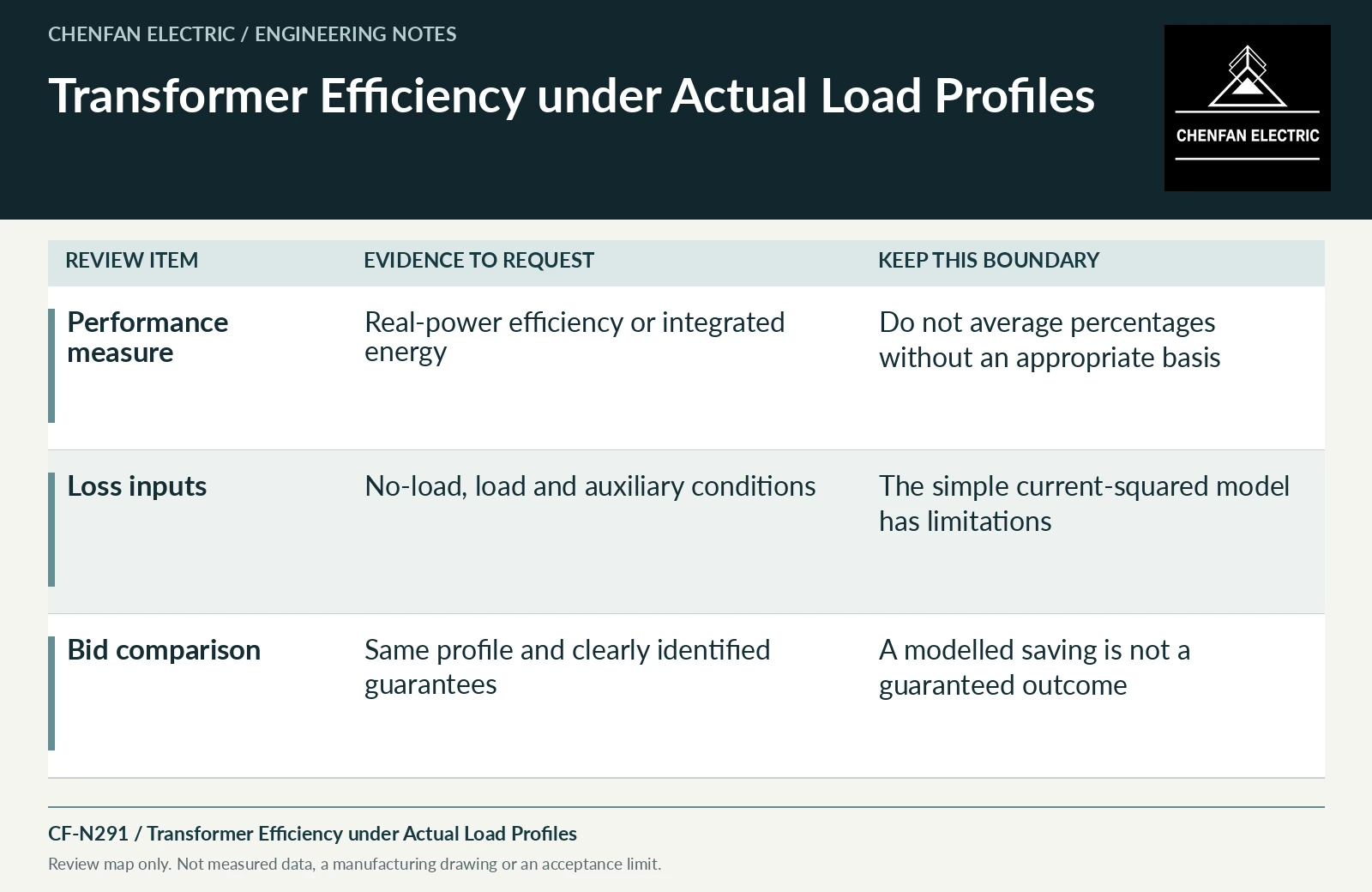
Separate power efficiency and energy performance
At a stated operating point, efficiency can be expressed as output real power divided by output real power plus losses. Output apparent power is not a substitute for real power when calculating that ratio. Over a period, integrate the relevant input and output energy instead of averaging isolated efficiency percentages without weighting. The chosen method should show how low-load periods and energized standby contribute to the result.
Use a loss model with visible assumptions
A first-pass model can use approximately constant no-load loss at fixed voltage and frequency, plus a current-squared load-loss term at a defined temperature basis. Actual temperature, harmonics, unbalance and auxiliary operation can require refinement. Do not present that simplified model as a full simulation. Keep the loss-test reference conditions and any corrections available so another reviewer can reproduce the estimate.
Demonstrate why the profile matters
Consider a deliberately simplified example with 1 kW no-load loss and 8 kW rated-current load loss. At half current, the model gives 1 + 0.5² × 8 = 3 kW before auxiliaries; at rated current it gives 9 kW. These invented numbers are not Chenfan test data. They show why a design favored during long lightly loaded periods may differ from one favored under sustained high current.
Compare bids without mixing guarantees
Use the same hours, currents, ambient assumptions and loss basis for every offer. Separate guaranteed values from typical or preliminary figures. A financial comparison also needs an explicitly chosen energy-price and evaluation-period assumption; it is not a guaranteed saving. Applicable regulatory tests remain a separate check using the current rules for the destination and equipment scope, not a conclusion inferred from a favorable profile calculation.
| Review item | Evidence to request | Boundary to preserve |
|---|---|---|
| Performance measure | Real-power efficiency or integrated energy | Do not average percentages without an appropriate basis |
| Loss inputs | No-load, load and auxiliary conditions | The simple current-squared model has limitations |
| Bid comparison | Same profile and clearly identified guarantees | A modelled saving is not a guaranteed outcome |
References and scope
- IEC 60076-1:2011 — Power transformers: GeneralPublic standard abstract · General transformer scope, interfaces and controlled equipment specification.
- IEC 60076-2:2011 — Temperature rise for liquid-immersed transformersPublic standard abstract · Temperature-rise requirements, cooling identification and the distinction between test conditions and installed duty.
- IEEE C57.91-2025 — Loading Mineral-Oil-Immersed Transformers and Step-Voltage RegulatorsPublic standard abstract · Mineral-oil loading, thermal duty and loading beyond nameplate; do not transfer the scope automatically to ester or dry-type equipment.