

Scaling a transformer changes magnetic field strength, conducting dimensions and thermal response. Equal DC ampere-turns preserve one comparison quantity; establish the electromagnetic and thermal similarities separately before using a small model to assess full-size heating. [1]
The NERC thermal framework identifies construction-dependent responses. A scaled experiment can investigate a mechanism, but transferring its temperatures requires more than matching the current-turn product.
Establish the flux-density scaling relationship
For an ideal geometrically similar magnetic path scaled by a length factor λ, path length scales as λ and area as λ². With constant permeability, reluctance scales as 1/λ. At unchanged magnetomotive force F, flux scales as λ and flux density therefore scales as 1/λ.
This elementary result already defeats the assumption that equal F preserves B. To preserve field strength H ≈ F/l in that simplified path, F would instead scale with length. A real nonlinear core needs the corresponding material characteristic, AC excursion and return paths; the constant-permeability result is explanatory, not a full transformer prediction.
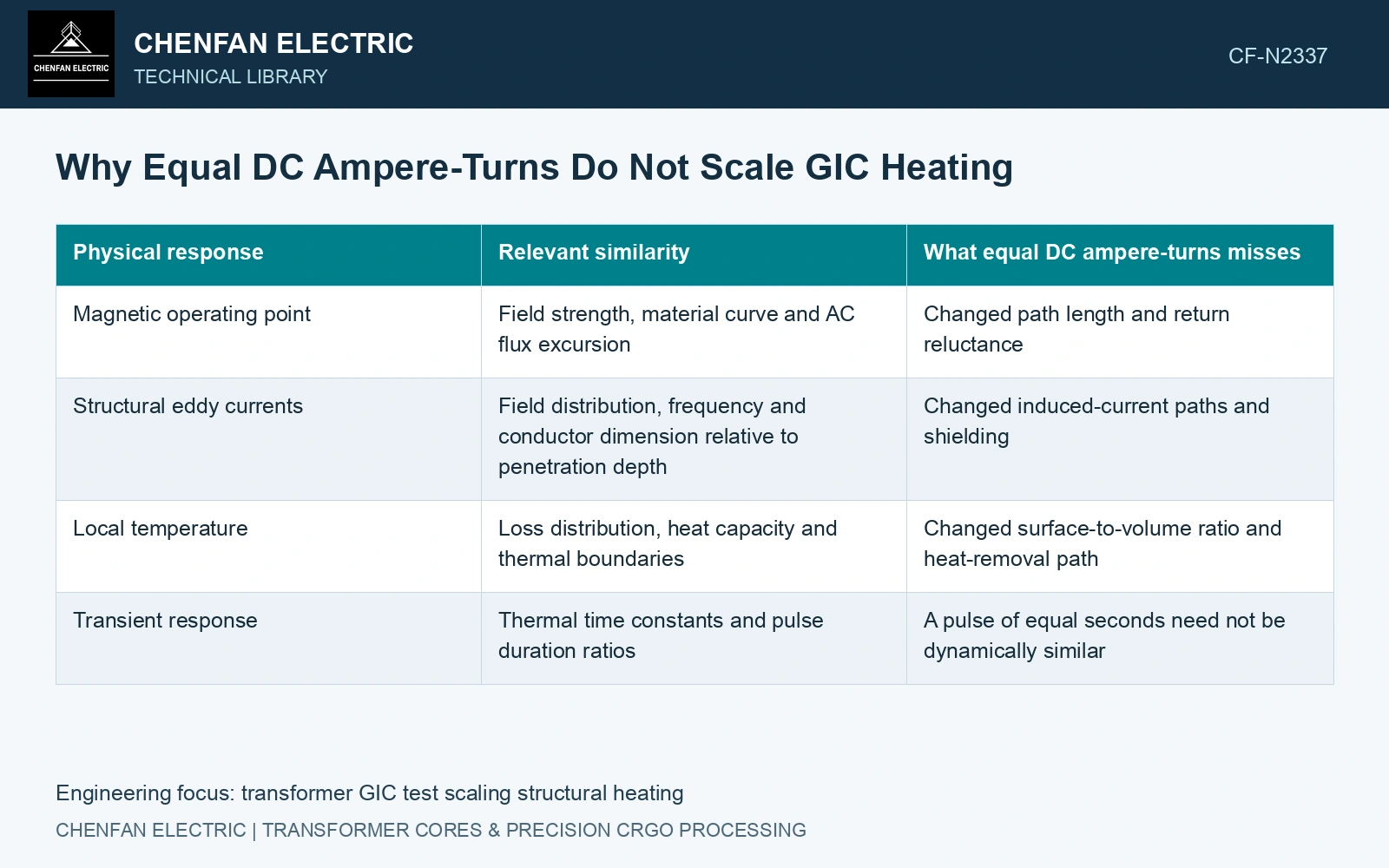
Test each similarity separately
| Physical response | Relevant similarity | What equal DC ampere-turns misses |
|---|---|---|
| Magnetic operating point | Field strength, material curve and AC flux excursion | Changed path length and return reluctance |
| Structural eddy currents | Field distribution, frequency and conductor dimension relative to penetration depth | Changed induced-current paths and shielding |
| Local temperature | Loss distribution, heat capacity and thermal boundaries | Changed surface-to-volume ratio and heat-removal path |
| Transient response | Thermal time constants and pulse duration ratios | A pulse of equal seconds need not be dynamically similar |
For a simple conducting material with constant permeability and conductivity, electromagnetic penetration depth varies as 1/√f. If thickness changes while frequency does not, thickness divided by penetration depth changes. The induced-current distribution may therefore be different even under a comparable surface field.
For a thin conducting sheet with sinusoidal flux parallel to its face, thickness much smaller than penetration depth and weak magnetic shielding, classical eddy loss per volume scales as f²Bpk²d². Here d is sheet thickness. This approximation does not describe arbitrary normal flux into a cabinet panel or a saturated three-dimensional clamp.
Restrict the extrapolation to what the model preserves
Thermal mass scales with volume for identical material, while exposed area scales differently. Contact conduction, oil flow and convection do not automatically follow geometric scaling. Equal loss density consequently does not establish equal temperature rise or equal time to reach it.
List which quantities were preserved, which were deliberately distorted and which remain unverified. A model may support the presence of an external flux route or the relative effect of a structural break without supporting a full-size hot-spot temperature.
Carry manufacturing controls into both test articles
Control sheet gauge, rolling direction, cut-edge condition, joint geometry and clamp state in the model and full-size core. Cutting stress, burr bridges and changed joint registration can alter the assembled magnetic response. Preserve structural insulation breaks and conductive connections separately; matching catalogue grade alone does not establish manufacturing similarity [1] [2].
Expose a scale mismatch using an actual sheet gauge
Catalogue input: 23ZH90 has nominal sheet thickness 0.23 mm [2]. Assume a geometrically similar model-to-full-size length factor of 2, identical permeability and equal applied DC ampere-turns. The linear path model gives Bfull/Bmodel = 1/2. Full geometric similarity would also require 0.46 mm laminations; retaining the catalogue 0.23 mm gauge leaves that dimension unscaled. Separately, in the thin-sheet weak-shielding approximation at equal sinusoidal in-plane B and frequency, doubling thickness would multiply classical eddy loss per volume by 4. These different comparisons cannot be combined into a valid full-size heating prediction. Use the actual structural geometry and thermal boundaries [1].
Use scaled measurements to validate the electromagnetic mechanism they preserve. Calculate full-size loss and temperature with the actual geometry and boundaries, and identify the scale effects governing that transfer.
References
- NERC, Transformer Thermal Impact Assessment White Paper, Project 2013-03 Geomagnetic Disturbance Mitigation, October 2017.
- Nippon Steel Corporation, Grain-Oriented Electrical Steel Sheets, catalogue D004je, April 2020, specification tables, size tolerances and Annealing by Customers.