


Transformer Core Engineering Notes · CF-N225
A fluid’s fire point is a property measured under a specified test method. It is not the temperature at which every transformer installation becomes safe or unsafe, and it is not an approval for indoor use. Fire planning must connect the selected liquid to the complete equipment, site layout and applicable project requirements.
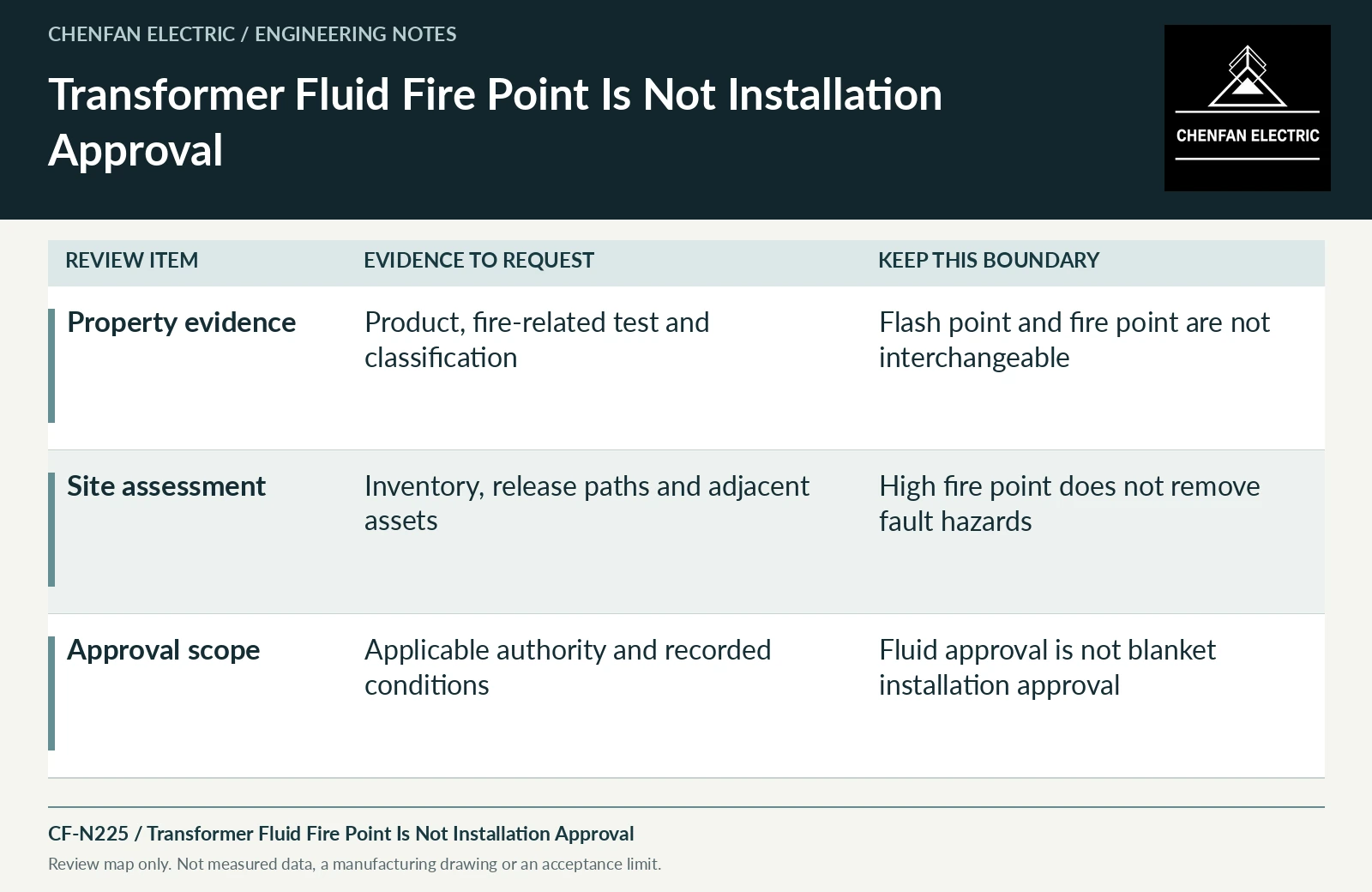
Distinguish flash point, fire point and classification
Flash point and fire point describe different test behaviours; their values should not be substituted for one another. A less-flammable classification also has its own defined basis. Request the product identity, method and supporting documentation behind the claim. Do not compare a closed-cup flash point for one liquid with an open-cup fire point for another and call the result a safety ranking. The property names and methods need to match the question.
Consider fault consequences beyond a pool fire
An electrical fault can involve pressure, hot material and damage to the tank or connected equipment. A high-fire-point liquid does not remove these possibilities. The installation review should consider liquid inventory, release paths, nearby assets and the response of protective systems. This article does not assign a universal separation distance or containment volume. Those decisions require the responsible fire, civil and electrical specialists using the actual project conditions.
Verify the claimed installation pathway
A product listing or insurer-recognized classification can be relevant, but its conditions and scope must be read. Approval of a fluid does not necessarily approve a particular transformer-room arrangement. Ask which authority or project requirement governs the installation and what evidence it requires. Maintain the distinction between a supplier’s product claim and the site’s documented acceptance. Avoid wording such as “no fire protection required” without a specific, valid project basis.
Recheck after retrofill or layout changes
Residual liquid, replacement seals, revised liquid quantity and changed containment arrangements can affect an earlier assessment. A retrofit should document the final fluid composition and the scope of any new approval. Likewise, moving the transformer indoors is not merely a transport decision. Update the equipment and site records together so that maintenance staff are not relying on a fluid label while the installation still reflects the assumptions of a different configuration.
| Review item | Evidence to request | Boundary to preserve |
|---|---|---|
| Property evidence | Product, fire-related test and classification | Flash point and fire point are not interchangeable |
| Site assessment | Inventory, release paths and adjacent assets | High fire point does not remove fault hazards |
| Approval scope | Applicable authority and recorded conditions | Fluid approval is not blanket installation approval |
References and scope
- FR3 fluid technical detailsManufacturer technical page · Product-specific natural-ester properties and distinction between typical values and acceptance criteria.
- Transformer Fire Protection (FIST 3-32), redacted releaseHistorical technical manual · Fire protection and installation interfaces; local authority and project requirements remain separate.
- IEEE C57.166-2026 — Acceptance and Maintenance of Insulating Liquids in Transformers and Related EquipmentPublic standard abstract · Acceptance and maintenance of insulating liquids; equipment type, liquid family and compartment must be identified.