

Approve ferroresonance mitigation against the path it changes, the duty its components can carry and the initiating cases it has faced. Post-change operating time becomes useful evidence when those triggering conditions and the monitoring coverage are documented.
Ferracci describes several mitigation principles, while Jacobson’s cases show that location, thermal burden and network changes matter. No single resistor, grounding label or favorable test replaces the case-specific causal record. [1] [2]
State the mechanism the change is intended to alter
Identify the supplied nonlinear path and the evidence distinguishing it from switching transients, intermittent faults or measurement error. If attribution remains uncertain, the mitigation result must retain that uncertainty. [1]
Describe whether the change removes a supply path, changes accessible states or adds damping at a defined port. These are different actions and require different verification.
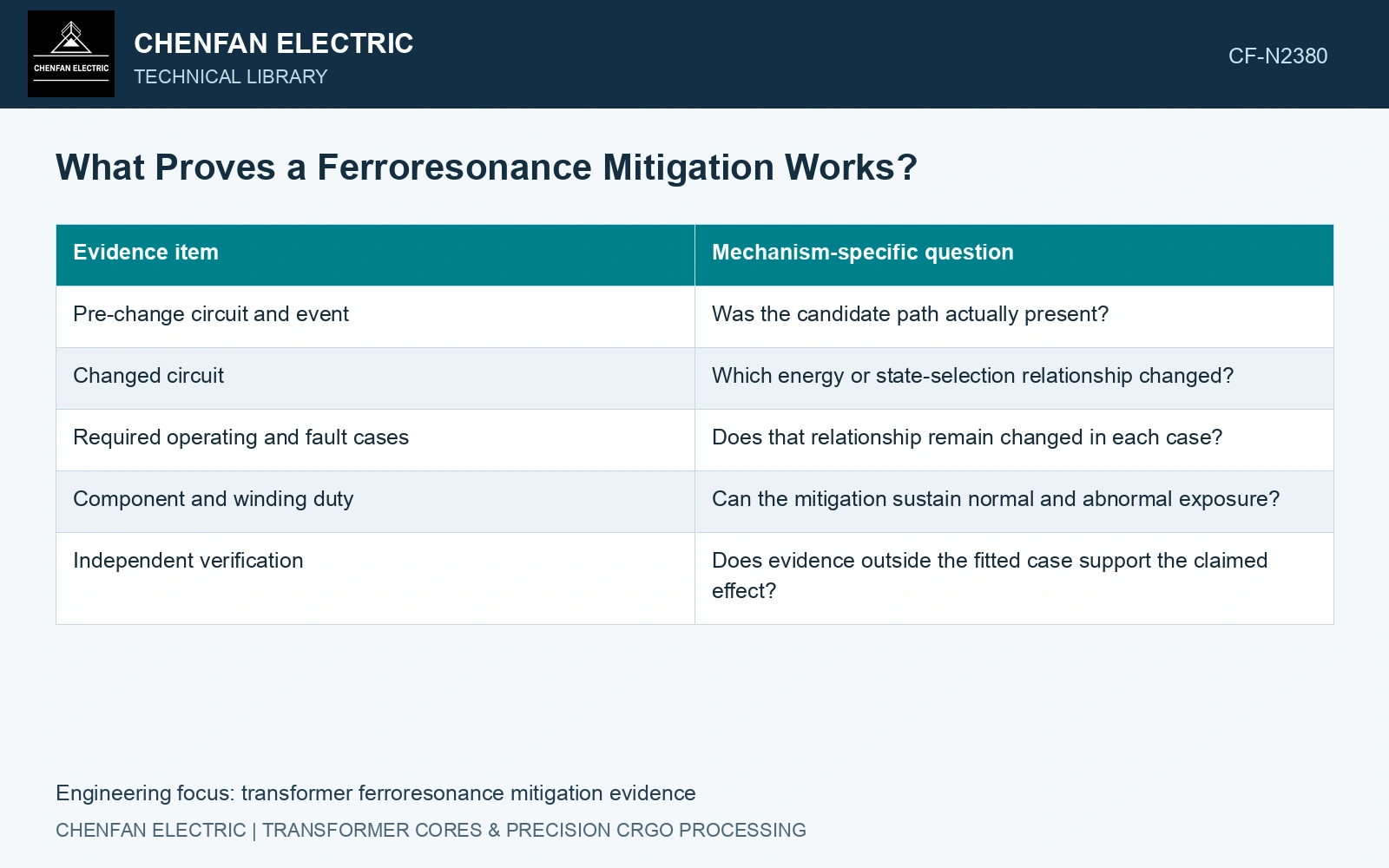
| Evidence item | Mechanism-specific question |
|---|---|
| Pre-change circuit and event | Was the candidate path actually present? |
| Changed circuit | Which energy or state-selection relationship changed? |
| Required operating and fault cases | Does that relationship remain changed in each case? |
| Component and winding duty | Can the mitigation sustain normal and abnormal exposure? |
| Independent verification | Does evidence outside the fitted case support the claimed effect? |
Challenge the changed model, not only its nominal point
Retain plausible capacitance, source, loss and initial-state ranges. Compare required open-phase, fault-cleared and isolated configurations under the approved operating basis. A device effective in the normal arrangement may be disconnected or delayed in the very state that creates the problem. [1]
Check numerical convergence and distinguish prevention from extinction where relevant. Suppressing one initialized abnormal response does not establish that every credible history reaches an acceptable state.
Verify that the proposed mechanism is physically feasible
Assess continuous losses, transient energy, supplying-winding burden and required availability. A simulated damping resistance that exceeds equipment duty is not a supported implementation, even if it makes the modeled waveform normal. [1]
Retain the protection and insulation consequences of the change where they affect the circuit. Altering one nonlinear path can change another duty that the original model did not evaluate.
Use post-change evidence with comparable exposure
Compare actual monitored conditions with the cases used to claim effectiveness. Absence of recurrence is more informative when the relevant initiating conditions occurred and the measurement system could detect the response. [1]
Keep unresolved or untested cases explicit. If observation coverage changed, or the initiating topology never returned, the post-change period may establish operation under new conditions without testing the original trigger.
Release the mitigation for the configurations supported by the altered-path model, component-duty assessment and monitored initiating cases. Identify the next test or design change needed for each uncovered case. This makes the operating scope and the remaining work explicit at acceptance.
References
- P. Ferracci, Schneider Electric, Ferroresonance, Cahier Technique No. 190, March 1998.
- D. A. N. Jacobson, Examples of Ferroresonance in a High Voltage Power System, IEEE PES General Meeting, 2003. DOI: 10.1109/PES.2003.1270499.