

Test a ferroresonance explanation against its energy supply and dissipation. A sustained response needs replenishment from the source; an isolated voltage peak may instead reflect redistribution of stored energy.
Ferracci distinguishes transient behavior from supplied steady responses. An energy check provides a complementary test of a candidate mechanism, especially when the visible waveform is ambiguous. [1]
Draw the source and storage boundaries
Identify each electrical input port, including supported coupling across an open device. For this independent energy-accounting check, integrate signed instantaneous port voltage times current over one defined interval. Do not treat an apparently open conductor as proof that every supply path is absent.
Capacitive energy in one branch is ½C(vk − vj)². Sum unique physical branches without counting the same mutual capacitor twice. A capacitance to ground uses the ground potential for one terminal.
For a nonlinear conservative magnetic relation, stored-energy change requires integrating current with respect to flux linkage. The expression ½Li² assumes a constant linear inductance and should not be extended blindly through saturation. A hysteretic model requires its dissipative contribution to be separated consistently from stored energy.
Check an interval residual
| Energy term | Evidence or model basis | Common omission |
|---|---|---|
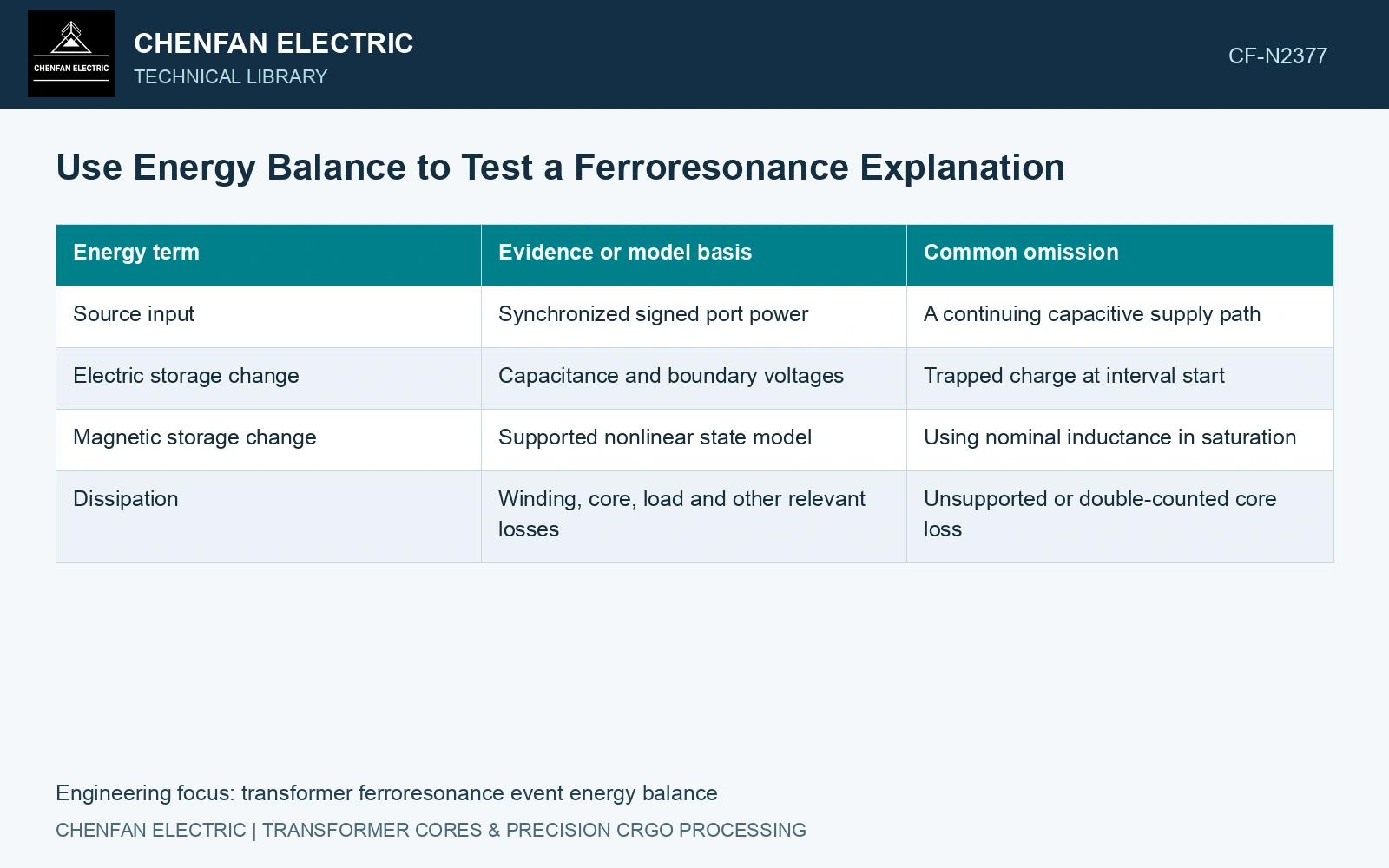
| Source input | Synchronized signed port power | A continuing capacitive supply path |
| Electric storage change | Capacitance and boundary voltages | Trapped charge at interval start |
| Magnetic storage change | Supported nonlinear state model | Using nominal inductance in saturation |
| Dissipation | Winding, core, load and other relevant losses | Unsupported or double-counted core loss |
For this modeled boundary, input minus dissipated energy must equal stored-energy change within numerical and measurement limitations. Jacobson’s case modeling highlights the importance of representing core loss to match transients [2]. Retain the balance residual; do not select an unexplained loss solely to force closure.
Choose an interval that matches the response
For a periodic multi-cycle response, use its full repeat period or an appropriate multiple. One source cycle can have a nonzero stored-energy change even when the complete subharmonic period returns to the same state. [1]
For a changing or irregular response, retain storage changes over several intervals. Do not assume zero merely because the average voltage appears stationary.
Check voltage/current polarity, clock alignment and bandwidth before interpreting a small power difference. Large reactive exchange can coexist with much smaller net energy input, making phase and timing error material.
Trace the source that replenishes the modeled losses. A persistent oscillation with no such input calls for checking omitted coupling and numerical energy generation. Close the signed energy balance, then use the topology and nonlinear response to distinguish ferroresonance from a transient; obtain the missing measurements where that balance remains open.
References
- P. Ferracci, Schneider Electric, Ferroresonance, Cahier Technique No. 190, March 1998.
- D. A. N. Jacobson, Examples of Ferroresonance in a High Voltage Power System, IEEE PES General Meeting, 2003. DOI: 10.1109/PES.2003.1270499.