


Transformer Core Engineering Notes · CF-N243
Redundancy is the ability to retain a defined function after a defined failure. A transformer with many fans is not necessarily redundant if they share one supply, controller or cooling bank. Specify the required remaining capacity and failure cases, then assess cooling groups and their dependencies rather than counting motors.
Define the function that must survive
State whether the objective is continued rated loading, reduced continuous loading or a limited emergency period. These are different requirements. Ask the OEM to identify the cooling equipment necessary for each accepted operating state. An N+1 description should specify what N represents and what failure is covered. One spare fan cannot automatically compensate for the loss of a pump, an entire radiator bank or the common electrical supply.
Map shared dependencies
Group fans by electrical supply, protective device, controller and the heat exchanger they serve. Include wiring or control faults that can disable more than one motor. The cooling review should also examine whether the remaining airflow reaches the useful radiator area after a group is unavailable. A simple fan-count percentage does not necessarily equal the percentage of retained cooling performance because air distribution and radiator duty are not independent of the arrangement.
Verify failure detection and response
A command to run is not the same as confirmation that a fan operates. Define the signals used to detect unavailable cooling and the resulting alarm, start of standby equipment or load restriction. Avoid assuming that one status contact detects every airflow problem. The functional test should exercise the intended failure cases using the approved procedure and show that the operator receives a clear indication of the capacity or action affected.
Compare redundancy on equal conditions
Two offers should be compared at the same ambient, loading, liquid and failure condition. State whether the quoted post-failure rating is continuous or time-limited and what initial temperature it assumes. Keep maintenance isolation and unexpected failure as separate scenarios where appropriate. The useful output is a cooling availability matrix with documented thermal consequences, not a claim that more fans always produce a more reliable transformer.
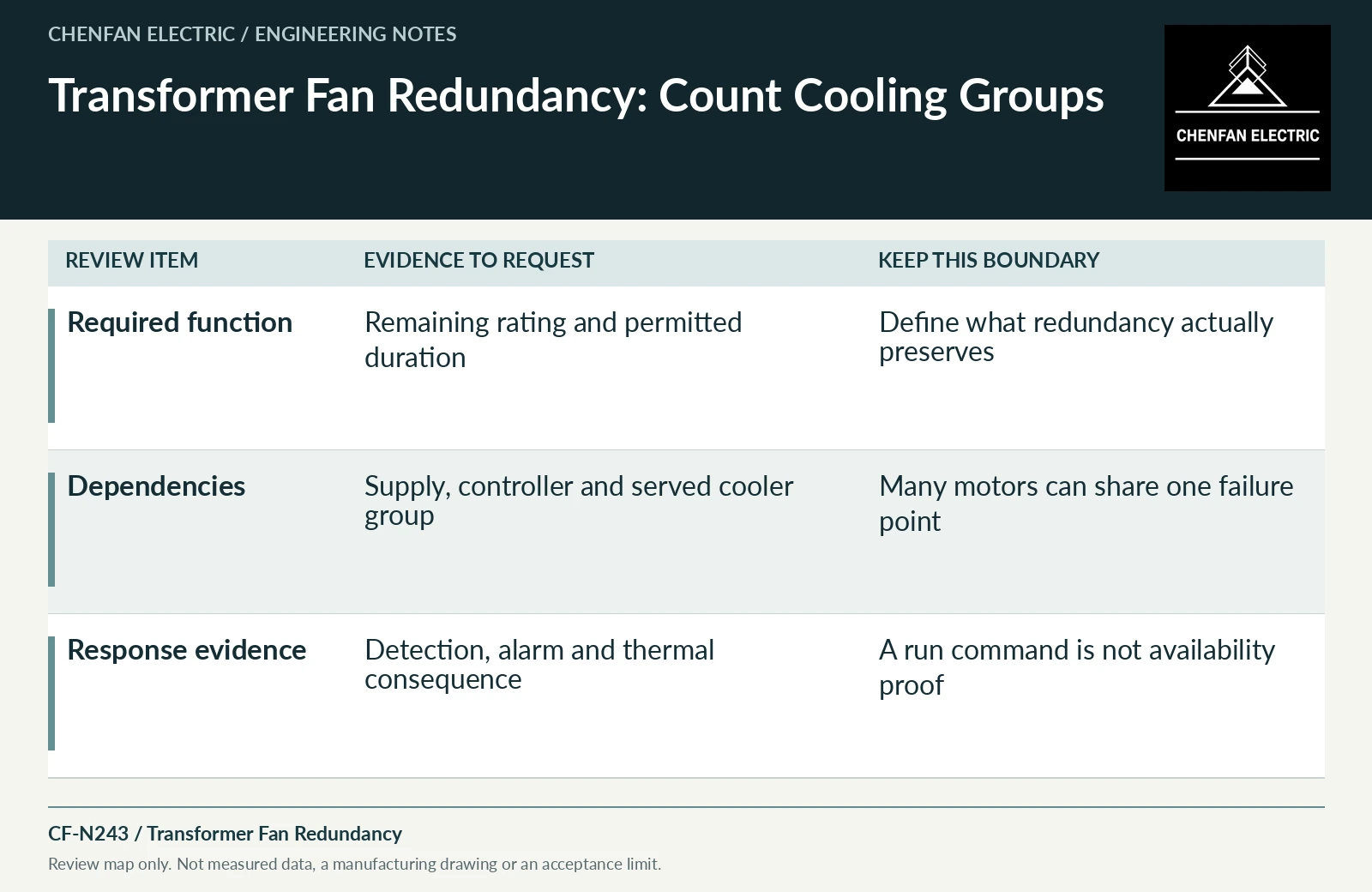
| Review item | Evidence to request | Boundary to preserve |
|---|---|---|
| Required function | Remaining rating and permitted duration | Define what redundancy actually preserves |
| Dependencies | Supply, controller and served cooler group | Many motors can share one failure point |
| Response evidence | Detection, alarm and thermal consequence | A run command is not availability proof |
References and scope
- IEC 60076-2:2011 — Temperature rise for liquid-immersed transformersPublic standard abstract · Temperature-rise requirements, cooling identification and the distinction between test conditions and installed duty.
- IEEE C57.91-2025 — Loading Mineral-Oil-Immersed Transformers and Step-Voltage RegulatorsPublic standard abstract · Mineral-oil loading, thermal duty and loading beyond nameplate; do not transfer the scope automatically to ester or dry-type equipment.
- IEEE C57.165-2024 — Temperature Monitoring of Liquid-Immersed TransformersPublic standard abstract · Temperature-monitoring methods for liquid-immersed transformers and their measurement/model boundaries.