


Transformer Core Engineering Notes · CF-N254
A dynamic loading calculation is only as traceable as its input data and model selection. A spreadsheet with a detailed temperature curve can still be unreliable when its starting state, thermal parameters or cooling sequence are assumed without evidence. Establish the minimum data package before treating the calculated capacity as an operating instruction.
Identify the actual transformer and rating basis
Record the unit identity, insulation system, liquid type, cooling stages and the rating to which per-unit load is referenced. Include the relevant loss and temperature-rise evidence, along with the source of thermal model parameters. Do not silently apply a mineral-oil loading model to a different liquid or high-temperature system. When model parameters are estimated, distinguish those estimates from measured or OEM-confirmed inputs in the calculation file.
Prepare synchronized time-series data
Load current, ambient temperature and cooling state should use a consistent timeline and units. For significant unbalance or harmonics, a single three-phase average may omit relevant heating information. State how missing intervals, sensor errors and changes in sampling frequency are handled. Preserve the original data alongside any cleaned version. A simulation should not conceal a long data gap by silently drawing a smooth line through it.
Declare initial conditions and operating limits
Choose initial temperatures from a credible operating history or justified conservative assumptions. State the applicable hot-spot, liquid and component limits and the permitted duration of each operating state. Cooling failure cases need their own equipment availability assumptions. The model must not use one cooling configuration for heat rejection while applying a rating that requires additional equipment which is unavailable in that scenario.
Make the result independently reviewable
Deliver the input source list, model edition, parameter values, unit conversions and a sensitivity check for important uncertain inputs. Compare predictions with available temperature records under appropriate conditions. Report where the model has not been validated. The acceptance decision belongs to the responsible equipment and operating engineers; a precise-looking maximum load output should not hide uncertainty or replace approval of the operating scenario.
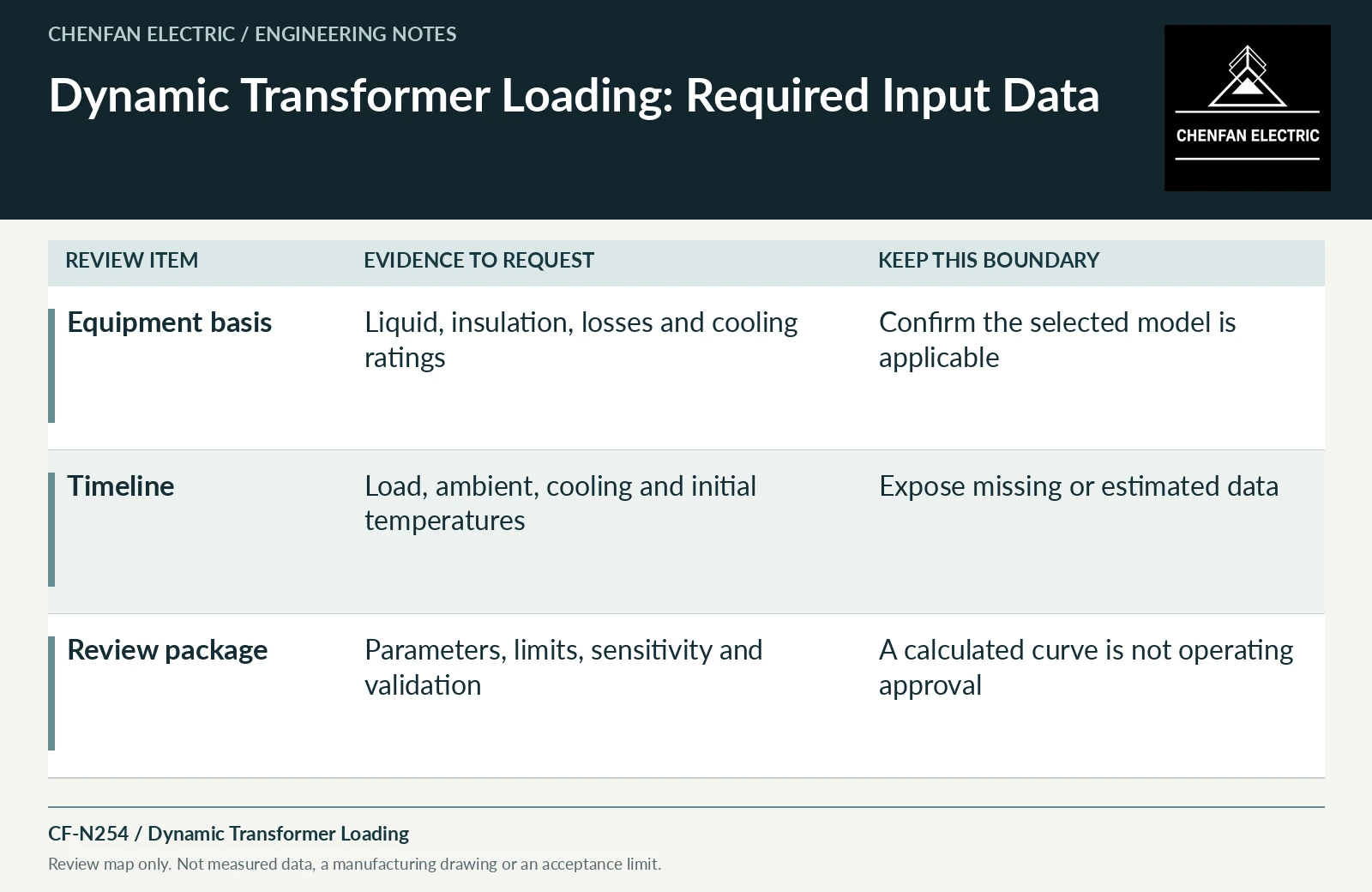
| Review item | Evidence to request | Boundary to preserve |
|---|---|---|
| Equipment basis | Liquid, insulation, losses and cooling ratings | Confirm the selected model is applicable |
| Timeline | Load, ambient, cooling and initial temperatures | Expose missing or estimated data |
| Review package | Parameters, limits, sensitivity and validation | A calculated curve is not operating approval |
References and scope
- IEEE C57.91-2025 — Loading Mineral-Oil-Immersed Transformers and Step-Voltage RegulatorsPublic standard abstract · Mineral-oil loading, thermal duty and loading beyond nameplate; do not transfer the scope automatically to ester or dry-type equipment.
- IEC 60076-7:2018 — Loading guide for mineral-oil-immersed power transformersPublic standard abstract · Mineral-oil transformer loading and thermal-ageing framework, not a universal asset-life prediction.
- IEEE C57.165-2024 — Temperature Monitoring of Liquid-Immersed TransformersPublic standard abstract · Temperature-monitoring methods for liquid-immersed transformers and their measurement/model boundaries.