

A dielectric report containing only a moisture estimate cannot be independently reproduced. The next analyst needs the measured response, the object state and the model settings that converted one into the other. Preserve enough information to test an alternative interpretation. [1]
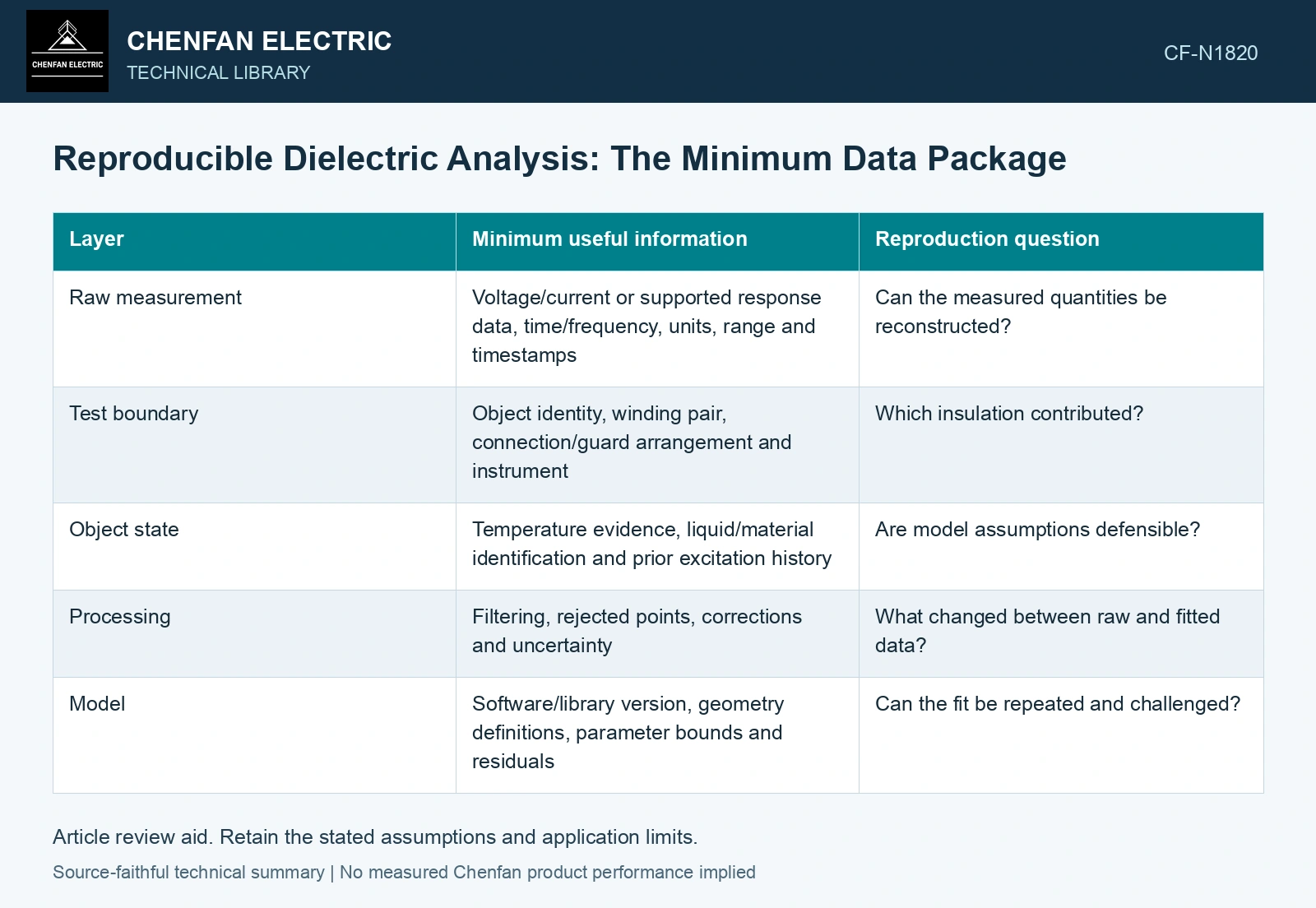
Retain the layers separately
| Layer | Minimum useful information | Reproduction question |
|---|---|---|
| Raw measurement | Voltage/current or supported response data, time/frequency, units, range and timestamps | Can the measured quantities be reconstructed? |
| Test boundary | Object identity, winding pair, connection/guard arrangement and instrument | Which insulation contributed? |
| Object state | Temperature evidence, liquid/material identification and prior excitation history | Are model assumptions defensible? |
| Processing | Filtering, rejected points, corrections and uncertainty | What changed between raw and fitted data? |
| Model | Software/library version, geometry definitions, parameter bounds and residuals | Can the fit be repeated and challenged? |
Preserve units and sign conventions
Store time origin, charging duration and signed polarization/depolarization convention for PDC. For frequency measurements, retain whether frequency is hertz or angular frequency and which capacitance/loss representation is used. The factor 2π and a reversed current sign are small metadata omissions with substantial mathematical consequences.
Keep original files alongside processed exports. A spreadsheet containing only rounded final points cannot recover discarded traces or establish how unstable points were treated.
Multi-exponential relaxation fits depend on the measured time window and residual weighting; a good early-current fit can leave the late tail poorly represented. [2]
Recompute one exported loss factor
Assume a linear 50 Hz measurement has conductance 1 nS and capacitance 100 pF at the same temperature and boundary. Tanδ = G/(2πfC) = 0.03183. Omitting 2π would give 0.200, 6.283 times too large. Preserve SI scaling and the complex-current convention so an independent analyst can reproduce the result.
References
- IEEE, IEEE C57.161-2018, IEEE Guide for Dielectric Frequency Response Test.
- J. Raxsa, P. Nimsanong, T. Mai-Eiam and P. Yutthagowith, Determination of Dielectric Models Based on Effective Multi-Exponential Fittings, Energies 16, 4615, 2023. DOI: 10.3390/en16124615.