

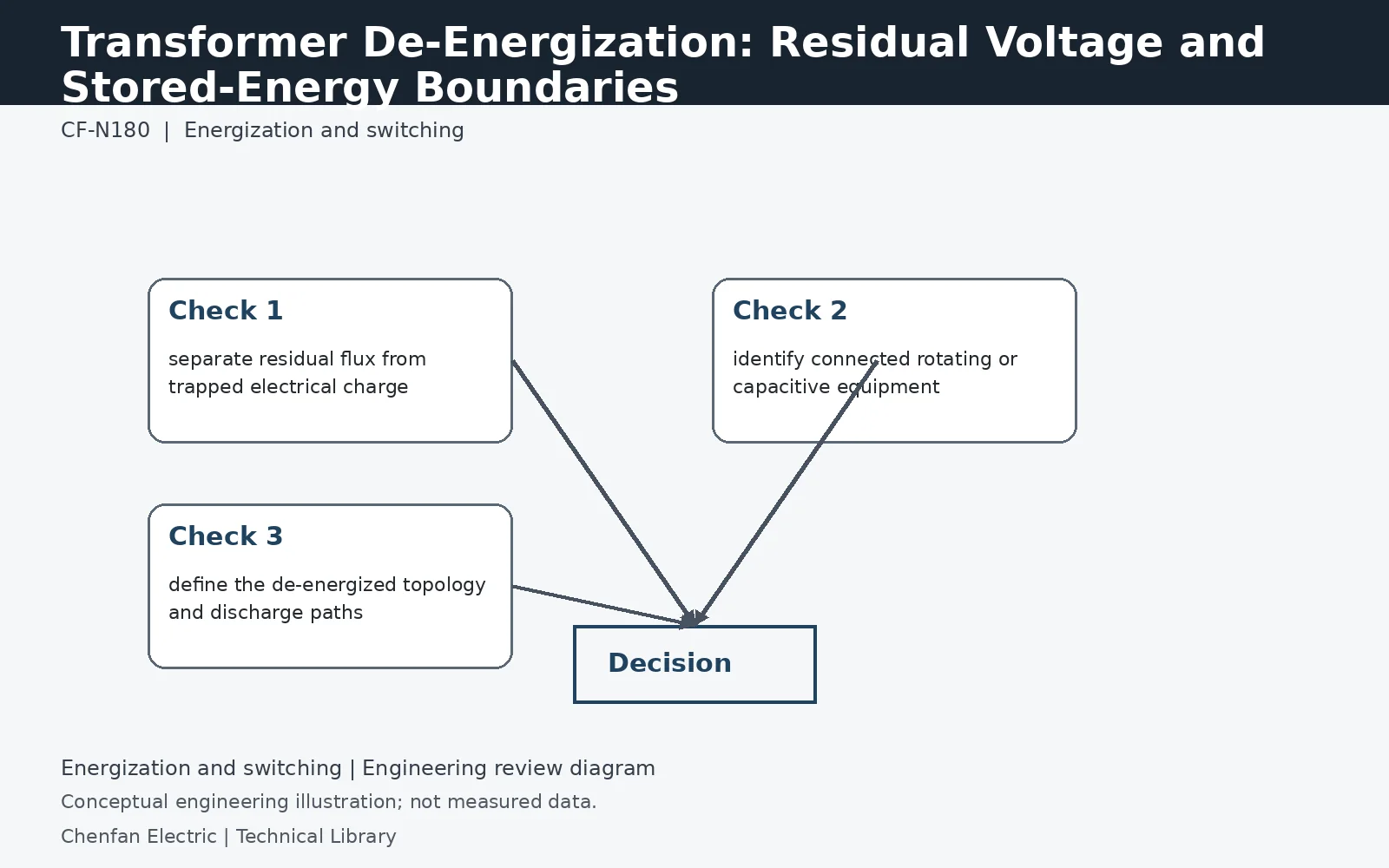
De-energization can leave residual core flux and stored electrical energy in cables, capacitances and connected equipment. Those states affect later switching but are not equivalent to a measured “residual voltage” everywhere in the system. The engineering boundary should distinguish core residual flux, trapped charge, rotating-machine backfeed and discharge paths, with each modeled according to the actual topology.
Core remanence is not an accessible terminal voltage
A magnetic material can retain remanent flux after winding voltage is removed. That state affects later energization, but a stationary residual flux does not itself imply an induced voltage at every terminal. Conversely, a zero terminal-voltage reading does not reveal the core's remanent-flux value. The transient model should carry magnetic state separately from the electrical node voltages and should not replace both with one unspecified “residual voltage” parameter.
Stored charge follows the actual discharge network
A simple isolated capacitance discharging through a fixed resistance follows V(t) = V0 exp[−t/(RC)]. Its stored energy is ½CV². Real installations can contain several capacitances, nonlinear devices and additional sources, so this elementary equation does not establish a safe discharge time for field work. Identify the relevant paths and equipment-rated discharge provisions in the engineering model. Absence of an intentional supply is not proof that every connected component is discharged.
Map remaining energy sources before defining the boundary
Rotating machines, converter circuits, adjacent energized conductors and alternate supplies can produce conditions not represented by a disconnected transformer alone. Identify which are included in the study and which require separate analysis. The resulting electrical states inform switching and restoration studies, while actual isolation, verification of absence of voltage and earthing remain governed by the authorized safety procedure. An engineering estimate must never be treated as a substitute for those site controls.
Technical reference framework
[1] CIGRE Technical Brochure 568 — Transformer energization in power systems: A study guide.
[2] IEC 60076-8:1997 — Application guide.
[3] IEC 60071-2:2023 — Insulation co-ordination, Application guidelines.