

The insulating liquid couples core and tank motion through pressure and boundary movement. A structural mode can interact with an acoustic cavity mode. As parameters change, the coupled frequencies and shapes can reorganize, so the nearest frequency is not always the same physical mode.
A dry structural model is useful as a reference. It is not automatically a filled-transformer model with one added mass. The fluid has pressure degrees of freedom and can contribute both inertia and compressibility effects under the relevant assumptions.
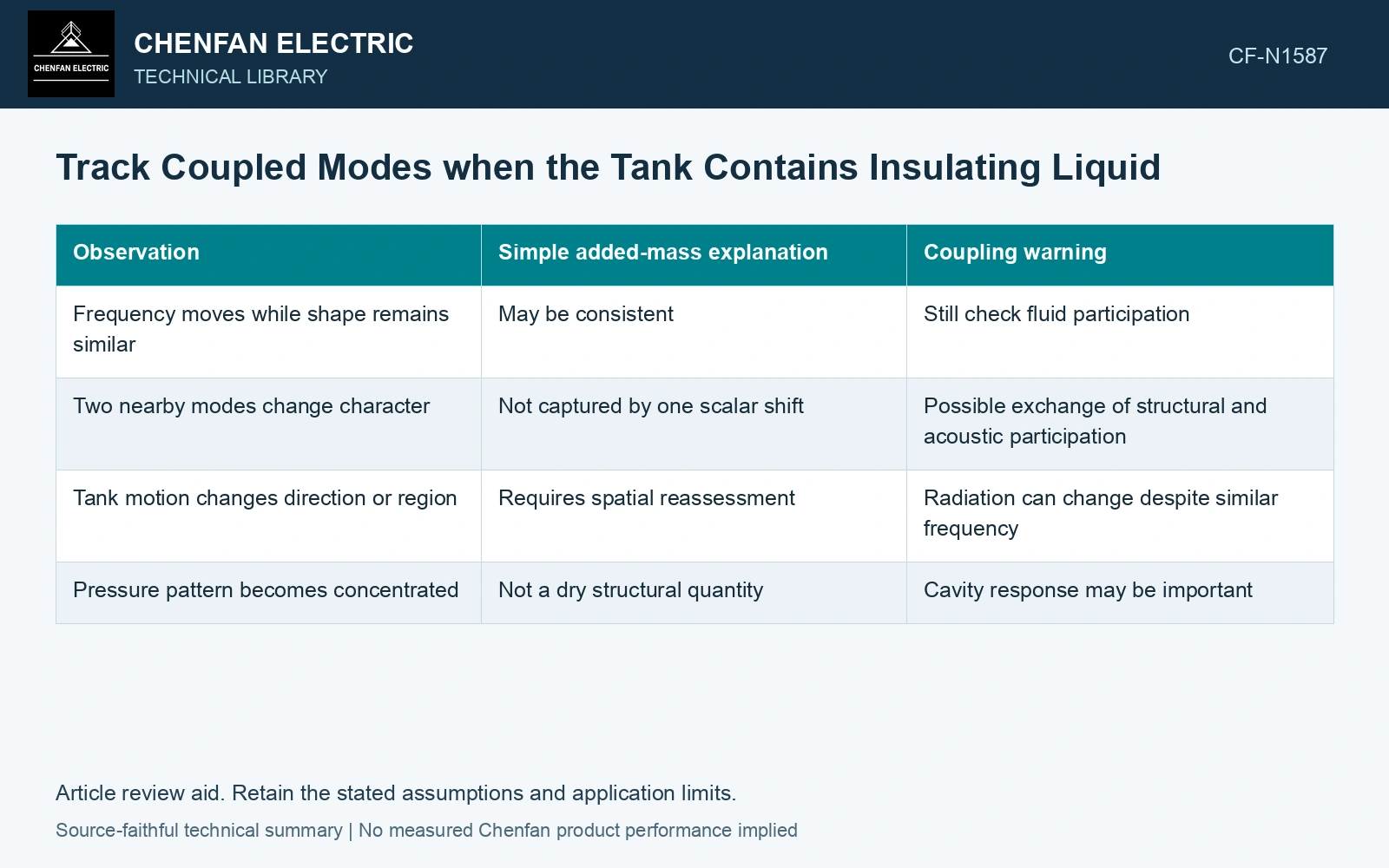
Track identity with several observations
Use a validated coupled formulation with the actual liquid properties, geometry and structural boundaries. Compare mode shapes, surface motion and fluid pressure participation. Normalize shapes consistently before comparing their spatial patterns.
| Observation | Simple added-mass explanation | Coupling warning |
|---|---|---|
| Frequency moves while shape remains similar | May be consistent | Still check fluid participation |
| Two nearby modes change character | Not captured by one scalar shift | Possible exchange of structural and acoustic participation |
| Tank motion changes direction or region | Requires spatial reassessment | Radiation can change despite similar frequency |
| Pressure pattern becomes concentrated | Not a dry structural quantity | Cavity response may be important |
A modal assurance criterion or another shape correlation can help associate structural components across models. It should not be the only criterion when fluid participation changes. A structural-only comparison can miss that the coupled mode’s pressure field has become dominant.
Separate model comparison from unsafe operating comparisons
Do not energize a transformer outside its approved liquid and insulation conditions to obtain a convenient acoustic reference. Modal investigations should use approved nonoperating tests, suitable representative assemblies or computational comparisons.
Keep other conditions controlled. Temperature affects liquid properties and can also alter support or contact behavior. A changed clamp state or added component can confound a filling comparison. Record what differs between the cases rather than labeling every change a fluid effect.
For operating response, apply the same defined source to the compared models only when that source assumption is justified. A modal shift alone does not predict vibration amplitude; damping, source distribution and proximity to excitation frequencies also matter.
Follow the mode through the change
If two resonances approach one another during a parameter sweep, examine their shapes at intermediate points. They may exchange dominant character instead of crossing as unrelated frequencies. Tracking only “mode 7” by sorted frequency can then connect different physical motions.
Use the resulting association to select verification measurements. A tank point that detects one mode well may be nearly insensitive after its shape changes. Pair structural motion measurements with relevant pressure information where the approved method allows it.
Track the coupled resonances against liquid state and structural response. Choose a tank or support modification only after the observed pathway shows which boundary or coupling assumption controls the tone being addressed.
Distinguish an added-mass shift from a changed mode shape
Assume a dry structural mode has 100 kg effective mass and 100 Hz natural frequency, with unchanged stiffness in an added-mass screen. Adding 25 kg gives f = 100√(100/125) = 89.44 Hz, a 10.56% decrease. For assumed normalized structural vectors [1,0] dry and [0.8,0.6] filled, the modal assurance criterion is |uᵀv|²/[(uᵀu)(vᵀv)] = 0.64. The frequency shift could fit an added-mass explanation, but the changed spatial pattern demands a coupled mode check. Track pressure participation and shape through the fill-parameter sweep before assigning an operating tone [1]. Judge the acoustic outcome using defined transformer and cooling-device sound conditions [2].
References
- COMSOL AB, Acoustics Module User’s Guide: The Pressure Acoustics, Boundary Elements Interface, version 6.3.
- IEC, IEC 60076-10:2016, Power transformers – Part 10: Determination of sound levels, 2016, official public scope.