

Magnetostrictive eigenstrain is a material’s tendency to change shape as its magnetic state changes. It can exist without an externally applied mechanical force. Constraints oppose that tendency and create elastic stress and reactions.
In a small-strain elastic illustration, stress is σ = C:(ε − εm), where C is the stiffness tensor, ε the total strain and εm the prescribed magnetostrictive strain. Both strains are dimensionless; σ and C use consistent pressure units. Other inelastic strains can be included separately when required.
Test the limiting cases first
Consider a uniform one-dimensional bar with modulus E and constant eigenstrain εm. If it is free to extend, its total strain can equal εm and its elastic stress is zero. If it is fully restrained so that total strain is zero, its stress is −Eεm. This simple test checks the source implementation before contacts and anisotropy make errors difficult to locate.
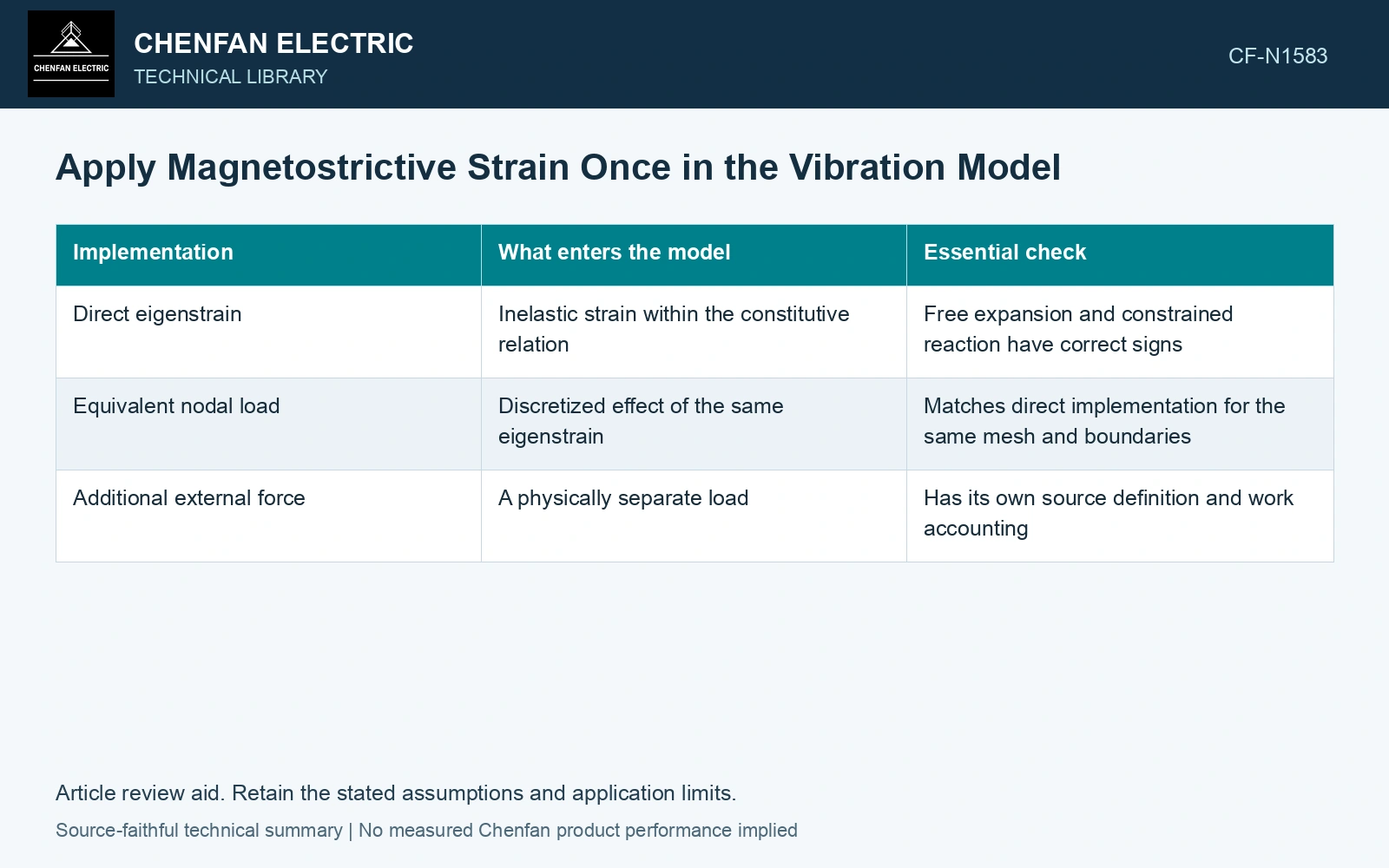
| Implementation | What enters the model | Essential check |
|---|---|---|
| Direct eigenstrain | Inelastic strain within the constitutive relation | Free expansion and constrained reaction have correct signs |
| Equivalent nodal load | Discretized effect of the same eigenstrain | Matches direct implementation for the same mesh and boundaries |
| Additional external force | A physically separate load | Has its own source definition and work accounting |
An equivalent nodal load is a mathematical representation of the strain source. It does not create a second source. If the same εm is already included in the constitutive model, adding its equivalent force again can duplicate the excitation.
Check work and reactions
Compare the two implementations on a simple mesh with identical material properties and boundary conditions. Evaluate displacement, support reactions and elastic energy, rather than just one output node. Agreement on one displacement can conceal an inconsistent constraint or sign convention.
In a dynamic model, retain the source’s spatial distribution and phase. Replacing a distributed strain by one concentrated force may reproduce one response while exciting other modes incorrectly. Its equivalence must be shown for the intended task, not assumed from a fitted amplitude.
Maxwell traction at a joint can be a separate physical contribution. Distinguish it from magnetostriction and check how the selected formulation accounts for electromagnetic stress. Combining incompatible force descriptions can also duplicate work even when each term has a plausible name.
Measured material strain must match the source definition. A constrained specimen’s observed total strain is not automatically its free eigenstrain. Mechanical restraint and stress-dependent magnetic behavior may require a constitutive interpretation.
Once the free and restrained tests pass, add anisotropic material directions, contact and support details progressively. Identify where each physical excitation mechanism enters the equations. That small discipline makes a large model easier to audit than trying to correct an unexplained vibration amplitude by scaling all magnetic loads together.
Check free extension and restrained reaction on one sheet
Use catalogue nominal GOES thickness 0.23 mm [1]. Assume a 0.50 m long, 0.10 m wide sheet with E = 200 GPa and uniform magnetostrictive eigenstrain of 1.0 μstrain at the modeled excitation state. Free extension is Lεm = 0.50 μm and stress is zero. Full axial restraint gives stress −Eεm = −0.20 MPa, reaction magnitude EAεm = 4.60 N and stored elastic energy Eεm²AL/2 = 1.15 μJ. Verify these limits with either the eigenstrain or its equivalent nodal load. Applying both would duplicate the same source, invalidating the force and displacement check [2]. Directional strain under DC-biased and harmonic excitation requires its own source characterization [3].
Rolling direction, cut-edge stress, joint geometry and clamp restraint determine how sheet eigenstrain is transmitted into the assembled core. Preserve that directional and restraint information in the constitutive and contact model. A measured constrained strain is not automatically the free strain required as a model input.
References
- Nippon Steel Corporation, Grain-Oriented Electrical Steel Sheets, catalogue D004je_03_202004, 2020, Specifications; Size and Form Tolerances.
- COMSOL AB, Structural Mechanics Module User’s Guide: Magnetostriction and Piezomagnetism, version 6.3.
- Zhao, X., Du, Y., Liu, Y., Du, Z., Yuan, D., and Liu, L., Magnetostrictive Properties of the Grain-Oriented Silicon Steel Sheet under DC-Biased and Multisinusoidal Magnetizations, Materials 12, 2156, 2019. DOI: 10.3390/ma12132156.