

A continuous optimizer may propose 101.4 primary turns and 50.7 secondary turns. That pair has a ratio of exactly two, but neither winding can be manufactured as specified. Rounding both numbers once and retaining the original objective value leaves the design evaluation unfinished. [1]
The useful output is a small map of neighbouring integer pairs. Each point represents a complete winding combination, with its magnetic and physical consequences recalculated. A point is feasible only when every applicable constraint is satisfied.
Enumerate pairs before rebuilding the winding
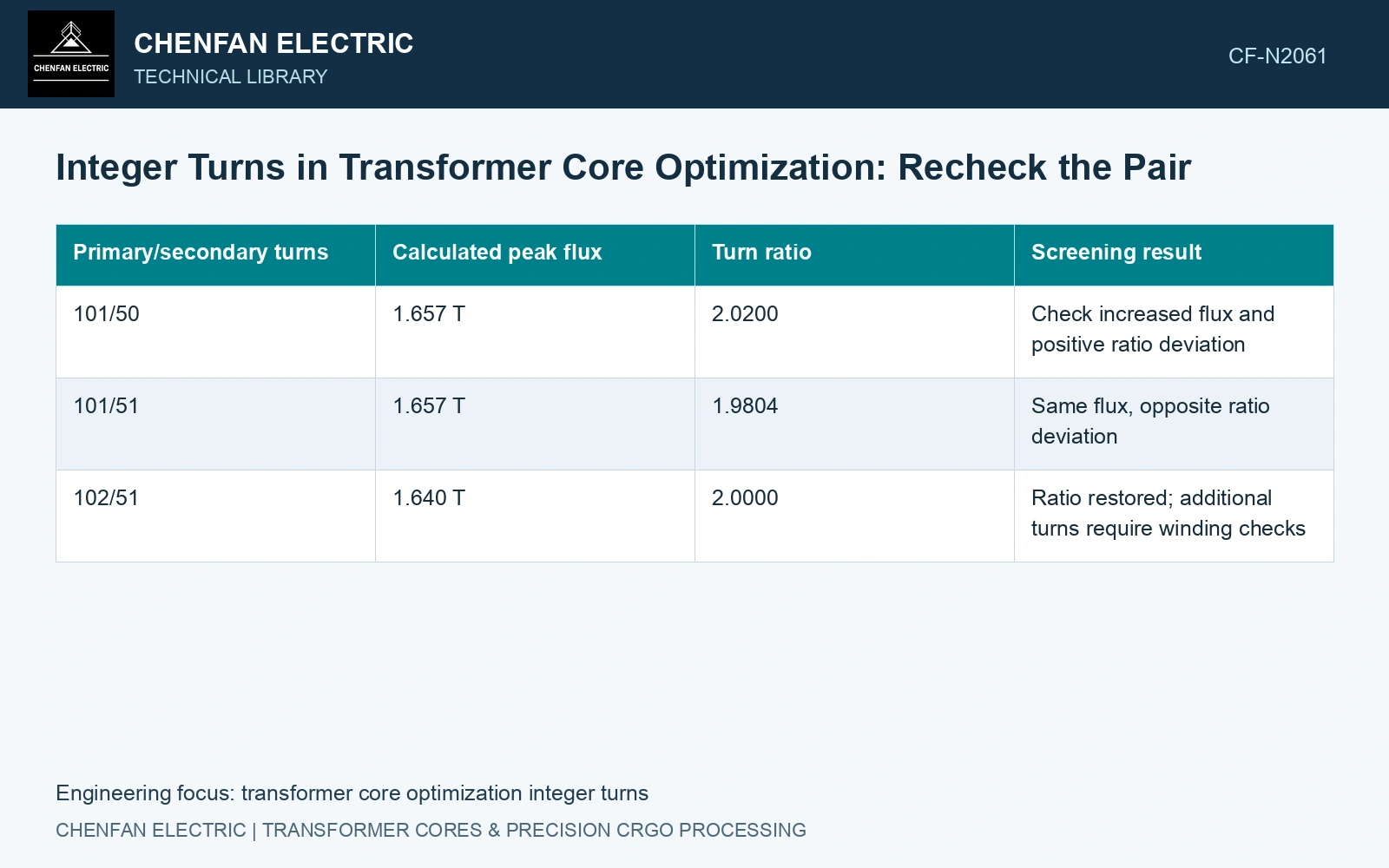
Use the catalogue 1.7 T, 50 Hz comparison condition [2]. Assume a sinusoidal relaxed design with 101.4 primary turns at that calculated peak flux; hold voltage, frequency and net steel area fixed. An integer primary N₁ then gives B = 1.70 × 101.4/N₁. This is a flux screen, not a complete loss or excitation model.
| Primary/secondary turns | Calculated peak flux | Turn ratio | Screening result |
|---|---|---|---|
| 101/50 | 1.707 T | 2.0200 | Check increased flux and positive ratio deviation |
| 101/51 | 1.707 T | 1.9804 | Same flux, opposite ratio deviation |
| 102/51 | 1.690 T | 2.0000 | Ratio restored; additional turns require winding checks |
These figures are illustrative, not acceptance limits. The permitted ratio error, tapping arrangement and excitation envelope belong to the actual specification. Where a regulating winding supplies tap increments, enumerate its discrete positions too; a satisfactory principal pair may still produce an unacceptable tap sequence.
Recompute the occupied space
An additional turn can change a layer count, disc count or connection layout. A smooth copper-length estimate may miss that jump. Rebuild the winding cross-section using the actual conductor, insulation and duct arrangement. Check axial and radial dimensions, leads, clearances and the assembly path into the window.
Keep conductor sizing linked to current and thermal duty. Quietly reducing conductor section to accommodate a rounded turn count changes resistance, temperature and mechanical behaviour. That is a new design, not a harmless correction to the old candidate.
Allow the geometry to move again
If the nearest pairs fail, hold a permitted integer pair fixed and re-optimize the continuous core and window dimensions. Repeat for the credible neighbours. This separates the discrete choice from the smooth search without pretending that an ordinary continuous solver enforces integer turns.
Nippon’s 1.7 T comparison point is not a saturation limit [2]. The assumed relaxed design gives 1.7067 T at 101 turns and 1.6900 T at 102. The first is above that catalogue test point and needs suitable magnetic data. Pairs 101/50 and 101/51 have ratio deviations +1.000% and −0.9804% from an assumed target of 2.000. Against an assumed ±0.5% ratio tolerance both fail; 102/51 passes. Carry that pair into the actual winding/packet design and verify material data over its duty; this ratio check cannot establish thermal, sound or assembled-core loss compliance.
Active turns, effective section, joint registration and packet closure must correspond to the same candidate. A nominal steel grade cannot rescue a turn pair that misses the specified ratio or changes the physical winding build.
Recalculate feasible integer-turn pairs and preserve rejected points on the pair map. Show how the selected ratio and flux margin change core area, copper and taps, then issue the manufacturable pair as the purchase basis.
References
- U.S. Department of Energy, DOE-HDBK-1011/4-92, Electrical Science, Volume 4, 1992.
- Nippon Steel Corporation, Grain-Oriented Electrical Steel Sheets, catalogue D004je, April 2020, specification and typical-property tables.