

Operating force is often difficult to measure directly inside a core assembly. One alternative is to measure vibration and infer loads through a structural transfer model. The result is an estimate conditioned on that model, rather than a direct force reading.
At a frequency ω, write y = Hf + e. The vector y contains measured response phasors, f contains candidate load coordinates, H maps those loads to the responses, and e includes measurement and model discrepancy. Units depend on the chosen response, such as acceleration per newton for H.
Ask whether the loads are distinguishable
If two columns of H are nearly proportional, the sensors see those two load patterns similarly. Their individual amplitudes can then vary greatly while their combined response changes little. Adding more sensors at equally insensitive positions may not solve that problem.
Inspect singular values or an equivalent conditioning assessment using physically scaled coordinates. Arbitrary unit scaling can make a numerical condition number misleading. Identify which combinations of loads are weakly observable rather than reporting only one global matrix metric.
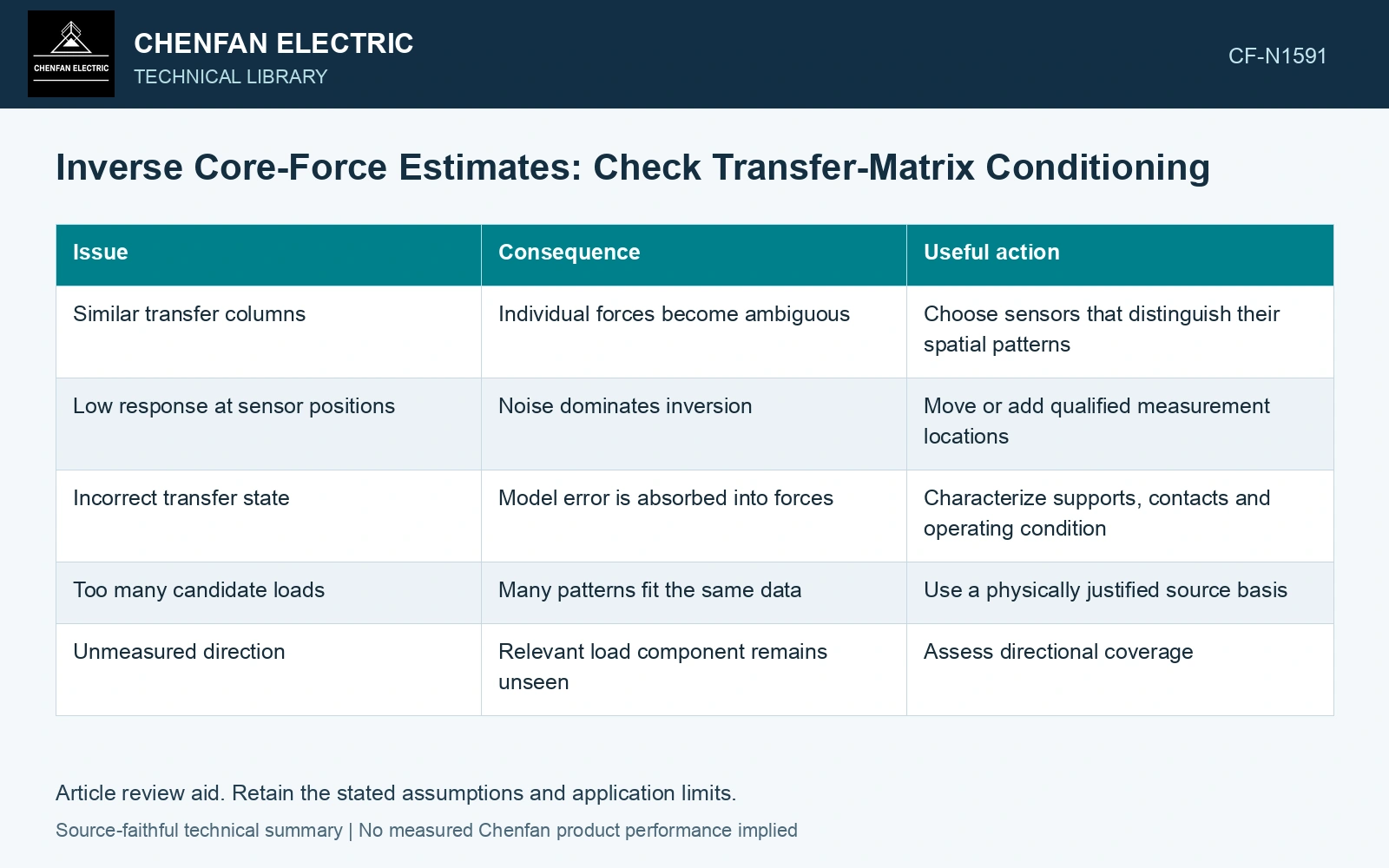
| Issue | Consequence | Useful action |
|---|---|---|
| Similar transfer columns | Individual forces become ambiguous | Choose sensors that distinguish their spatial patterns |
| Low response at sensor positions | Noise dominates inversion | Move or add qualified measurement locations |
| Incorrect transfer state | Model error is absorbed into forces | Characterize supports, contacts and operating condition |
| Too many candidate loads | Many patterns fit the same data | Use a physically justified source basis |
| Unmeasured direction | Relevant load component remains unseen | Assess directional coverage |
Regularization selects among possible answers
A common estimate minimizes ||Hf − y||² + α||Lf||², where α controls the penalty and L defines a preference such as smoothness or small load magnitude. The terms must be scaled consistently. The penalty supplies information that the measurements do not uniquely provide.
Report the selected penalty, its justification and sensitivity to α. A smooth estimate is not automatically a smooth physical force. Different plausible penalties may produce similar predicted motion but different loads.
Propagate measurement uncertainty and reasonable transfer-model variation through the inversion. Present a range for poorly identified components or report only a stable combined load when the individual components cannot be separated.
Predict a response that was not fitted
Reserve measurement locations or operating conditions for verification. Use the inferred loads to predict their complex responses, then compare amplitude and phase. A successful fit at the same sensors used for inversion mainly demonstrates that the optimization worked.
If the unused responses fail, inspect the force basis and transfer state before adding arbitrary load coordinates. A nonlinear contact or changed boundary condition may invalidate the linear model.
The defensible result states which force combinations are identifiable, their sensitivity and the independent response agreement. That gives a vibration investigation actionable information without turning one numerical solution into an unjustified claim about the exact operating load distribution.
Show how a small response error changes inferred core forces
Use catalogue 0.23 mm sheet thickness and assumed density 7,650 kg/m³ [1]. An assumed 100-sheet, 0.50×0.10 m packet has mass m = 8.7975 kg. At one 100 Hz operating state, assume acceleration transfer matrix H = (1/m)[[1, 1], [1, 1.01]], with entries in (m/s²)/N and m entered in kilograms. Forces [1, 1] N give responses [2/m, 2.01/m] m/s². Increasing only the second response by 0.01/m = 0.001137 m/s² changes the exact inverse solution to [0, 2] N. The scaled matrix condition number is 402.0. Report the identifiable combined force and improve independent sensor information before trusting the individual estimates [2].
Packet mass and sheet count provide one physical scale; joint seating, clamp preload, contact stiffness and support position determine the transfer matrix. Measure those assembly states when obtaining H. Increasing the number of response channels without changing their sensitivity to the load patterns does not remove a manufacturing-state error. Use the measured transfer and response quantities in an uncertainty model before reporting individual inferred forces [2].
References
- Nippon Steel Corporation, Grain-Oriented Electrical Steel Sheets, catalogue D004je_03_202004, 2020, Specifications; Size and Form Tolerances.
- JCGM, JCGM 100:2008, Evaluation of measurement data — Guide to the expression of uncertainty in measurement, 2008.