

Cross-lamination shear motion depends on how adjacent sheets transmit tangential load. A bonded stack and an unbonded clamped stack can therefore respond differently even when they contain the same steel. The comparison must control preload, geometry and transducer coupling before attributing differences to the interfaces.
Define the propagation direction and polarization. A wave traveling along sheets tests a different effective response from one traveling across their interfaces. Calling both measurements “core wave speed” hides that distinction.
Measure travel and decay separately
For a homogeneous isotropic elastic medium, shear speed is cs = √(G/ρ), where G is shear modulus in pascals and ρ density in kilograms per cubic metre. A laminated stack can be anisotropic, dispersive and contact-dependent, so this relation is only a reference model unless an effective-medium description has been validated.
Use measured travel times between defined locations to estimate propagation behavior. Preserve the pulse shape and frequency content; different spectral components can travel differently. A peak-arrival time can shift when attenuation reshapes the pulse.
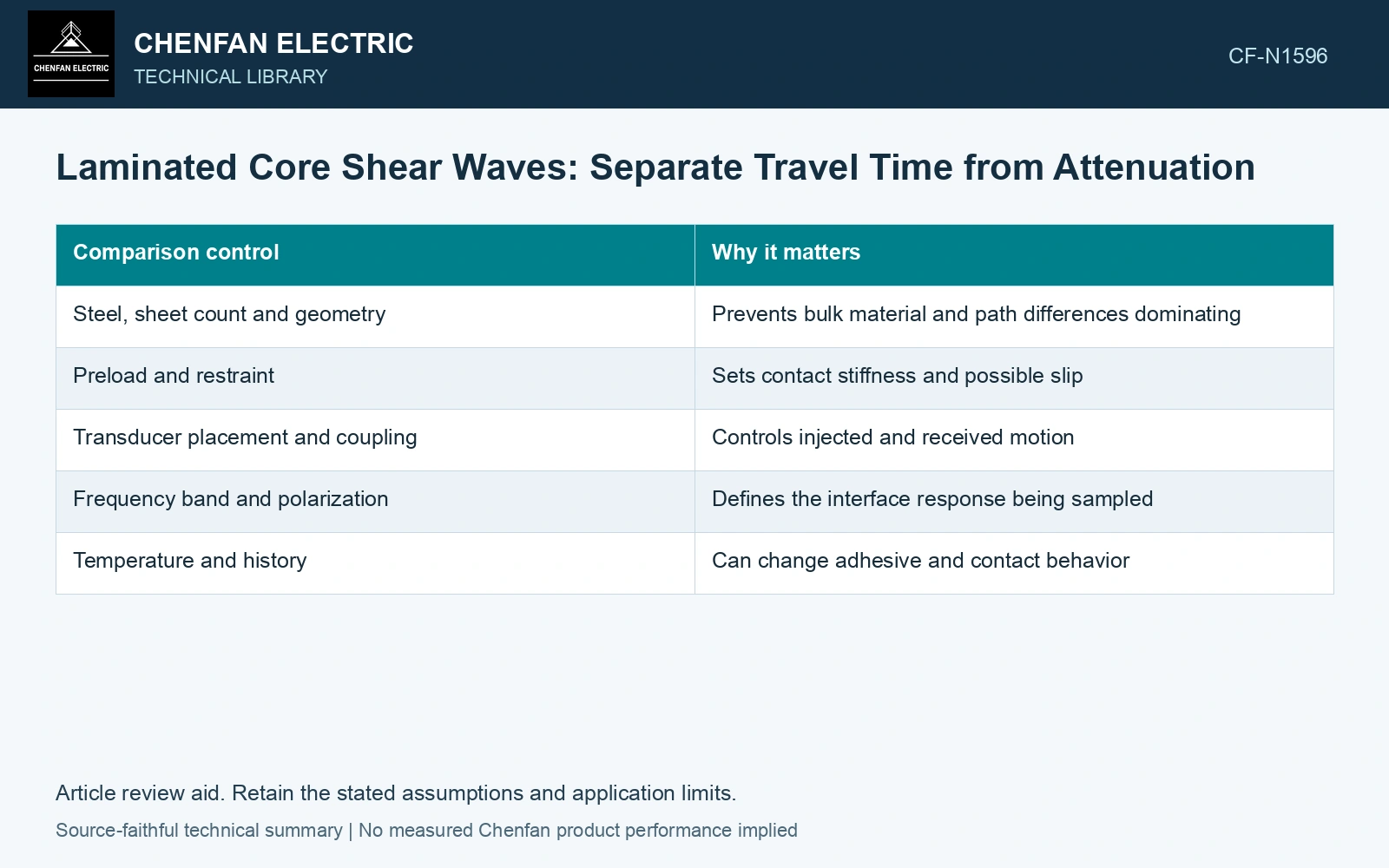
| Comparison control | Why it matters |
|---|---|
| Steel, sheet count and geometry | Prevents bulk material and path differences dominating |
| Preload and restraint | Sets contact stiffness and possible slip |
| Transducer placement and coupling | Controls injected and received motion |
| Frequency band and polarization | Defines the interface response being sampled |
| Temperature and history | Can change adhesive and contact behavior |
Attenuation should be distinguished from geometric spreading, boundary reflections and coupling losses. Comparing amplitudes at two distances can help, but only with a consistent propagation model and receiver sensitivity. A weaker signal is not automatically greater material damping.
Challenge the effective-medium assumption
If the wavelength is large relative to the relevant layer dimensions, an effective description may be useful. When those scales approach one another, interface-level scattering and dispersion can matter. Assess the measured band rather than choosing a convenient frequency and assuming continuum behavior.
Repeat at controlled excitation amplitudes. If the unbonded stack response changes with amplitude, interface micro-slip may be contributing. Repeat after reducing amplitude to check whether the state has changed permanently or retains history dependence.
Use bonded specimens that represent the actual coating and process being evaluated. Results from another adhesive system or nonoriented motor steel do not establish CRGO-core performance or liquid compatibility.
The comparison should report speed or phase behavior, attenuation assumptions and contact state separately. It may supply dynamic properties for a model or identify a change needing investigation. It cannot alone establish bond durability, manufacturing acceptance or acoustic benefit, which involve different loading and environmental questions.
Calculate speed and attenuation as separate outputs
Use the catalogue assumed steel density of 7,650 kg/m³ and 0.23 mm nominal thickness [1]. Assume a homogenized cross-sheet shear modulus of 5.0 GPa, a 100-sheet steel-only path of 23.0 mm and a narrowband pulse for which this nondispersive model applies. Then cs = √(G/ρ) = 808.45 m/s and one-way travel time is 28.45 μs. If a separately assumed amplitude ratio across that path is 0.80 after correcting spreading and coupling, α = −ln(0.80)/0.023 = 9.70 Np/m. Report both outputs. Neither the travel time nor the catalogue density supplies the measured attenuation or validates the effective modulus.
Cross-sheet transmission depends on coating continuity, burr contact, sheet count, packet alignment and applied preload. Record those manufacturing variables with propagation direction and frequency band. A bonded reference specimen must match the coating and process being evaluated; its modulus or damping cannot automatically represent an unbonded clamped transformer core. Magnetic strain data must also retain excitation and material direction; GOES source behavior is not established by a bulk propagation test [2].
References
- Nippon Steel Corporation, Grain-Oriented Electrical Steel Sheets, catalogue D004je_03_202004, 2020, Specifications; Size and Form Tolerances.
- Zhao, X., Du, Y., Liu, Y., Du, Z., Yuan, D., and Liu, L., Magnetostrictive Properties of the Grain-Oriented Silicon Steel Sheet under DC-Biased and Multisinusoidal Magnetizations, Materials 12, 2156, 2019. DOI: 10.3390/ma12132156.