

A core vibration spectrum contains the source and the structural response. Magnetic strain can already contain harmonics. A nonlinear contact can generate additional components as it moves. Their presence in the final spectrum does not reveal which mechanism produced them.
Begin with synchronized source-related and response measurements. Preserve phase and operating condition. Compare strain or another justified source proxy with the measured structural motion rather than treating current alone as the complete mechanical input. Directional strain under DC-biased and harmonic excitation requires its own source characterization [1].
Use the linear expectation as a reference
In a linear stationary structure, a force at frequency f produces response at f. It does not create a response at 2f or 3f by itself. Nonlinear contact, actuator distortion or time-varying boundaries can break that expectation.
An approved mechanical excitation with a measured force spectrum can therefore challenge the contact path separately from the magnetic source. If the input is nearly single-frequency but the output includes additional orders, inspect nonlinear mechanics and the measurement chain. The test does not by itself identify which contact moved.
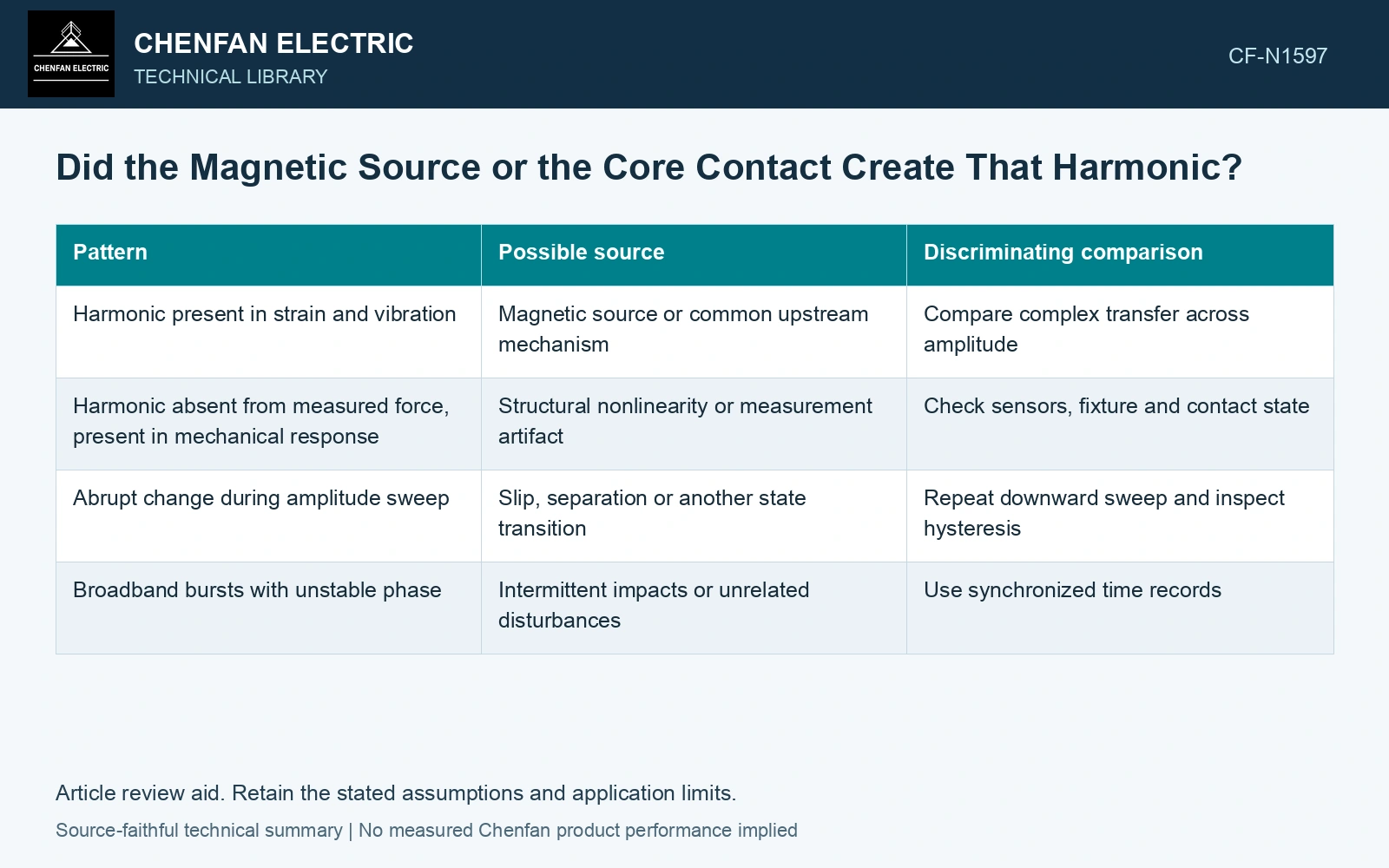
| Pattern | Possible source | Discriminating comparison |
|---|---|---|
| Harmonic present in strain and vibration | Magnetic source or common upstream mechanism | Compare complex transfer across amplitude |
| Harmonic absent from measured force, present in mechanical response | Structural nonlinearity or measurement artifact | Check sensors, fixture and contact state |
| Abrupt change during amplitude sweep | Slip, separation or another state transition | Repeat downward sweep and inspect hysteresis |
| Broadband bursts with unstable phase | Intermittent impacts or unrelated disturbances | Use synchronized time records |
Sweep amplitude without losing the state record
Hold frequency, preload and support conditions fixed while varying an approved excitation amplitude. Track fundamental response, generated harmonics, phase and loop behavior. Repeat at decreasing amplitude because contact response may depend on prior movement.
A smooth increase in output harmonic amplitude is not enough to assign a mechanism. The actuator itself may become nonlinear, or a sensor may approach its range limit. Measure the actual applied input and confirm acquisition headroom.
Compare the mechanically characterized response with operating data. If contacts show amplitude-dependent behavior near the operating motion range, a linear transfer model may be insufficient. If no such effect appears within the validated range, retain that bounded result rather than declaring all contacts linear under every condition.
Phase locking is helpful but not unique. A contact driven periodically can generate harmonics synchronized with the electrical cycle. Conversely, magnetic-source variability can reduce coherence. Use several observations instead of one spectral label.
Locate where the extra harmonic first appears along the measured source–structure chain. An unchanged magnetic source with new response harmonics points the next investigation toward contact behavior or instrumentation, rather than directly to the steel specification.
Scale an apparent harmonic into a force-screening quantity
Use the catalogue assumed density 7,650 kg/m³ and 0.23 mm nominal thickness [2]. Assume a rigidly moving 20-sheet specimen, 0.50 m long and 0.10 m wide: mass is 1.7595 kg. An assumed 100 Hz acceleration of 0.10 m/s² peak corresponds to 0.176 N peak inertial force. A new 200 Hz response of 0.010 m/s² corresponds to 0.0176 N in this rigid-body screening model. Compare those demands with the measured input spectrum and phase; a single-frequency input cannot generate the second harmonic through a linear time-invariant path. Investigate contact or instrumentation if that harmonic is absent upstream, rather than changing the GOES specification first [1].
Burr, sheet-edge contact, packet seating, joint overlap and clamp preload govern where slip or intermittent contact can occur. Keep those assembly records with source-strain and vibration measurements. The mass calculation defines a specimen and does not supply a dynamic force distribution for a flexible production core.
References
- Zhao, X., Du, Y., Liu, Y., Du, Z., Yuan, D., and Liu, L., Magnetostrictive Properties of the Grain-Oriented Silicon Steel Sheet under DC-Biased and Multisinusoidal Magnetizations, Materials 12, 2156, 2019. DOI: 10.3390/ma12132156.
- Nippon Steel Corporation, Grain-Oriented Electrical Steel Sheets, catalogue D004je_03_202004, 2020, Specifications; Size and Form Tolerances.