

Account for steel section, heat paths and packet support when revising core cooling ducts. At fixed external stack dimensions, an added gap can reduce magnetic area while changing oil access and the clamping load path.
Rebuild the section account
List steel packets, duct gaps and other non-steel dimensions across the actual stack. Distinguish gross geometric area from effective steel area, retaining lamination factor and the geometry used by the original magnetic calculation. An external dimension check cannot establish that the effective section is preserved.
If the redesign compensates by enlarging another dimension, record the resulting steel mass, packet layout and interfaces. That is a combined geometry revision, not proof that only cooling changed.
Connect the revised paths
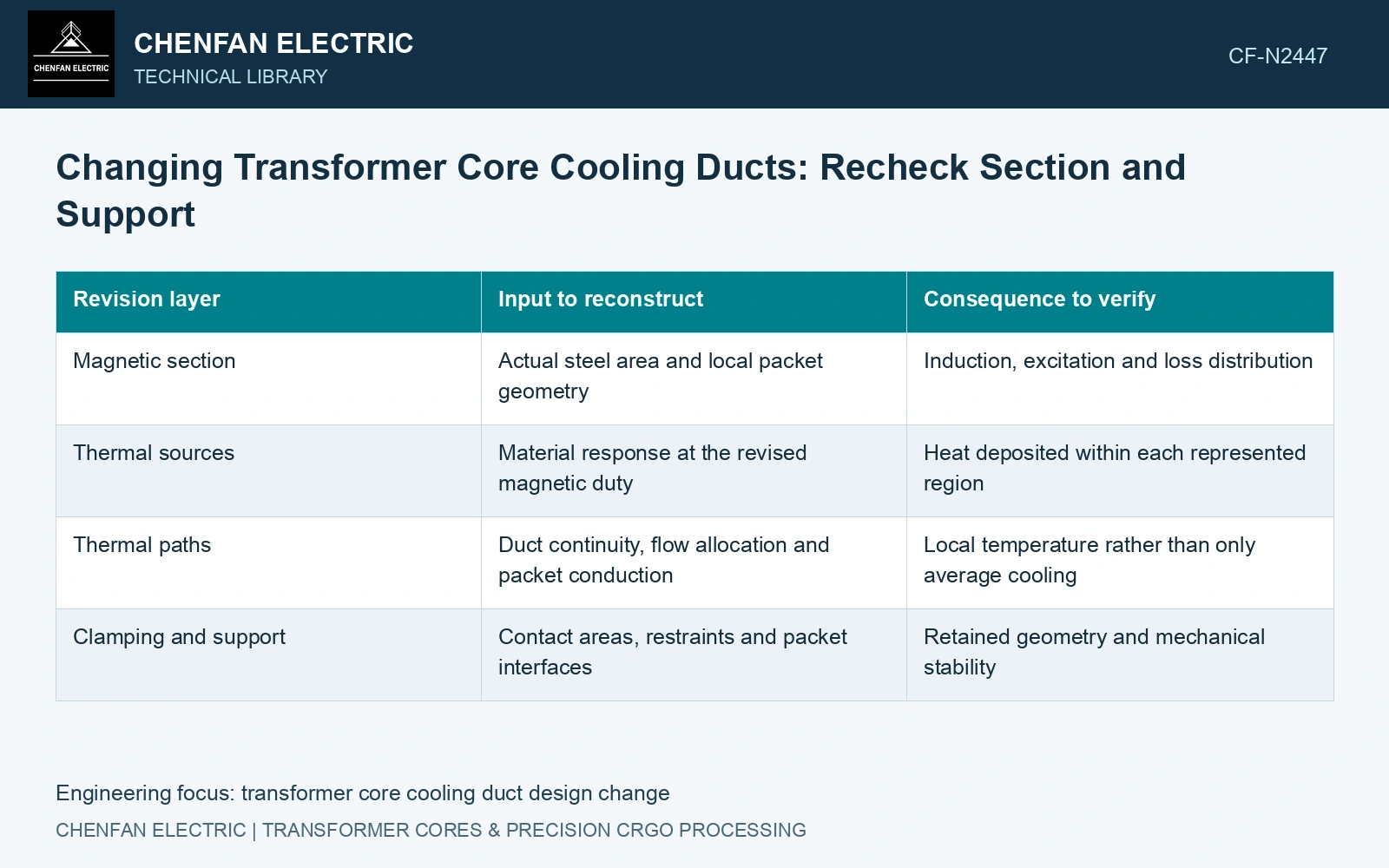
| Revision layer | Input to reconstruct | Consequence to verify |
|---|---|---|
| Magnetic section | Actual steel area and local packet geometry | Induction, excitation and loss distribution |
| Thermal sources | Material response at the revised magnetic duty | Heat deposited within each represented region |
| Thermal paths | Duct continuity, flow allocation and packet conduction | Local temperature rather than only average cooling |
| Clamping and support | Contact areas, restraints and packet interfaces | Retained geometry and mechanical stability |
Verify flow through the assembled ducts
An additional passage has to receive the intended flow and remain open in the assembled condition. A duct that interrupts another path, creates unequal allocation or changes packet thickness may produce a different temperature distribution from the one suggested by its count. Reconstruct the flow and conduction arrangement before choosing a confirming test.
The cited core-temperature study models spatial, anisotropic conduction and compares a prototype’s measured temperatures [1]. It does not qualify this duct layout. Compare the proposed design with local observations covering changed packets, obstructions and thermal boundaries; whole-transformer temperature rise may leave those locations unresolved.
Retain the mechanical connection
Check how duct spacers transmit clamping forces and how tolerances affect contact. The qualified assembly must preserve its intended geometry after processing and under the relevant mechanical conditions. A favourable thermal result does not demonstrate sufficient restraint.
Count the steel removed to create the extra ducts
Catalogue input is nominal 0.23 mm sheet gauge [2]. Assumptions: a fixed 225 mm external packet, 100 mm active width, 900 sheets initially, and five added 2.3 mm ducts created entirely by removing steel. The ducts occupy 11.5 mm, equivalent to 50 nominal sheets. Steel-only area falls from 20,700 to 19,550 mm². At unchanged sinusoidal voltage, turns and 50 Hz, an assumed original 1.70 T peak becomes 1.70 × 900/850 = 1.80 T. Obtain the replacement loss and excitation data at that duty; the catalogue’s 1.7 T loss point cannot be extrapolated as a constant [2] [1].
Control sheet gauge, active steel count, cut-edge condition, joint registration and retained clamp load. Match the manufactured packet and duct geometry to the magnetic and thermal models before extending previous core evidence.
Approve evidence inheritance against the measured duct and packet layout. Recheck calculations whose magnetic section, flow path or support boundary changed, and document the unchanged features whose earlier results still apply.
References
- Z. Chen, Z. He and S. Wang, Transformer Iron Core Temperature Field Calculation Based on Finite Element Analysis, Energies, 2025. DOI: 10.3390/en18246537.
- Nippon Steel Corporation, Grain-Oriented Electrical Steel Sheets, catalogue D004je, April 2020, specification tables, size tolerances and Annealing by Customers.