


Transformer Core Engineering Notes · CF-N293
A transformer noise specification should identify the acoustic quantity and the operating state. Core-related sound, load-related sound and cooling equipment can contribute differently. Comparing an all-cooling-off measurement with a guarantee requiring fans and pumps in service is not a like-for-like comparison, even when both reports show a value in decibels.
Distinguish sound power and sound pressure
Sound power describes a source-related acoustic output, while sound pressure depends on the observation location and environment as well as the source. State the weighting and measurement method. A sound-pressure value at one distance is not interchangeable with sound power or with a value at another site boundary. IEC 60076-10 provides the transformer sound-determination framework; the actual contractual quantity and procedure must be clearly selected.
Name the operating and cooling states
Record excitation, frequency, relevant load condition and the fans or pumps operating during the measurement. A quiet natural-cooling condition may not represent the highest declared rating. If separate source contributions are needed, agree the measurement or assessment method rather than subtracting arbitrary decibel values. The acoustic specification should remain consistent with the thermal rating and control sequence that the transformer will actually use.
Combine levels on a valid basis
Decibel levels are logarithmic. For two independent, uncorrelated contributions of equal level at the same observation point under a compatible measurement basis, their energy sum is about 3 dB above either contribution, not twice its numeric decibel value. This is an illustrative acoustic relationship, not a prediction for a particular transformer. Coherent tonal sources and differing measurement conditions require more careful treatment.
Separate factory acceptance and site outcome
Walls, reflections, other equipment and structure-borne transmission can change site observations. A factory sound result does not by itself guarantee every boundary or room condition. Ask the acoustic designer to assess the installed arrangement and coordinate any mitigation with ventilation and access. Enclosures or barriers that reduce sound must not undermine the cooling state required to achieve the promised transformer capacity.
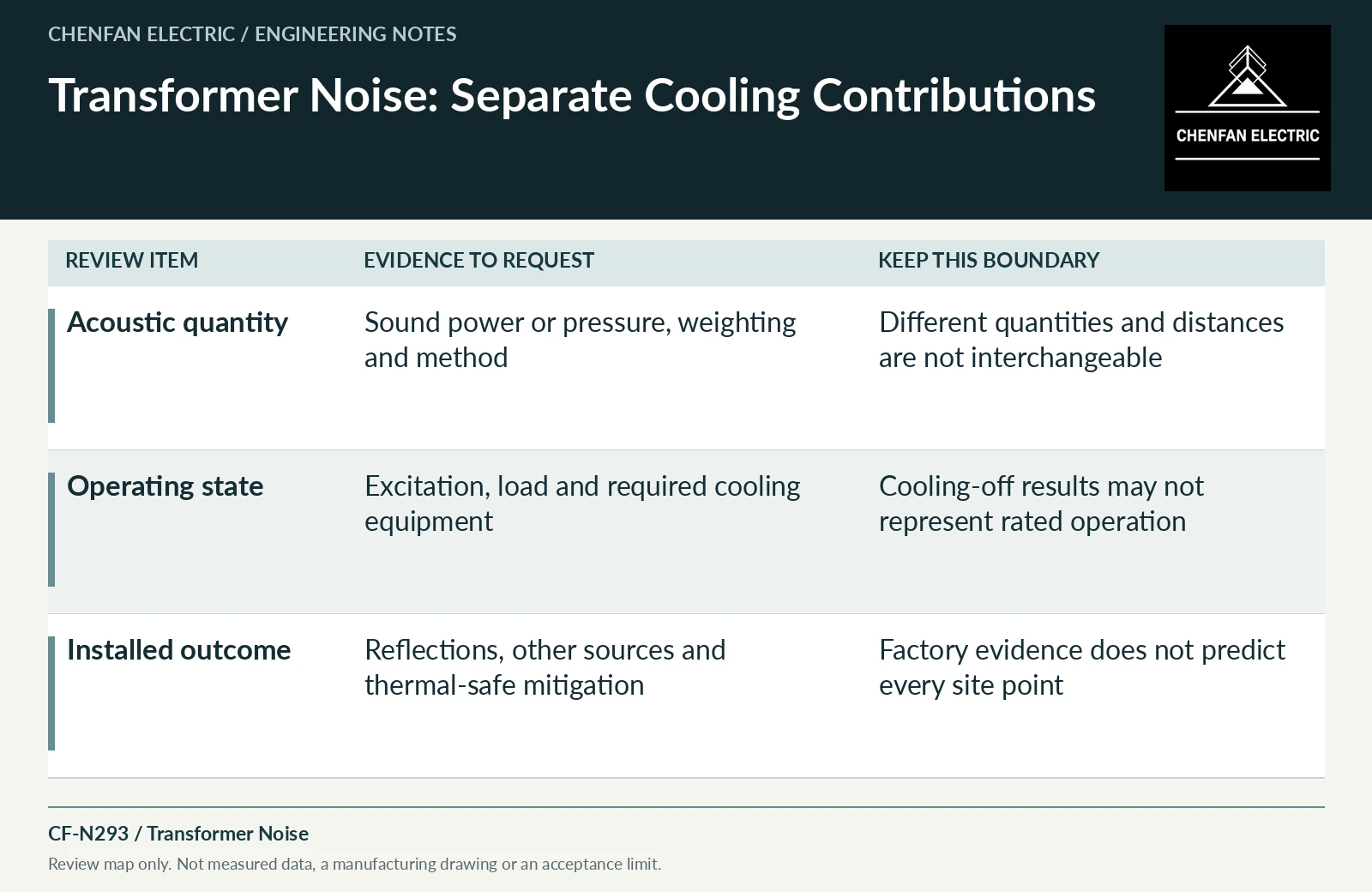
| Review item | Evidence to request | Boundary to preserve |
|---|---|---|
| Acoustic quantity | Sound power or pressure, weighting and method | Different quantities and distances are not interchangeable |
| Operating state | Excitation, load and required cooling equipment | Cooling-off results may not represent rated operation |
| Installed outcome | Reflections, other sources and thermal-safe mitigation | Factory evidence does not predict every site point |
References and scope
- IEC 60076-10:2016 — Determination of sound levelsPublic standard abstract · Transformer/reactor sound measurement; operating conditions and sound-power/sound-pressure distinctions matter.
- IEC 60076-2:2011 — Temperature rise for liquid-immersed transformersPublic standard abstract · Temperature-rise requirements, cooling identification and the distinction between test conditions and installed duty.
- IEC 60076-1:2011 — Power transformers: GeneralPublic standard abstract · General transformer scope, interfaces and controlled equipment specification.