

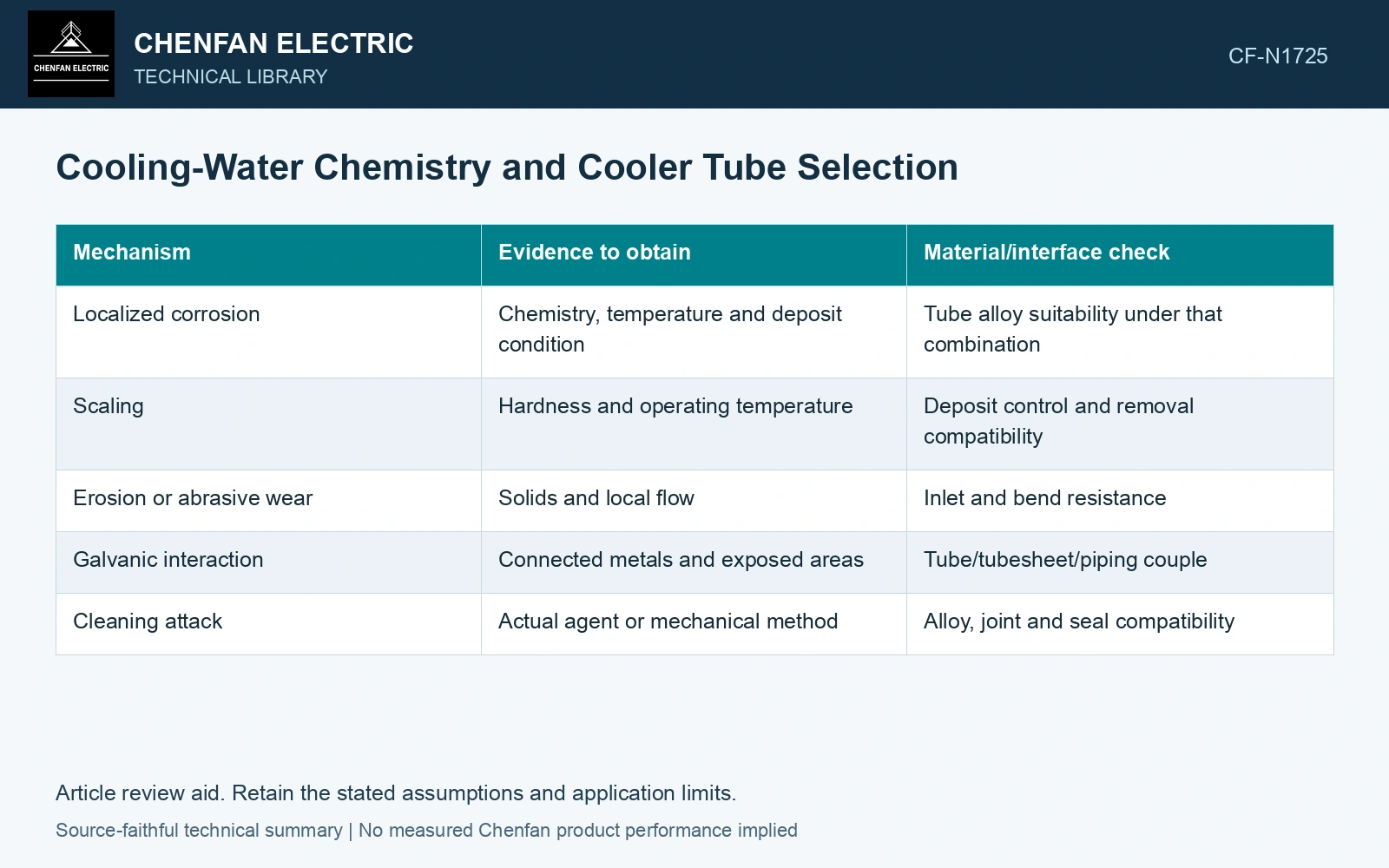
Tube selection needs the water environment and the assembled metal interfaces. DOE’s corrosion handbook explains low-flow crevice cells, stress/chemistry interaction and galvanic contact between dissimilar metals [1]. A bulk chloride reading alone cannot establish a cooler alloy’s suitability.
Collect representative water chemistry and its seasonal range. Include chloride, hardness, dissolved oxygen, pH and suspended matter where relevant to the material review. Specify whether water is once-through, recirculating or treated, because concentration and deposits can change over time.
| Mechanism | Evidence to obtain | Material/interface check |
|---|---|---|
| Localized corrosion | Chemistry, temperature and deposit condition | Tube alloy suitability under that combination |
| Scaling | Hardness and operating temperature | Deposit control and removal compatibility |
| Erosion or abrasive wear | Solids and local flow | Inlet and bend resistance |
| Galvanic interaction | Connected metals and exposed areas | Tube/tubesheet/piping couple |
| Cleaning attack | Actual agent or mechanical method | Alloy, joint and seal compatibility |
Test the worst credible local condition
A bulk sample can differ from water beneath a deposit or in a stagnant pocket. Record where deposits develop and whether shutdown leaves trapped water. Use this mechanism to choose relevant material evidence or a representative compatibility test.
A cleaning process suitable for the tube wall can damage a seal, joint or second-wall leak path. Review the assembled cooler rather than an isolated alloy coupon only. Keep the cleaning concentration and procedure with the specific manufacturer-approved method; do not improvise chemistry from a general corrosion discussion.
Transformer maintenance guidance identifies debris in water tubes, seal leakage and cooling-flow obstruction [2]. Preserve the deposit and joint evidence when reviewing the assembled cooler, rather than selecting material from an isolated clean-water coupon.
Compare local concentration with bulk chemistry
For a hypothetical procurement screen, assume bulk chloride 50 mg/L and a local stagnant-region sample 200 mg/L at 40 °C and pH 8. The local value is four times the bulk value. Assume candidate A’s documented envelope covers 100 mg/L and B’s 250 mg/L at that same temperature, pH and stress condition. Ratios are 200/100 = 2.0 and 200/250 = 0.80: reject A from this chloride screen and carry B to joint, deposit and cleaner compatibility review. Passing this one screen does not qualify the whole cooler.
References
- U.S. Department of Energy, DOE-HDBK-1015/1-93, Chemistry, Volume 1, 1993, Corrosion: Crud and Galvanic Corrosion; Specialized Corrosion.
- U.S. Bureau of Reclamation, FIST Volume 3-30, Transformer Maintenance, 2000.