


Transformer Core Engineering Notes · CF-N258
Emergency loading after a cooler failure is a scenario-specific operating decision. The failed equipment, remaining flow paths, starting temperatures and available protection all matter. A generic percentage of nameplate capacity is not a substitute for the OEM’s defined emergency envelope and the owner’s approved operating procedure.
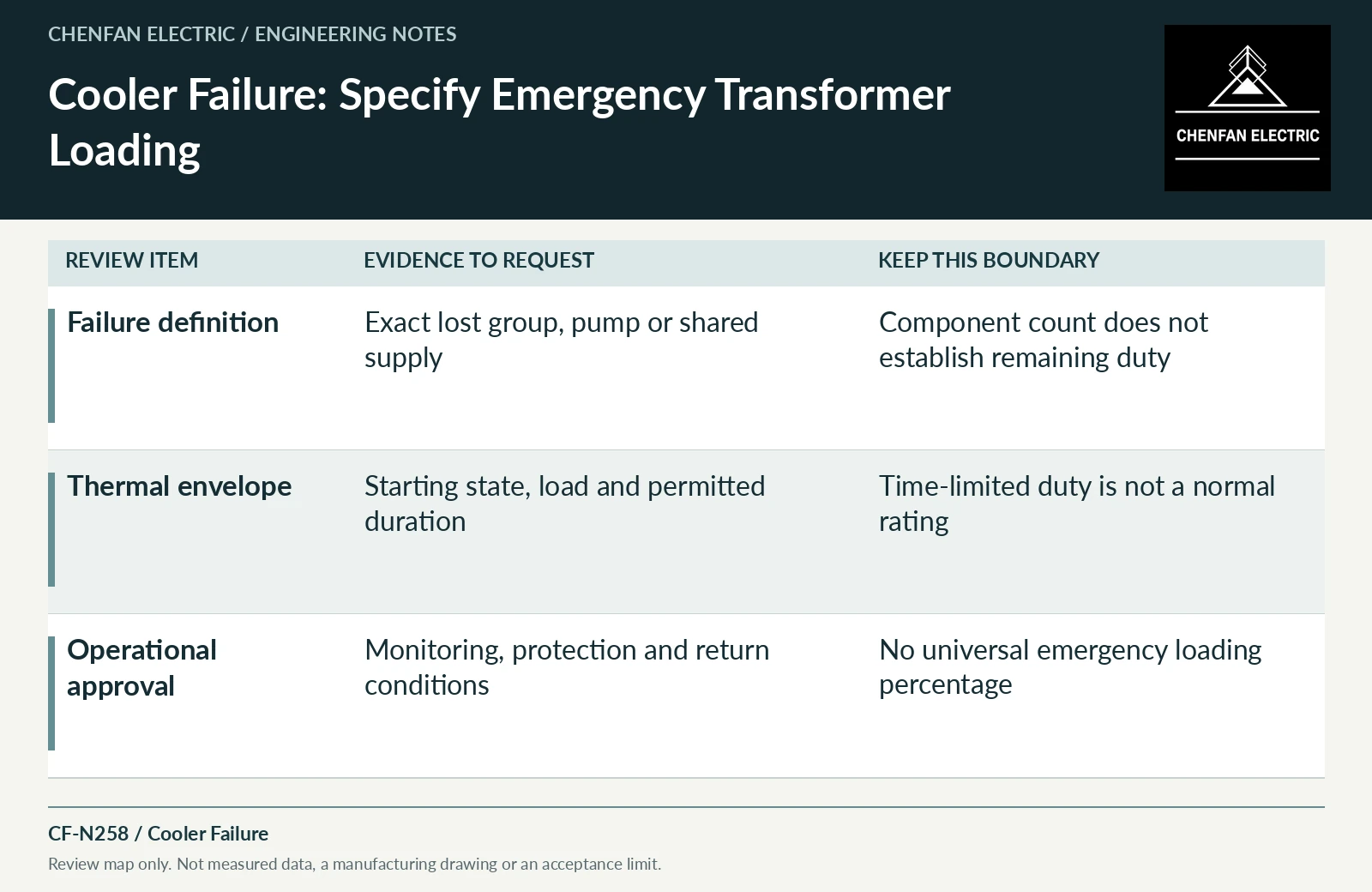
Describe the exact cooling loss
Losing one fan motor, a complete fan group, an oil pump or a common auxiliary supply creates different conditions. Identify which coolers and flow paths remain effective. A pump outage in a directed-flow arrangement cannot be treated as the loss of an arbitrary fraction of cooling area. Ask the OEM to evaluate the defined failure states rather than infer remaining capability from the number of components still running.
Define the starting state and permitted duration
An emergency period beginning after light loading is not equivalent to one beginning after a sustained peak. Specify the load and temperature history used for the assessment, the intended load reduction and the maximum duration of each accepted state. Repeated emergency episodes need their own review. A time-limited allowance should not become the normal operating rating merely because temperatures did not trigger an alarm during one previous event.
Include components outside the oil model
Review winding hot spots, leads, terminals and any components whose capability depends on the failed cooling or auxiliary supply. Confirm the monitoring and protection available during the failure. A common supply loss may affect both cooling and the information needed to manage the event. The assessment should identify which unavailable signals invalidate the proposed operating envelope or require a different response.
Turn the assessment into an approved decision table
The deliverable should identify each failure state, allowed duty, duration, monitoring requirements and responsible decision authority. Include the conditions for returning to normal operation after repair. Settings and actions must come from the approved engineering and protection process; this article provides no live-operation sequence. Keep the final procedure consistent with the delivered cooling hardware, controls and the latest approved transformer configuration.
| Review item | Evidence to request | Boundary to preserve |
|---|---|---|
| Failure definition | Exact lost group, pump or shared supply | Component count does not establish remaining duty |
| Thermal envelope | Starting state, load and permitted duration | Time-limited duty is not a normal rating |
| Operational approval | Monitoring, protection and return conditions | No universal emergency loading percentage |
References and scope
- IEEE C57.91-2025 — Loading Mineral-Oil-Immersed Transformers and Step-Voltage RegulatorsPublic standard abstract · Mineral-oil loading, thermal duty and loading beyond nameplate; do not transfer the scope automatically to ester or dry-type equipment.
- IEC 60076-7:2018 — Loading guide for mineral-oil-immersed power transformersPublic standard abstract · Mineral-oil transformer loading and thermal-ageing framework, not a universal asset-life prediction.
- IEC 60076-2:2011 — Temperature rise for liquid-immersed transformersPublic standard abstract · Temperature-rise requirements, cooling identification and the distinction between test conditions and installed duty.