

Changing insulating gas changes the transformer system. Wu et al. study heat dissipation with a defined C4F7N/CO2 mixture [1]; that study does not establish interchangeability with another gas. Compare electrical insulation, cooling and material/monitoring states for the actual design.
Equal pressure is an incomplete comparison
At the same pressure and temperature, gases can have different density, heat capacity, thermal conductivity and dielectric behaviour. Keeping the old gauge setting therefore does not preserve either thermal performance or electrical margin. A mixture adds composition tolerance and possible phase changes to the comparison.
The proposed operating envelope should identify gas composition, minimum and maximum temperatures, pressure or density limits and the permitted abnormal states. A nominal room-temperature composition leaves the coldest compartment and hottest winding region undefined.
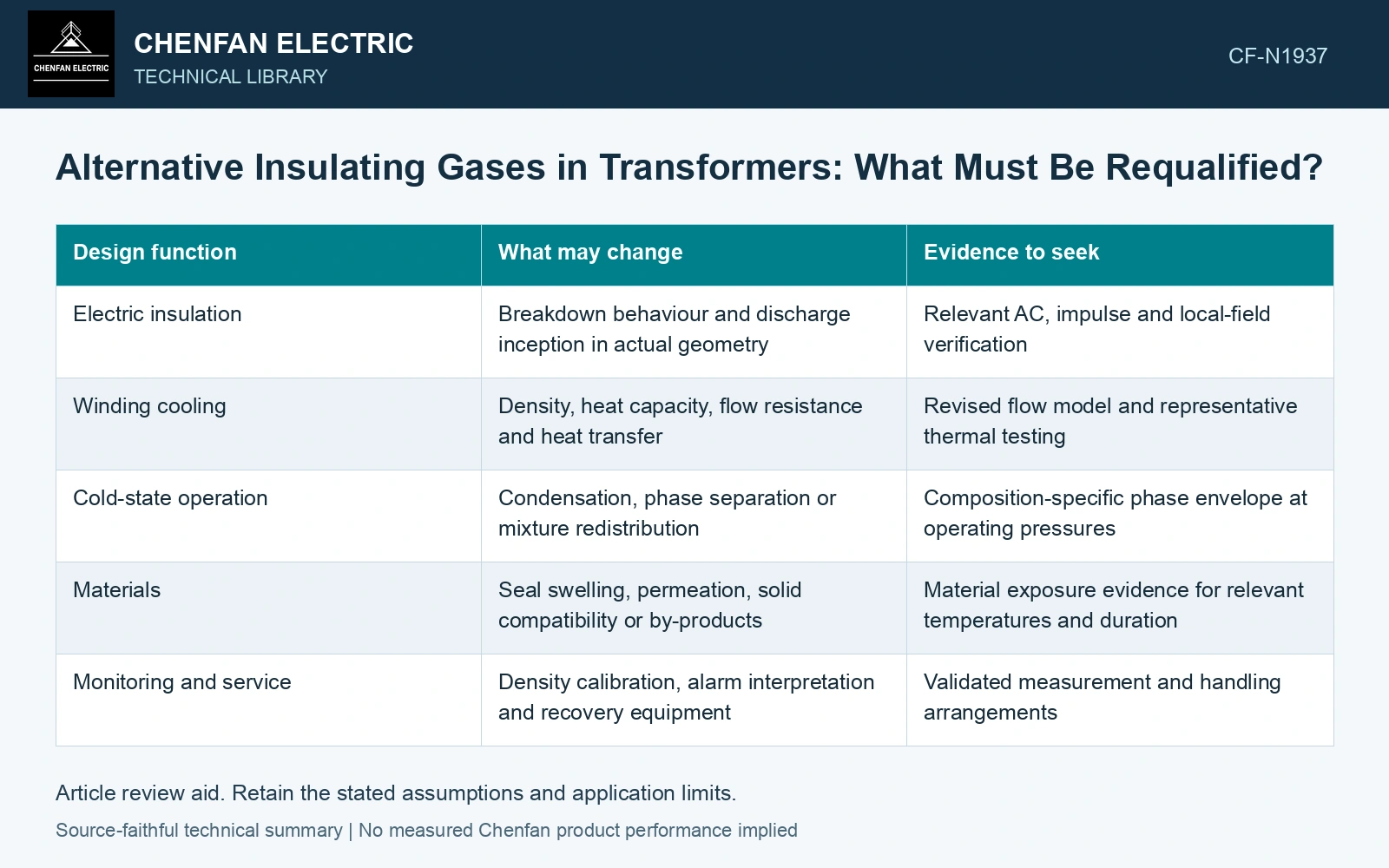
| Design function | What may change | Evidence to seek |
|---|---|---|
| Electric insulation | Breakdown behaviour and discharge inception in actual geometry | Relevant AC, impulse and local-field verification |
| Winding cooling | Density, heat capacity, flow resistance and heat transfer | Revised flow model and representative thermal testing |
| Cold-state operation | Condensation, phase separation or mixture redistribution | Composition-specific phase envelope at operating pressures |
| Materials | Seal swelling, permeation, solid compatibility or by-products | Material exposure evidence for relevant temperatures and duration |
| Monitoring and service | Density calibration, alarm interpretation and recovery equipment | Validated measurement and handling arrangements |
Follow the cooling consequences into the rating
A revised gas-flow model needs the actual blower characteristic and winding ducts. Maintaining volumetric flow does not automatically maintain mass flow or heat removal. Changes in gas properties can also move the blower operating point and alter how flow divides between parallel winding paths.
The heat exchanger may become a different limitation from the winding. Assess both sides and the permitted cooling-device outages. If a new gas requires a larger exchanger, different blower or lower load rating, that is part of the product change rather than a minor service substitution.
Revisit the assumptions behind the protection
A density alarm calibrated for the old gas may not represent the intended new operating margin. Gas-quality measurements and decomposition-product interpretation also need a basis applicable to the replacement. The previous diagnostic history cannot be transferred merely by keeping the same instrument display.
For an independent screen, assume gases A/B have volumetric heat capacities 4,000/2,500 J/(m³·K) at their specified states. With equal 0.10 m³/s flow and 20 K rise, Q = ρcpV̇ΔT [2] gives 8/5 kW. B needs 0.16 m³/s, 60% more, to match A. Resolve the resulting pressure drop, blower operating point, local heat transfer and dielectric qualification together; an equal bulk heat rate alone cannot establish equivalent cooling.
The qualification decision should identify which original evidence still applies, which is invalidated and which new tests close the gaps. Environmental handling and market eligibility require separate, current jurisdiction-specific review. An attractive property table is an input to that work; it is not proof that an existing transformer can accept the new gas without redesign.
References
- Y. Wu et al., Research on Heat Dissipation Performance of Eco-friendly Gas insulated Transformer with i-C4F7N/CO2 as the Insulation Medium, Journal of Physics: Conference Series 2527, 012011, 2023. DOI: 10.1088/1742-6596/2527/1/012011.
- U.S. Department of Energy, DOE-HDBK-1012/2-92, Thermodynamics, Heat Transfer, and Fluid Flow, Volume 2, 1992.