

A three-limb core and a five-limb core differ most importantly in the magnetic paths available when the three wound-limb fluxes do not sum to zero. Compare those paths before comparing steel mass, overall height or no-load loss. Balanced operation alone does not establish how either design behaves during zero-sequence excitation, switching or a sustained unbalanced condition.
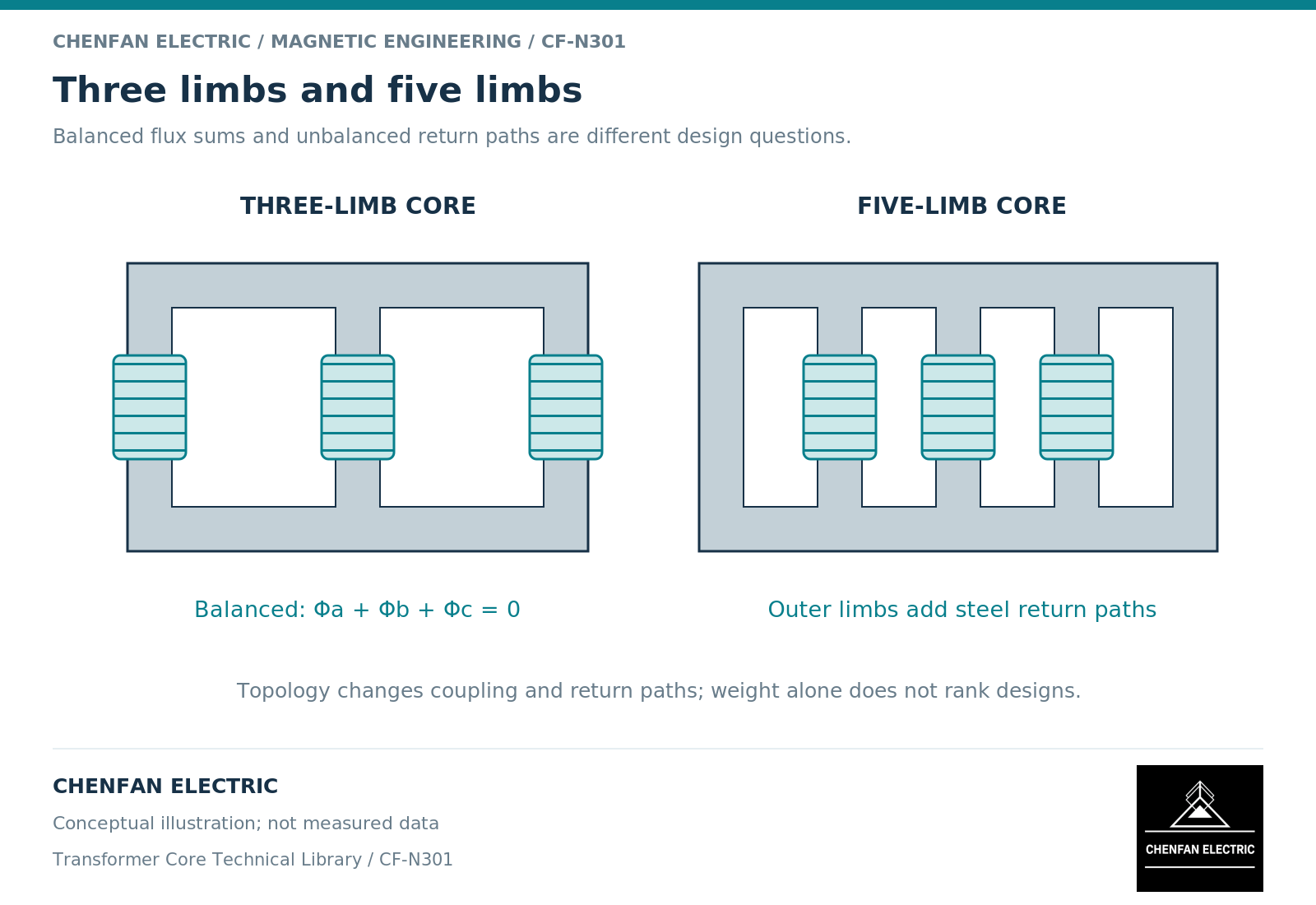
Separate normal flux from a common-mode component
For an ideal balanced three-phase set, the instantaneous fundamental fluxes add to zero. Flux leaving one wound limb can therefore return through the other wound limbs and their connecting yokes. This explains why a three-limb core can perform normal three-phase voltage transformation without dedicated outer return limbs. It does not mean that every local yoke section carries the same flux at every instant.
A zero-sequence component is different: the three phase components are in phase. Their sum is not zero, so their combined return must use a path outside the three wound limbs. In a three-limb construction, that path includes surrounding space and may involve tank walls and other structures. Five-limb construction provides additional steel branches, but those branches still have finite area and a nonlinear magnetic characteristic. Geometry-based transformer models distinguish these configurations explicitly. [1]
Compare operating cases, not silhouettes
A fair comparison holds the electrical duty constant. State winding connection, accessible neutrals, terminal voltages, frequency, turns, tap position and the condition of any tertiary winding. A closed delta can change the electrical response to zero-sequence and triplen excitation; an extra steel return path does not replace that winding connection.
Next separate the questions being answered. A balanced no-load comparison concerns excitation and loss at a defined waveform. A ground-fault study concerns the connected zero-sequence network. An unbalanced thermal assessment may require the distribution of return flux in structural parts. A switching study needs nonlinear characteristics and initial magnetic state. These are related evaluations, not interchangeable acceptance tests.
The classical independent-phase representation and a coupled magnetic representation can give different answers because they retain different physics. Selecting the more detailed model is justified when the omitted coupling affects the decision, not simply because one model has more parameters. [1] [2]
A useful topology comparison sheet
Use one row per candidate and preserve the same case definitions across rows. The following entries expose differences that a weight comparison misses.
| Comparison item | What to record | Why it matters |
|---|---|---|
| Magnetic branches | Wound limbs, yokes, outer limbs and external return | Identifies where non-cancelling flux can close |
| Electrical boundary | Connection, neutral and tertiary state | Determines which excitation components can develop |
| Section basis | Net magnetic area for every branch | Converts branch flux into the relevant local density |
| Evidence | Test object, operating point and model scope | Prevents a balanced result from being reused for another duty |
A practical thought experiment is to keep the three wound-limb flux components equal and in phase in a conceptual model. Their return requirement becomes three times one component. The exercise identifies the missing branch in a three-limb-only network; it does not predict a real fault current or prove that the five-limb option is thermally adequate.
Make the choice at active-part level
Additional return steel can alter package dimensions, mass distribution, clamping arrangement and winding access. Reducing height may increase width or change the yoke proportions. These effects belong in the same design comparison as magnetic performance. A compact outline is not a complete assessment of transport, insulation or mechanical feasibility.
For a core manufacturing handover, identify the chosen topology and freeze the branch areas and interface dimensions that support the electromagnetic design. Leave whole-transformer zero-sequence performance and structural heating with the party responsible for the assembled design unless that scope is expressly contracted.
The defensible conclusion is not that three limbs are simpler or five limbs are safer. It is that each candidate must provide an adequate magnetic return path for the specified electrical cases, supported by evidence at the correct assembly level. Weight becomes a meaningful commercial comparison only after those cases and boundaries are aligned.
References
[1] Manitoba Hydro International / PSCAD. The UMEC Approach.
[2] Manitoba Hydro International / PSCAD. The Classical Approach.