

A stacking-factor assumption enters the magnetic calculation before it appears in any loss result.
When the assumed iron content is wrong, the designer may be evaluating the material at the wrong flux density.
Translate the area assumption into the operating point
For a consistently defined laminated section, net iron area is the gross stack area multiplied by the applicable stacking factor. Deliberate non-iron spaces must be handled according to the drawing’s area convention, not silently included as steel.
At fixed induced voltage, frequency, turns and gross section, a lower net iron area requires a higher average peak flux density under the same sinusoidal-flux assumption. The area error is therefore an operating-point error, not merely a difference in packing efficiency.
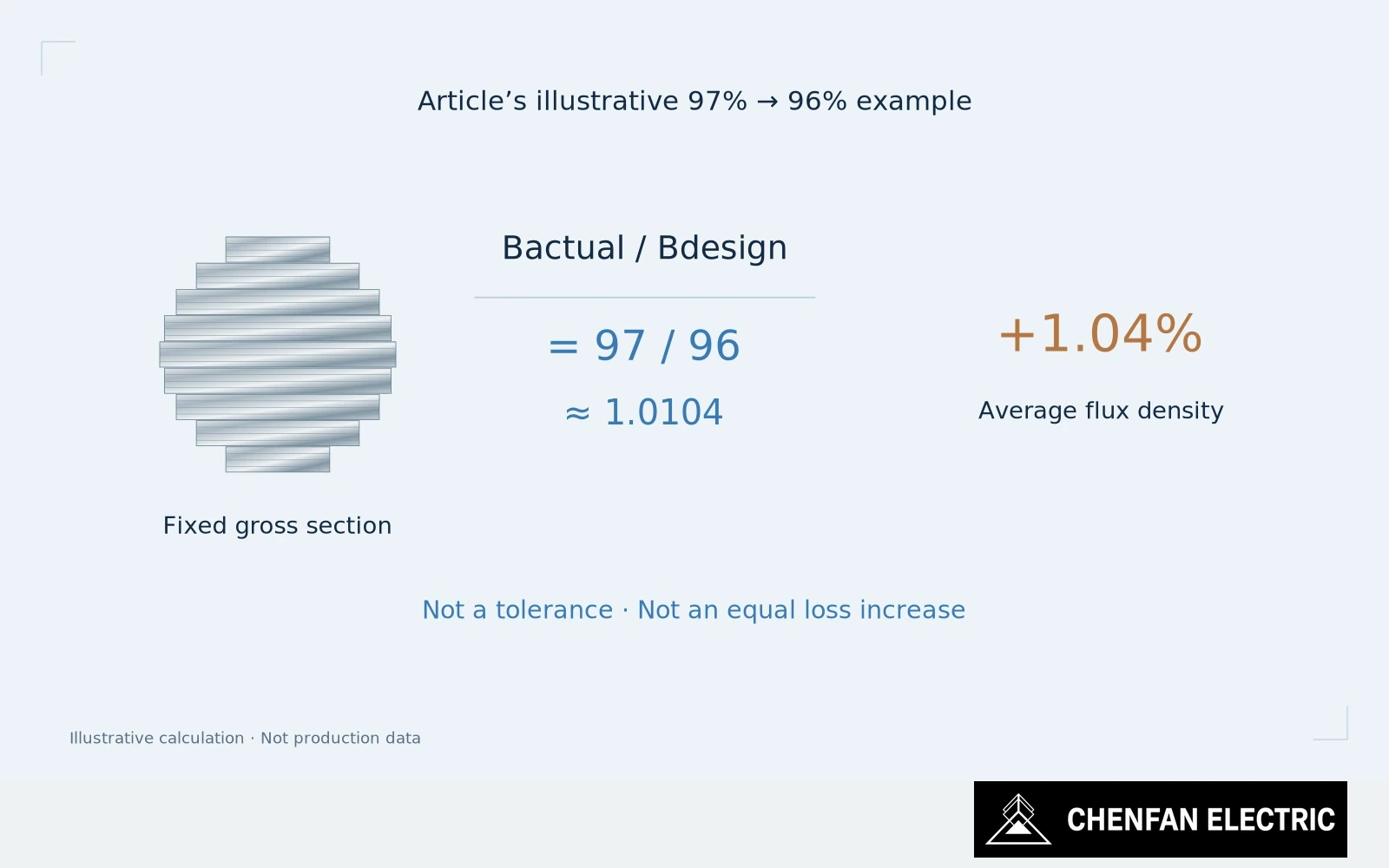
As an illustrative calculation, using 97% in the design when the corresponding actual value is 96% raises the calculated average flux density by a factor of 97/96, equivalent to an increase of about 1.04%, with all other quantities unchanged. This is a mathematical example, not a reported production result or an acceptable tolerance.
Use nonlinear material curves for loss and current
The loss and current consequences cannot be obtained by applying that same percentage. Their response depends on the material curves and the operating region. Near a steep part of the excitation characteristic, a modest area discrepancy can be more significant than the percentage alone suggests.
The measurement basis matters. A specimen stacking-factor test under a defined pressure is not automatically identical to a local value inferred from an assembled core‘s external thickness. Use the method and physical state that support the design calculation, and understand what each measurement includes.
Avoid a second common error: multiplying by stacking factor when the drawing already states net iron area. That double correction can distort both the predicted operating point and the apparent agreement between calculation and test.
Reconcile the measurement and drawing area conventions
If the assembled stack is thicker than expected, do not assume more iron has been supplied. The difference may concern seating, coating, sheet count or the measurement state. Reconcile the material content and dimensions before changing the magnetic model.
The procurement requirement should make the area convention explicit and identify how a departure will be evaluated. Demanding a high percentage without defining its basis leaves the designer with an impressive number and an uncertain denominator.
Treat stacking factor as an input to a controlled area calculation. Its engineering value is the operating point it helps establish, not the percentage printed beside the core photograph.
Practical takeaway
A small stacking-factor error shifts the magnetic operating point before loss is calculated.
Chenfan Electric manufactures custom transformer cores according to customer drawings. Where applicable to the specified material and core design, agreed process controls include burr height below 0.02 mm and stacking factor above 97%. Measurement methods and acceptance conditions are defined for each order.