

After one line pole opens, an arc on the disconnected phase can continue receiving energy from healthy phases. Capacitive and inductive coupling both contribute. Reactor compensation changes those paths, so the line model must be defined before a compensation value is selected. [1]
Include line length, conductor geometry, transposition, connected ends and the actual open-pole state. Mark shunt and neutral reactors at each end. A model of an isolated phase without coupling removes the source of secondary-arc feeding.
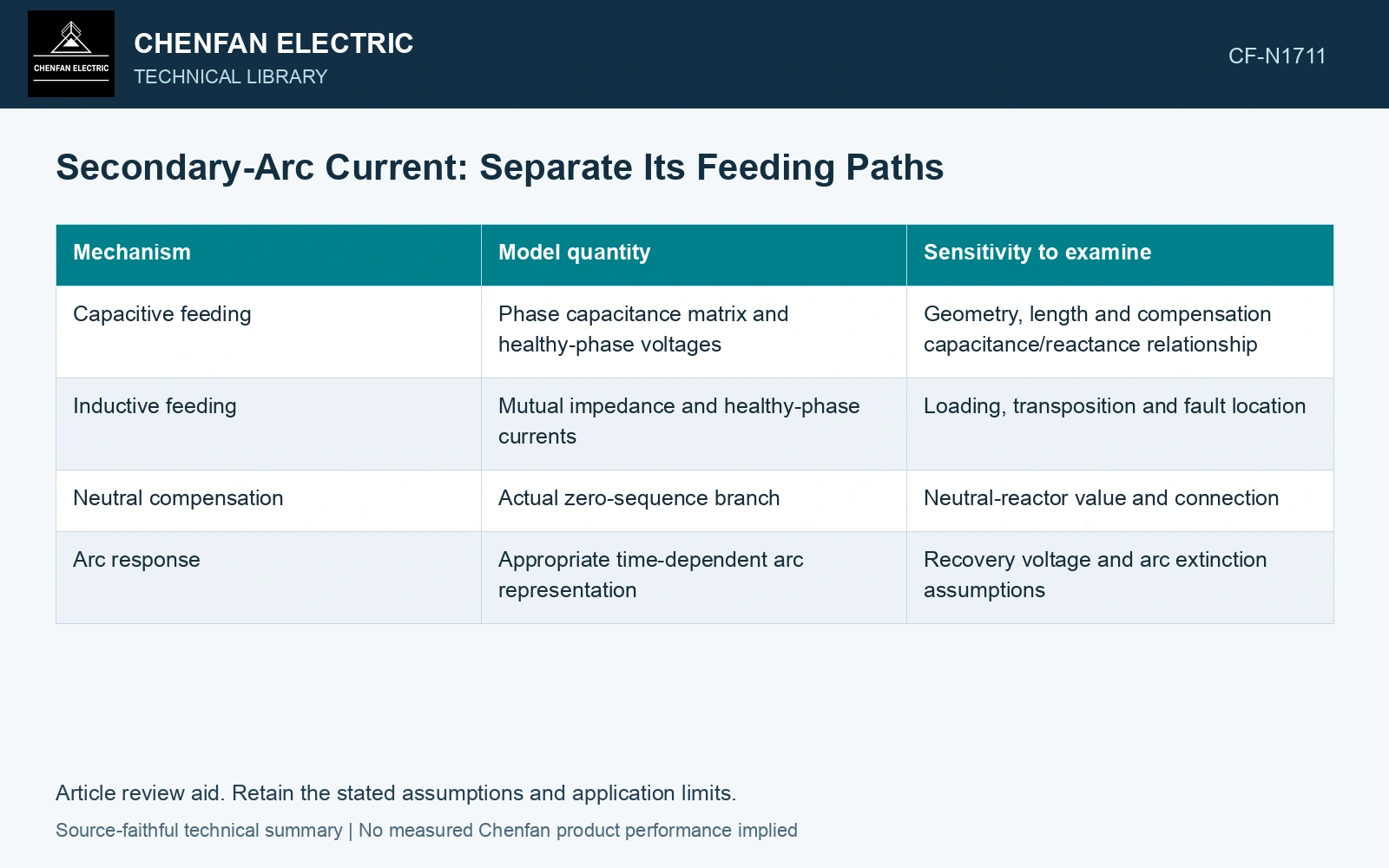
Keep the feeding mechanisms distinguishable
| Mechanism | Model quantity | Sensitivity to examine |
|---|---|---|
| Capacitive feeding | Phase capacitance matrix and healthy-phase voltages | Geometry, length and compensation capacitance/reactance relationship |
| Inductive feeding | Mutual impedance and healthy-phase currents | Loading, transposition and fault location |
| Neutral compensation | Actual zero-sequence branch | Neutral-reactor value and connection |
| Arc response | Appropriate time-dependent arc representation | Recovery voltage and arc extinction assumptions |
Separate current cancellation from extinction
A low calculated feeding current is favorable evidence but does not by itself prove reliable arc extinction. Recovery voltage, arc dynamics and the required dead time matter. The compensation study should report the quantities it calculates and retain its arc-model limitations.
Compare cases with varying line loading, fault location and reactor tolerances. Use the same connection and base when interpreting the sensitivity. A compensation point that minimizes one idealized current can be fragile if a small parameter change increases another stress.
For a sinusoidal screen, combine feeding terms as phasors on one frequency and reference; a magnitude-only sum discards their relative phase. [2]
Separate two secondary-arc feeding terms
Assume 50 Hz capacitive and inductive feeding terms of 20 A and 10 A RMS. Their phasor sum ranges from 10 A to 30 A as relative angle changes. Keep phase and the actual network; neither endpoint proves extinction in a time-dependent arc model. [2]
References
- X. Zhang et al., Compensation scheme for secondary arc current on four-circuit parallel transmission lines, IET Generation, Transmission & Distribution 10, 2079–2086, 2016. DOI: 10.1049/iet-gtd.2015.1102.
- U.S. Department of Energy, DOE-HDBK-1011/3-92, Electrical Science, Volume 3, June 1992.