

Detailed shell-form coil and joint geometry can be commercially sensitive. Protecting it does not require reducing a design review to statements such as “the field is acceptable” or “the cooling is proven.” A reviewer can assess carefully defined results without every dimension being public.
Decide what conclusion the evidence must support. A concept comparison, a local design assessment and a final qualification require different levels of access. Do not promise that one anonymized chart can satisfy them all.
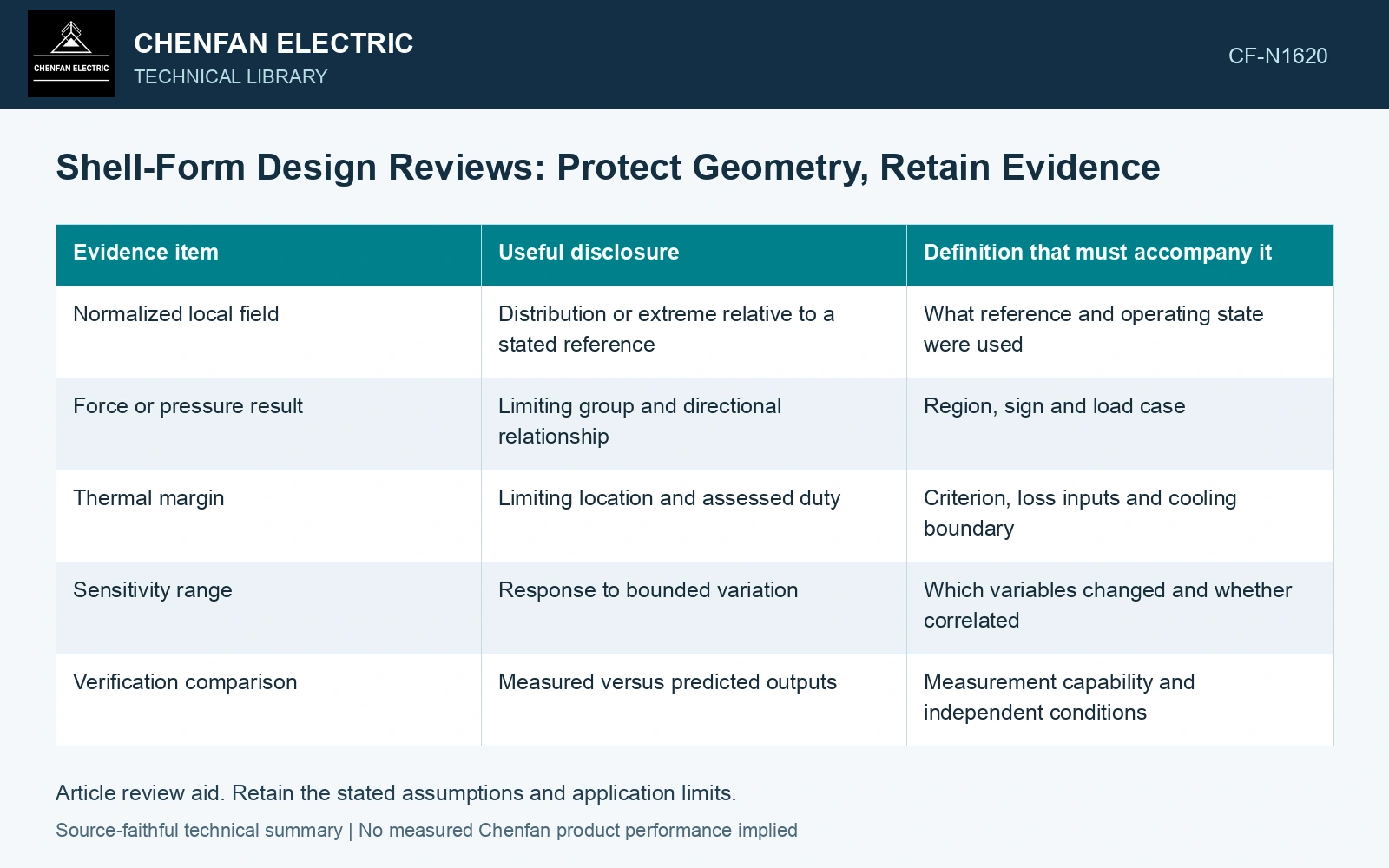
Define the reported quantities
| Evidence item | Useful disclosure | Definition that must accompany it |
|---|---|---|
| Normalized local field | Distribution or extreme relative to a stated reference | What reference and operating state were used |
| Force or pressure result | Limiting group and directional relationship | Region, sign and load case |
| Thermal margin | Limiting location and assessed duty | Criterion, loss inputs and cooling boundary |
| Sensitivity range | Response to bounded variation | Which variables changed and whether correlated |
| Verification comparison | Measured versus predicted outputs | Measurement capability and independent conditions |
A normalized value q/qref is interpretable only when qref is defined. If the reference is itself a confidential design quantity, explain enough of its meaning for the reviewer to understand the ratio. Avoid normalizing every curve to its own maximum when the purpose is to compare absolute severity.
Preserve location and method
Use schematic region identifiers or relative coordinates to show where the limiting result occurs. A global maximum without interface identity can conceal whether the relevant criterion was applied to steel, insulation or liquid.
Describe model dimensionality, material behavior, boundary conditions and numerical checks at a level suited to the review. Sharing a contour while withholding every modeling assumption prevents a meaningful assessment, even if the geometry remains confidential.
Separate predicted results from measurements. Identify which tests calibrate the analysis and which independently challenge it. A single fitted curve should not be presented as a broad qualification. Record rated quantities and test conditions on the general power-transformer basis of IEC 60076-1 [1].
Agree on access for unresolved questions
If a decision depends on a buried clearance or proprietary connection, a normalized summary may be insufficient. Use an agreed confidential review route, a controlled detailed report or independent verification where appropriate. State the remaining limitation rather than hiding it behind confidentiality language.
Respect actual ownership and disclosure agreements. Publicly accessible manufacturer examples do not confer permission to reproduce a proprietary design or imply a licensing relationship. The evidence package should make no such claim.
The shared review should identify the duty, limiting region, method and strength of the verification evidence. State which details the recipient cannot check from the protected material so that the acceptance decision reflects the evidence actually available.
Keep one common reference in a protected comparison
Assume two confidential designs are evaluated at the same 50 Hz load case. Their local RMS field results are 0.12 T and 0.15 T at the named clamp interface. With one declared 0.10 T reference, normalized results are 1.20 and 1.50; the second field is 25% larger. Normalizing each design to its own maximum would report 1.00 for both and erase that distinction. Disclose the common reference, location and uncertainty model [2] while retaining controlled access to dimensions. Accept the protected comparison only if the supplied quantities still permit the intended engineering decision. Assess the relevant measured quantities with a defined measurement model and propagated uncertainty [2].
References
- IEC, IEC 60076-1:2011, Power transformers – Part 1: General.
- JCGM, JCGM 100:2008, Evaluation of measurement data — Guide to the expression of uncertainty in measurement, 2008.