

Keep every lamination. Change the assembly. The wattmeter may still move.
Restacking is not an electrically neutral reset, even when no material is replaced.
Separate repair from an assembly investigation
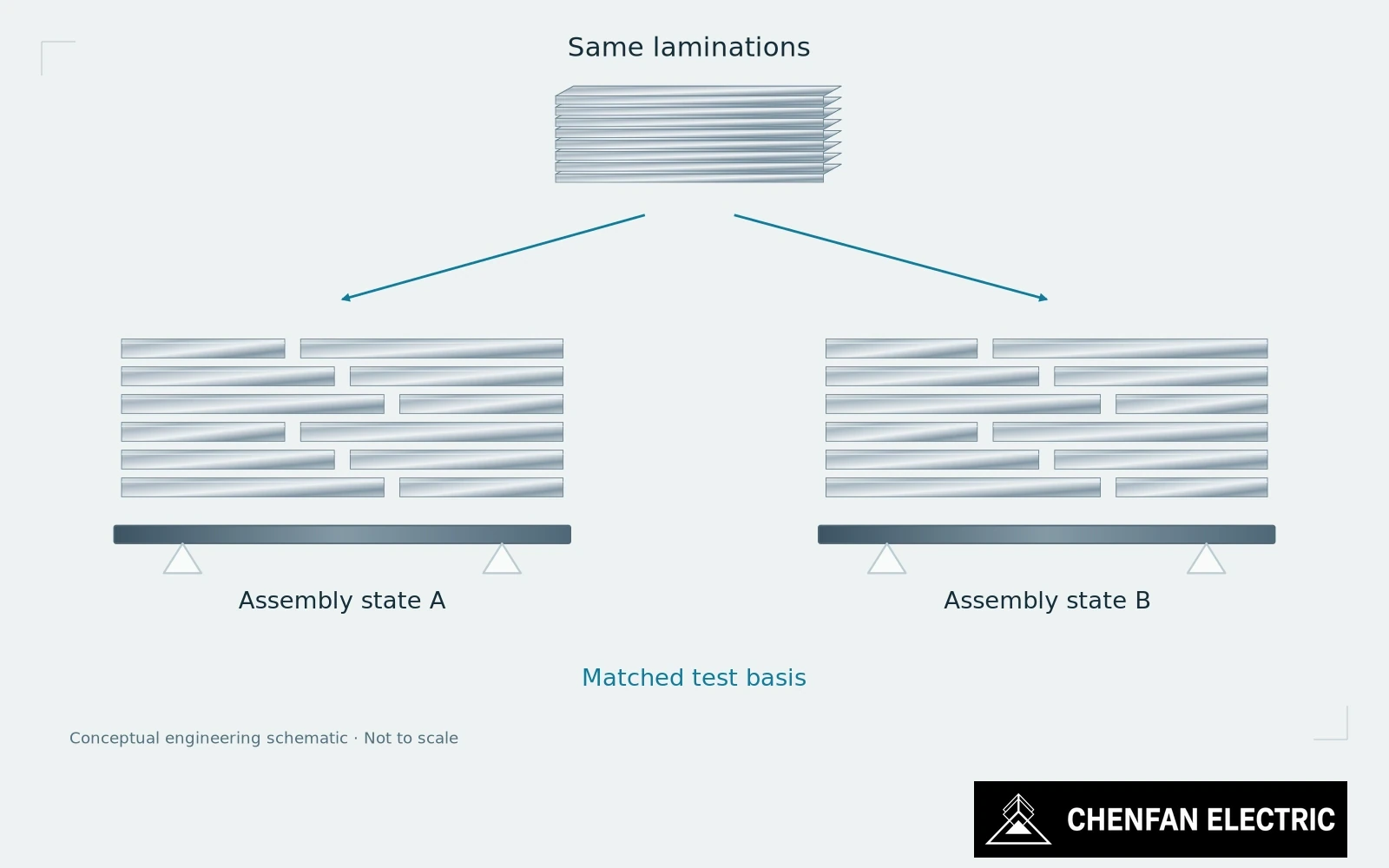
The rebuilt core may have a different distribution of joint gaps, overlap positions and packet seating. Small changes spread through the stack can alter local flux transfer. The same overall dimensions do not prove that each magnetic interface has returned to its previous state.
Mechanical history changes as well. Releasing restraints, separating sheets and applying the final clamping arrangement creates a new stress condition. Some effects may be reversible; damage or plastic deformation introduced during handling may not be. A lower reading is possible, but improvement is not guaranteed.
That makes a restacking trial useful only when its purpose is explicit.
Compare electrical results under equivalent conditions
For a production repair, the objective is to restore the approved configuration and verify the rebuilt core. For an investigation, the objective may be to test a particular assembly hypothesis. Mixing these objectives can produce an acceptable core without a defensible explanation of the original result.
Before opening the stack, preserve packet identity, sequence information and the measurable original condition. After rebuilding, record what was deliberately changed and what could not be held constant. A statement that “only restacking changed” often hides several uncontrolled variables.
Compare measurements under equivalent excitation, frequency, waveform, winding arrangement and support conditions. Check that the observed difference exceeds the repeatability of the measurement. Where the result is close, repeating the test without another mechanical intervention helps establish whether the apparent improvement is stable.
Do not use one successful rebuild to set a universal restacking allowance. A design with different joints, sheet widths or restraint behaviour may respond differently. Likewise, one unsuccessful rebuild does not prove the material was defective.
Record every attempt and define the accepted build
The most useful outcome is a reproducible assembly condition: a defined sequence and seating method that produces the expected response without relying on repeated attempts to obtain a favourable number.
If repeated disassembly and reassembly is needed before a core passes, retain every result. The spread is information about the assembly and test system, not paperwork to be discarded once a passing value appears.
A rebuild should leave the factory with a clearer definition of the accepted state, not merely a newer date on the test report.
Practical takeaway
Unchanged steel does not make a rebuilt magnetic circuit equivalent to its earlier assembly.
Chenfan Electric manufactures custom transformer cores according to customer drawings. Where applicable to the specified material and core design, agreed process controls include burr height below 0.02 mm and stacking factor above 97%. Measurement methods and acceptance conditions are defined for each order.