

Identify the force that makes GOES sheets rise together before choosing a separation method. Static charge, liquid films, pressure effects and mechanical interlocking call for different handling corrections.
Check charge on the actual coated surface
NASA’s ESD handbook distinguishes grounding conductive/dissipative materials from air ionization for insulative surfaces [1]. Its electronics context does not establish GOES adhesion. A conductive substrate with coating or isolated support needs its actual discharge path identified.
Record contact/separation history, support material, environment and electrical continuity. Measure charge/field for the actual geometry at separation; a later transported-state reading may miss the initial condition.
Run mechanism-specific comparisons
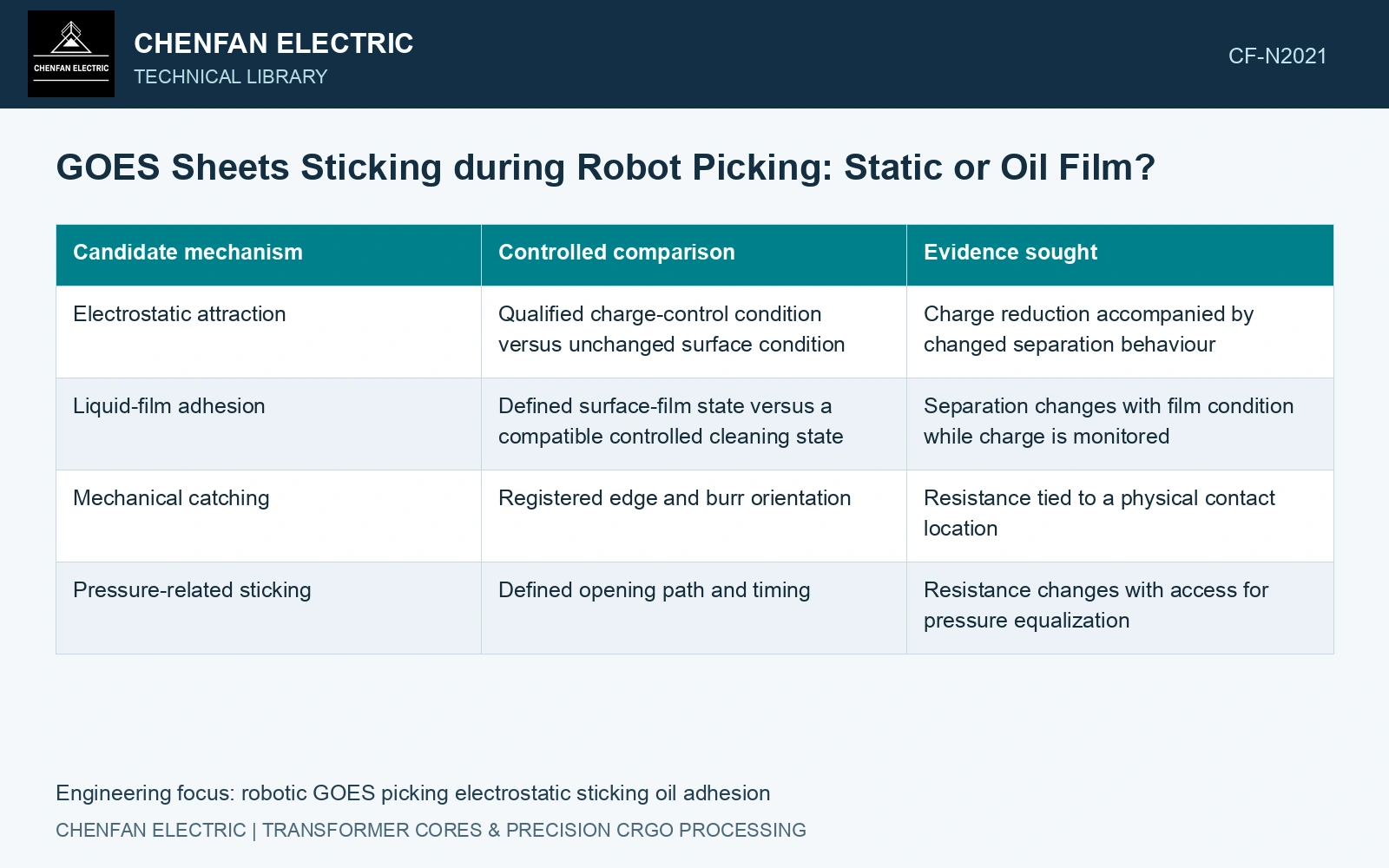
| Candidate mechanism | Controlled comparison | Evidence sought |
|---|---|---|
| Electrostatic attraction | Qualified charge-control condition versus unchanged surface condition | Charge reduction accompanied by changed separation behaviour |
| Liquid-film adhesion | Defined surface-film state versus a compatible controlled cleaning state | Separation changes with film condition while charge is monitored |
| Mechanical catching | Registered edge and burr orientation | Resistance tied to a physical contact location |
| Pressure-related sticking | Defined opening path and timing | Resistance changes with access for pressure equalization |
Keep gripper contact area, dwell and motion constant for each comparison. If an ionizer introduces an air jet, the jet may mechanically separate the sheets. Use a suitable airflow control before attributing the improvement to charge neutralization. Likewise, cleaning can change friction and charge generation as well as remove liquid.
Measure the separation force and transfer result
Retain the separation force or tool response, time to establish a gap, and whether a follower sheet remains attached. Record the sample position and repeat the comparison across representative coating and handling conditions. An occasional successful pick after an intervention is weak evidence when the original failure is intermittent.
Humidity can affect charge retention, but changing humidity also changes the storage environment. It is not a universal remedy for GOES sticking and should not be prescribed from a general electrostatic explanation.
Catalogue gauge 0.23 mm and density 7,650 kg/m³ give 0.3519 kg for an assumed 1.0 × 0.20 m sheet [2]; a double pick is 0.7038 kg. Assume paired separation-force differences have expanded uncertainty ±0.20 N: a 2.0→1.9 N ionization comparison changes force by 0.10 N, unresolved; an independently controlled film change gives 2.0→0.7 N, or 1.30 N, clearly larger than that assumed uncertainty. Investigate film/contact first without claiming no charge exists. Keep airflow, pick motion and double-sheet rejection controlled so the mechanisms remain distinguishable.
Surface oil amount, pad condition, contact time, peel trajectory and stack compression control separation. Establish which mechanism changes before setting the production remedy and retain physical double-pick rejection.
Qualify the supported separation method on single-sheet transfer, permanent deformation and coating condition. Retain double-sheet detection as the independent check on the transferred state.
References
- NASA, NASA-HDBK-8739.21, Workmanship Manual for Electrostatic Discharge Control (Excluding Electrically Initiated Explosive Devices), 2010, section 5.2.5.
- Nippon Steel Corporation, Grain-Oriented Electrical Steel Sheets, catalogue D004je, April 2020, specification and typical-property tables.