

Different X/R ratios can produce different real/reactive current sharing even when percent impedance magnitudes are close. In steady load flow, impedance angle influences how active and reactive components split; under faults, it also changes asymmetry. Parallel studies should therefore retain complex impedance, not just a single percent-Z magnitude, especially where reactive sharing or protection sensitivity matters.
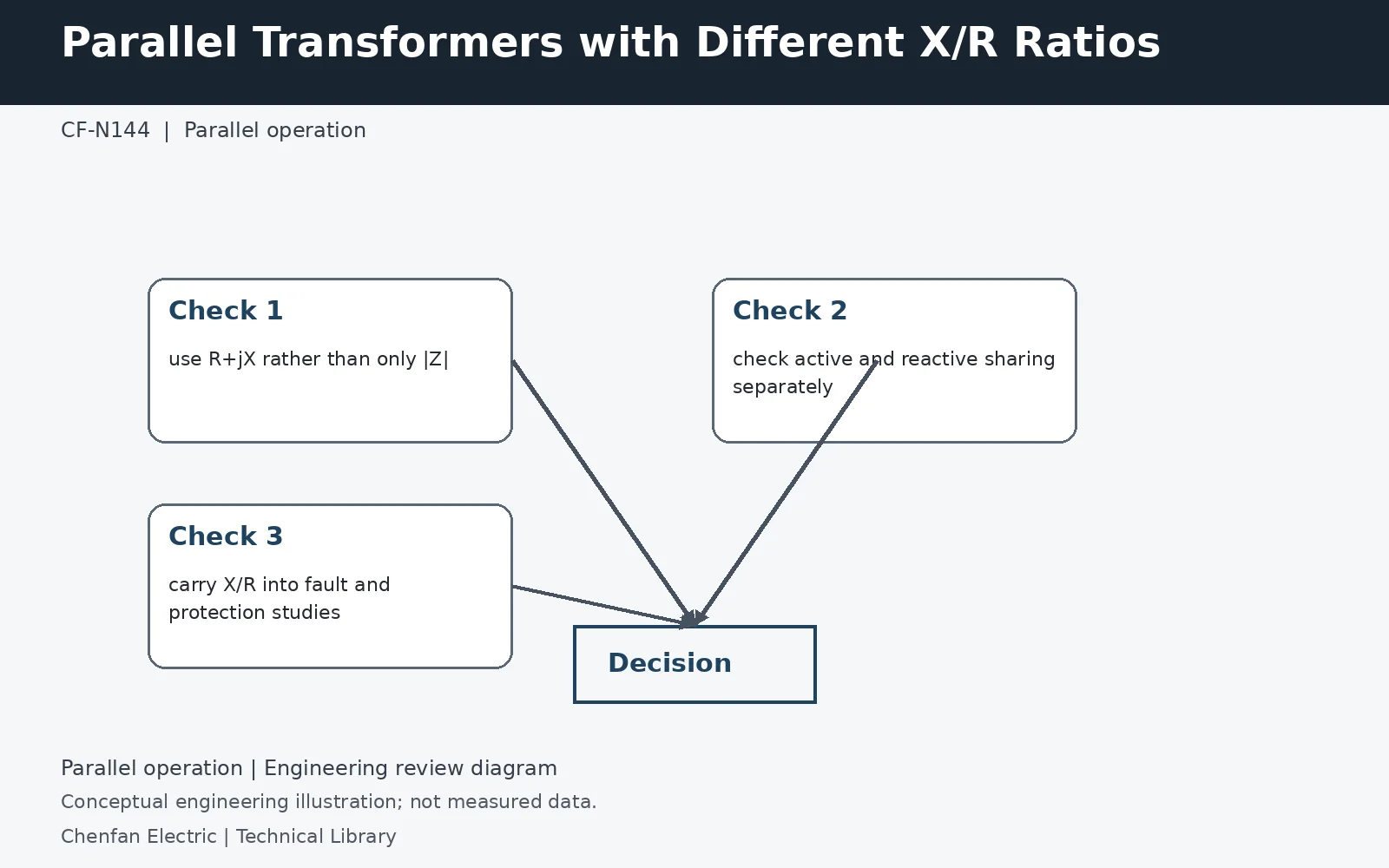
Impedance magnitude hides the sharing angle
Write each branch as Z = R + jX. For identical internal voltages, branch 1 carries I1 = Iload × Z2/(Z1 + Z2), and branch 2 carries the complementary current. If the impedance angles differ, these ratios are complex. Even equal magnitudes of Z1 and Z2 do not make each current phasor exactly one-half of the load current. The current magnitudes may match while the branches operate at different power factors.
Report kW and kvar beside amperes
For the common bus voltage, calculate each transformer's complex power from its own current phasor. This exposes a branch that contributes disproportionate reactive power even when its apparent-power loading looks acceptable. Review the resulting copper-loss and regulation consequences, particularly if the tap controller responds to reactive current. An aggregate bank power factor can conceal opposing or unequal reactive contributions, so it should not replace the individual transformer results in the acceptance report.
Use a separate fault-duty assessment
Steady-state sharing and fault-current asymmetry use related impedance data but answer different questions. The DC offset and decay of fault current depend on the relevant network X/R, not just on the transformer branch value. A load-flow result therefore cannot confirm breaker peak-making duty or CT transient performance. Retain the source and connection resistances in the short-circuit model and document any simplified assumptions used to move between the load-sharing and protection studies.
Technical reference framework
[1] IEC 60076-8:1997 — Application guide.
[2] Schneider Electric — Substation including generators and parallel operation of transformers.