

Onboard and trackside transformers should not share a specification merely because both serve railways. Onboard equipment operates within a vehicle’s mechanical and spatial environment, while trackside equipment belongs to a fixed installation with different supports and site conditions. Select the application framework and mechanical evidence according to the actual location and electrical function.
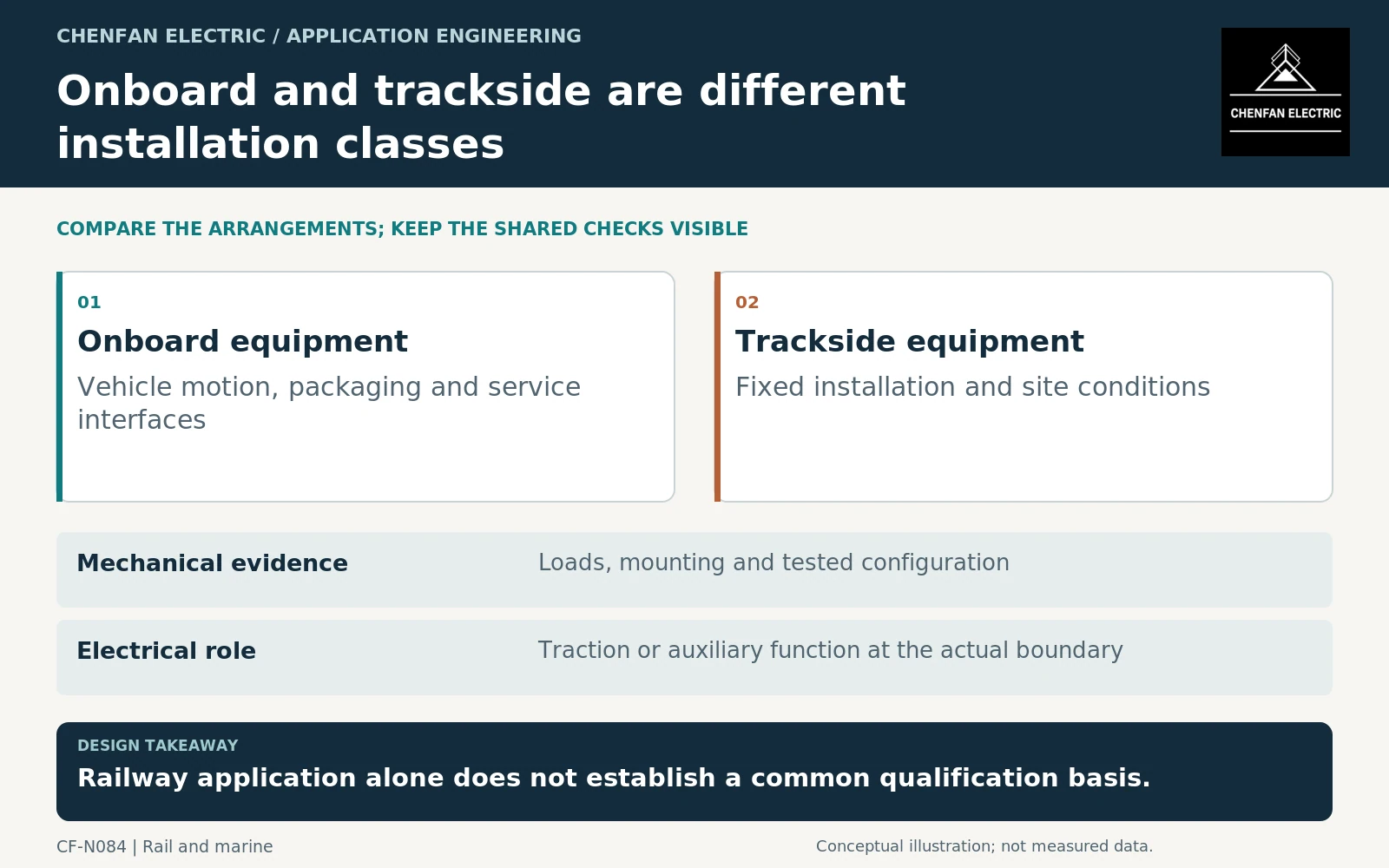
Use the correct application boundary
IEC 60310:2026 addresses transformers and inductors on board rolling stock, including traction and auxiliary applications within its scope. Tests of associated accessories, such as cooling equipment and tap-changing mechanisms, are outside that standard’s stated test scope. IEC 62695 addresses transformers for fixed railway installations. The current editions and contractual requirements should be checked rather than copying an older onboard reference into a new enquiry. [1] [2]
The distinction is functional as well as physical. A trackside auxiliary transformer and an onboard traction transformer can differ in voltage, waveform, duty cycle and connection requirements. Their common railway setting does not make their test evidence interchangeable.
State the equipment role on the single-line diagram and identify the installation location before listing standards. A long standards list is not useful when its scopes conflict with the actual assembly.
Describe the mechanical environment and mounting
For onboard equipment, obtain the vehicle designer’s relevant motion, shock and vibration requirements, mounting conditions and mass constraints. For fixed equipment, obtain the site support, transport and environmental conditions appropriate to its location.
IEC 61373:2026 addresses railway equipment shock and vibration within its scope. A reference to it should identify the applicable category and configuration through the responsible design, not serve as an undefined railway-resistant label. Its stated scope does not evaluate the anchoring bolts at fixing points or specify transport and handling tests; those responsibilities must be assigned separately. [3]
A test result should state the assembly and mounting represented, axes or load description, duration and required outcomes. A component-level test does not automatically qualify the complete transformer, and a different support arrangement may affect applicability.
Keep transit loads separate from in-service vehicle loads. A transformer transported to a fixed substation still experiences shipping exposure, but that does not turn its operating duty into an onboard duty.
Coordinate space, cooling and connections
The installed package should reserve service and removal access as well as body dimensions. Onboard constraints can involve vehicle openings, adjacent systems and permissible masses; fixed installations can have their own enclosure and site-access restrictions.
Cooling requirements should specify actual inlet conditions and available services. A vehicle cooling circuit and an outdoor radiator arrangement are different interfaces, even if the electrical rating is similar.
General transformer requirements provide a broader equipment framework, but specialized railway application requirements and actual service conditions must be selected deliberately. [4]
The connection schedule should also reflect movement and support assumptions. This article does not prescribe flexible connection geometry or mechanical design loads; those require the approved vehicle or site design.
Accept evidence for the purchased configuration
The enquiry should contain the electrical duty, installation class, mechanical input schedule, cooling boundary and access arrangement. Require the supplier to identify the evidence that applies to the exact configuration offered.
Acceptance should compare the delivered assembly with the configuration represented by qualification and test records. Accessory relocation, support changes or a different cooling arrangement may require review even when the main rating is unchanged.
The useful purchasing distinction is precise: onboard equipment is assessed for its vehicle installation, and trackside equipment for its fixed-site installation. “Railway transformer” is a category description, not a complete mechanical or electrical specification.
Core procurement checkpoint: Keep onboard and trackside evidence separate
An onboard core enquiry should identify the approved vehicle-equipment configuration and the actual core, clamps and supports included in supply. Do not reuse trackside manufacturing documents as evidence of onboard mechanical qualification. Core traceability supports the equipment manufacturer’s records, but vehicle shock, vibration, mounting and transport requirements need their own applicable scope and approval for the complete relevant assembly.
For the core enquiry: Onboard/trackside designation; core/clamp drawings; component boundary; mass/envelope requirements; qualification and transport responsibilities.