

An earth fault conducts briefly, disappears and returns. The event log may count several faults, while the NGR experiences one irregular heat-input sequence. Counting events does not quantify that duty: their power, duration and spacing determine the thermal consequence. [1]
Preserve the power history across the entire period, including the gaps. The assessment should distinguish irregular electrical conduction from the separate question of how heat moves through the assembly.
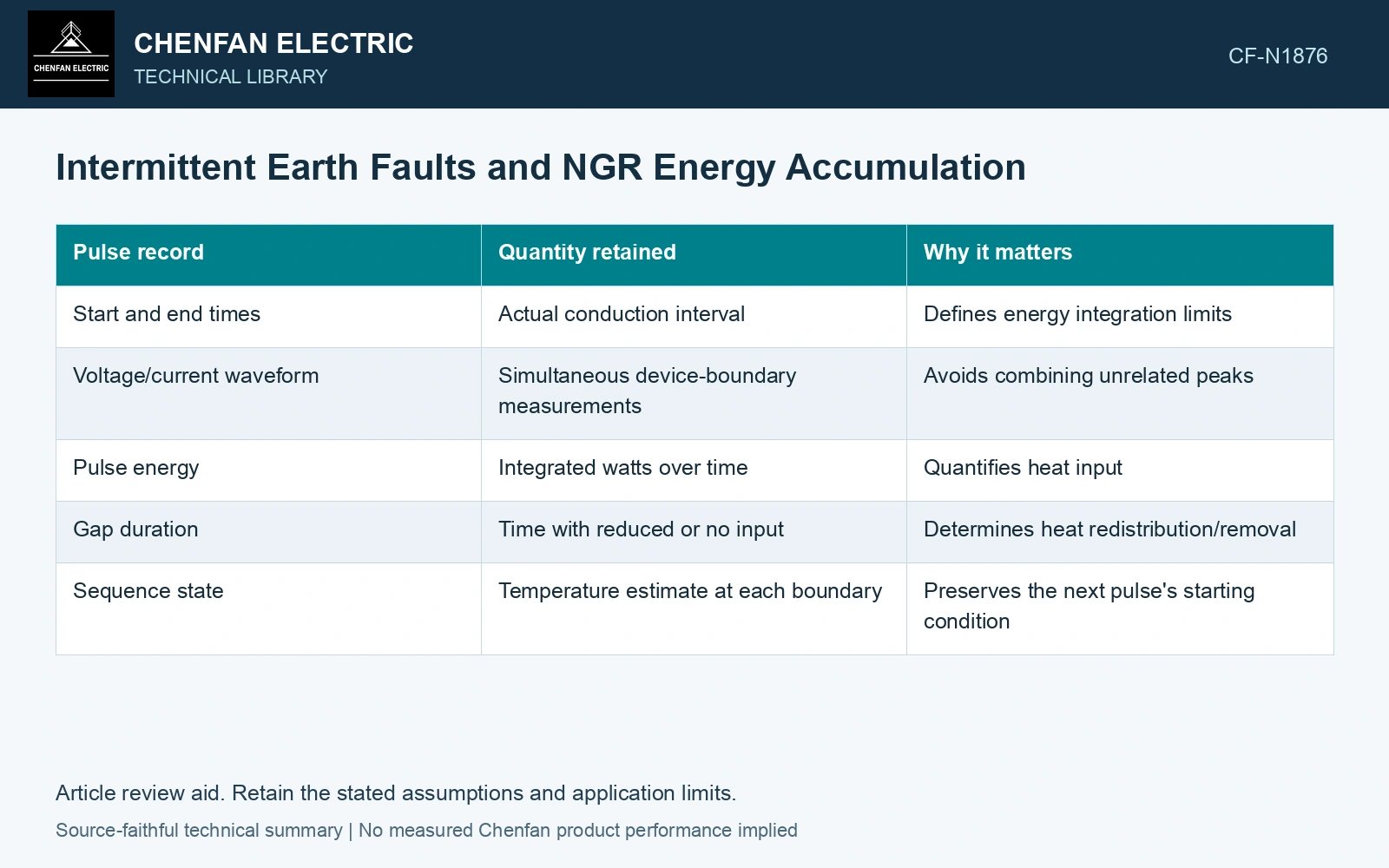
Build an energy ledger for the pulses
For each interval, absorbed electrical energy is Wi = integral of u(t)i(t) dt. Wi is in joules when voltage is in volts, current in amperes and time in seconds, with a consistent polarity convention. For a resistive element this represents electrical heating; the actual resistance and current can change with temperature.
| Pulse record | Quantity retained | Why it matters |
|---|---|---|
| Start and end times | Actual conduction interval | Defines energy integration limits |
| Voltage/current waveform | Simultaneous device-boundary measurements | Avoids combining unrelated peaks |
| Pulse energy | Integrated watts over time | Quantifies heat input |
| Gap duration | Time with reduced or no input | Determines heat redistribution/removal |
| Sequence state | Temperature estimate at each boundary | Preserves the next pulse’s starting condition |
Include the location of voltage and current measurements. A system voltage and a current in another branch do not automatically produce the NGR’s power.
Do not replace a sequence with average power too early
Average power over an interval is total energy divided by interval duration. It is useful for a long-term heat balance under suitable conditions. It may conceal a local peak temperature if energy arrives in concentrated pulses and the assembly has several thermal response times.
Two sequences can have equal total energy and different maximum temperature. One may allow cooling between pulses; the other may concentrate them before the support or element can recover. Keep the timeline until the thermal model establishes whether averaging is justified.
Distinguish irregular faults from regular repeat duty
A repeat qualification with fixed current, duration and interval covers its stated sequence. An intermittent fault with changing pulse widths and unequal gaps needs comparison against that evidence or another justified model. The number of pulses alone cannot establish equivalence.
Monitoring records can reveal the sequence but may lack sufficient waveform resolution for the energy calculation. State that limit rather than assigning each alarm a nominal energy. A missing short pulse can matter if the sampling method never observed it.
Keep thermal storage and cooling in the pulse calculation. For the following lumped-node example, use Cth dθ/dt = P(t) − θ/Rth, where θ is rise over a fixed cooling reference. Heat-transfer resistance and energy balance define this model. [2]
Build a pulse energy ledger
Assumptions: a 100 Ω element has pulses of 5 A for 0.4 s, 4 A for 0.6 s and 5 A for 0.2 s; R is held constant. Their energies are 1,000 J, 960 J and 500 J, totalling 2,460 J. Use a 40 °C initial/cooling reference, Cth = 100 J/K and Rth = 0.10 K/W, giving a 10 s time constant. During each constant-power pulse, θout = θin exp(−t/10) + PRth[1 − exp(−t/10)]; during a gap only the exponential cooling term remains. Contiguous pulses peak at 63.13 °C. With 10 s zero-input gaps between the same pulses, the peak is 52.71 °C. Against an assumed 55 °C gate, the clustered sequence fails while the spaced sequence passes this model. Keep actual pulse timing and local support/element thermal parameters before accepting that spacing in service.
References
- IEEE, IEEE C57.32-2015, IEEE Standard for Requirements, Terminology, and Test Procedures for Neutral Grounding Devices (historical edition).
- U.S. Department of Energy, DOE-HDBK-1012/2-92, Thermodynamics, Heat Transfer, and Fluid Flow, Volume 2, 1992.