

Storage between deployments must preserve a mobile transformer’s configuration as well as its condition. Track detached coolers, capped cable interfaces, disconnected batteries and stored reconnection hardware, with each item’s identity and preservation state recorded for dispatch. [1]
Calculation basis. Project-specific values and gates in the illustrative screens below are assumptions; cited catalogue values retain their source test conditions.
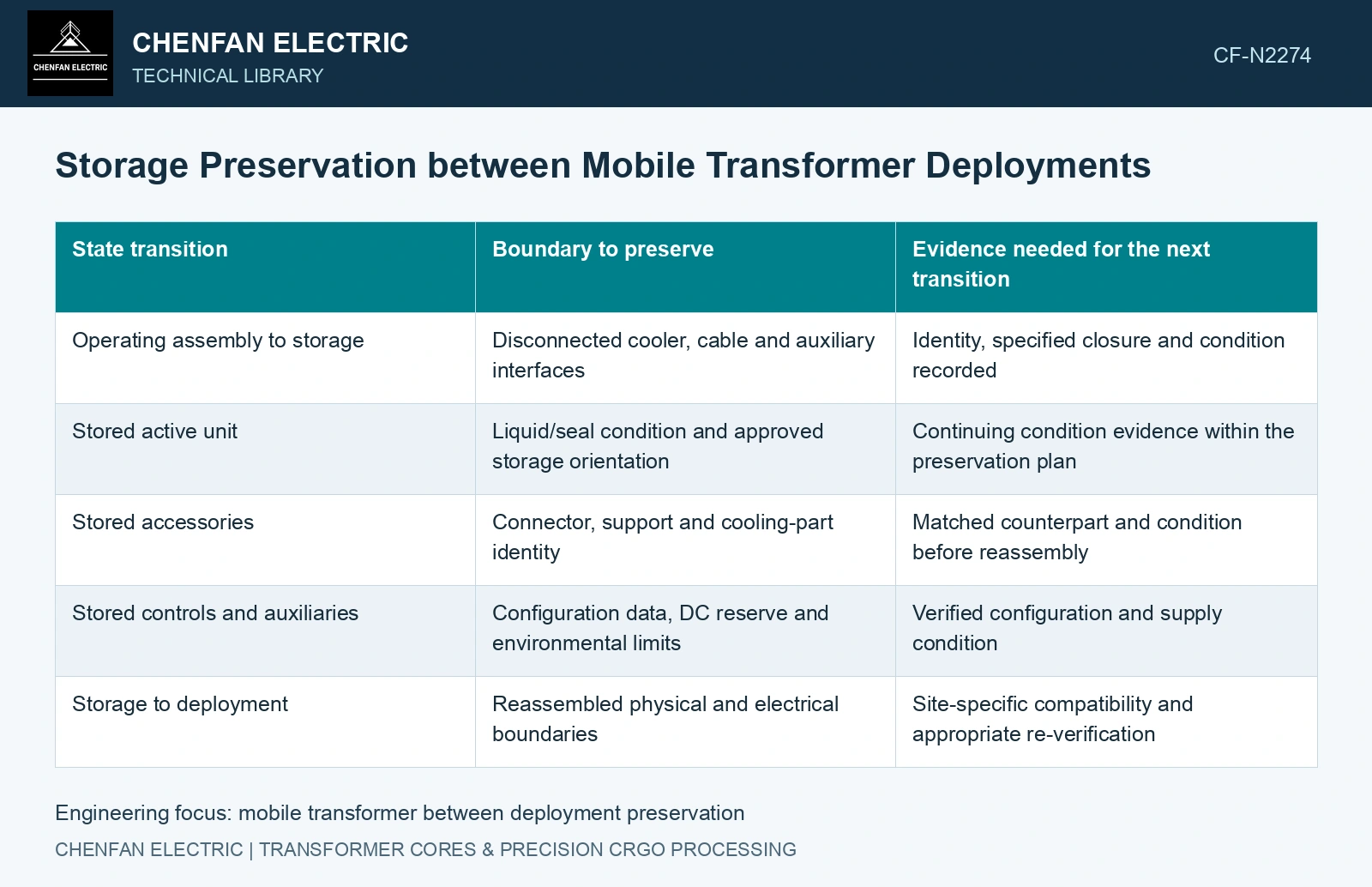
Record the transition into storage
List which interfaces were opened or separated and what the approved preservation arrangement requires for each. Track liquid inventory and sealed volumes where disconnection changes them. Identify the storage state of accessories and controls so that the next deployment does not inherit a service-readiness assumption from the previous site.
| State transition | Boundary to preserve | Evidence needed for the next transition |
|---|---|---|
| Operating assembly to storage | Disconnected cooler, cable and auxiliary interfaces | Identity, specified closure and condition recorded |
| Stored active unit | Liquid/seal condition and approved storage orientation | Continuing condition evidence within the preservation plan |
| Stored accessories | Connector, support and cooling-part identity | Matched counterpart and condition before reassembly |
| Stored controls and auxiliaries | Configuration data, DC reserve and environmental limits | Verified configuration and supply condition |
| Storage to deployment | Reassembled physical and electrical boundaries | Site-specific compatibility and appropriate re-verification |
Distinguish enclosure preservation from interface preservation
An intact tank does not prove that a detached connector face or pipe closure retained its required condition. Conversely, a clean external cap does not prove the connected liquid volume remained within its specified preservation state. Use the actual boundary and approved evidence rather than a single storage checklist applied to every accessory.
For control hardware, preserve configuration identity and document any replacement, firmware or mapping change. A battery or auxiliary supply can deteriorate independently of the main transformer. Its readiness belongs in the redeployment assessment, not in a general statement that the transformer was stored indoors.
Make redeployment gaps visible before dispatch
Reconcile the stored inventory with the intended site configuration. Missing adapters, cooler pipes, protective covers or support components can prevent an otherwise healthy active unit from being deployed. Do not replace an unidentified part with one that merely fits mechanically.
Apply the equipment-specific preservation and reassembly procedures for liquids, sealed volumes, controls and accessories. Assign missing condition evidence to the affected interface and complete the corresponding assessment.
Recover a known assembly with traceable condition records before dispatch. A clear storage-to-deployment handover reduces the interface checks left to the installation crew.
Reconcile the storage package before releasing the unit
Keep the specified seal, liquid and cooling-system preservation state with the stored assembly [2].
Assume the approved deployment bill lists 24 separately tracked items: 20 present with current condition evidence, three present with expired evidence and one missing. Physical completeness is 23/24 = 95.8%; verified readiness is only 20/24 = 83.3%. Recover the missing item and close the three condition checks before dispatching the complete package.
References
- NASA, NASA Systems Engineering Handbook, section 6.5, Configuration Management, official online text.
- U.S. Bureau of Reclamation, FIST Volume 3-30, Transformer Maintenance, 2000.