

A transformer enclosure for a dusty mining site must provide the required protection without invalidating its cooling assumptions. Dust type, deposition, filters and maintenance conditions all matter. A higher ingress-protection label does not automatically mean a workable thermal design, and ordinary dust protection must not be confused with approval for an explosive atmosphere.
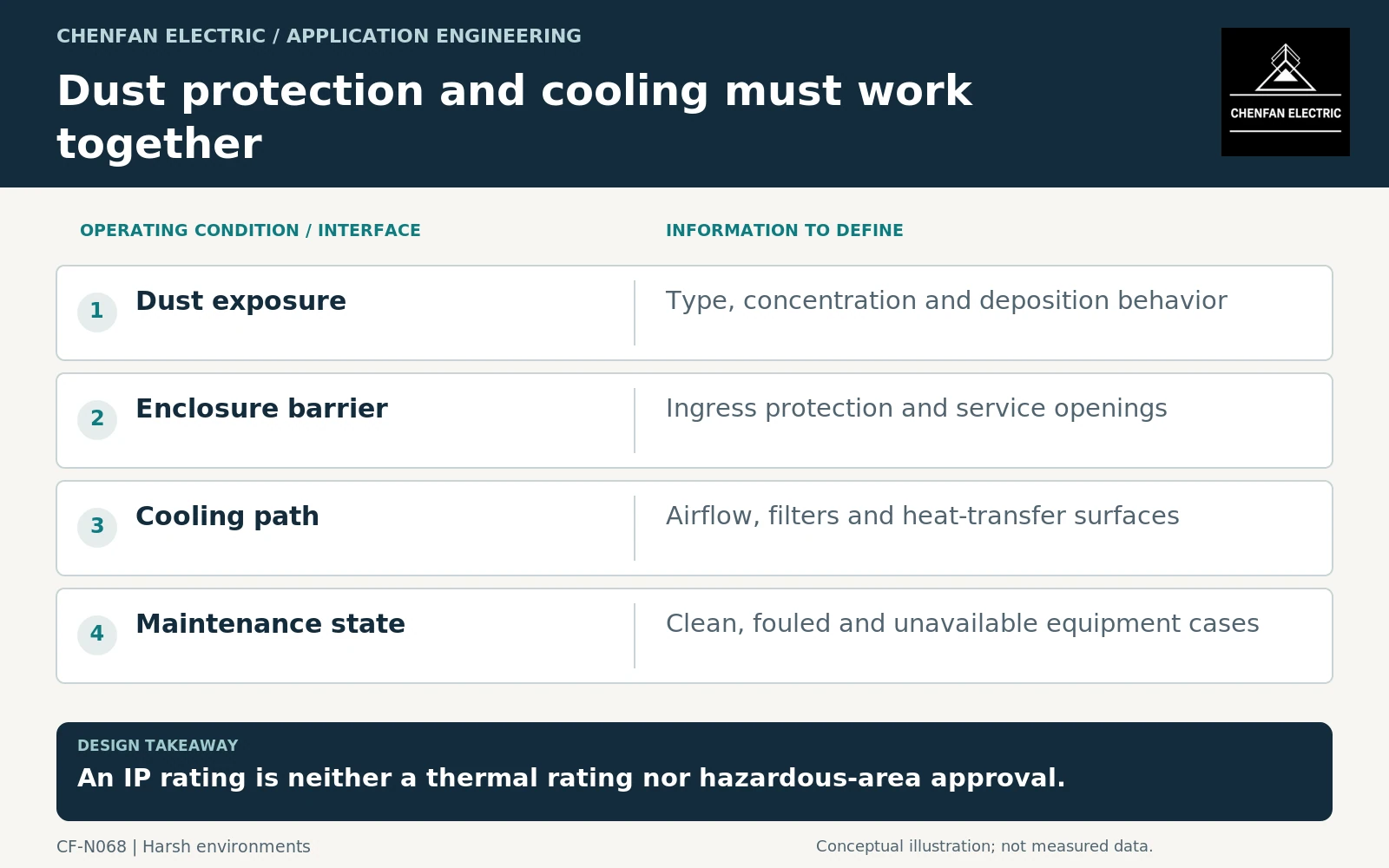
Characterize the dust and the installation
Describe whether exposure involves fine airborne material, conductive deposits, abrasive particles or another relevant condition. Identify the equipment location, nearby processes and expected cleaning access. A generic “mining duty” label does not provide enough information for material, enclosure or cooling selection.
IEC 60529 addresses enclosure ingress classifications. Its designation should be used for the protection boundary it describes, not as proof of complete environmental suitability. [1]
Where combustible dust or another hazardous atmosphere may exist, classification and equipment selection require a separate specialist assessment under the applicable project requirements. This article does not classify the area or authorize ordinary transformer equipment for it.
Evaluate the cooling path in more than its clean state
Filters, louvers, radiators and air passages can change condition during service. Define the maintenance basis and any agreed fouling or reduced-airflow case. A clean factory arrangement is not automatically representative of an enclosure operating after an undefined period of dust accumulation.
For dry-type equipment, enclosure and inlet-air conditions can be central to the thermal assessment. IEC 60076-11 addresses dry-type equipment within its scope, while its loading guide provides a separate framework for duty assessment. [2] [3]
For fan-assisted cooling, distinguish commanded operation from actual available airflow or equipment feedback. A running fan does not prove that a blocked path provides the assumed cooling. The cited IEC 60076-22-6 concerns fans used with liquid-immersed power transformers and reactors; it is not a blanket standard for dry-type ventilation or the site’s dust-maintenance system. [4]
A useful comparison considers three states: the approved clean condition, the agreed service condition before maintenance, and a detected cooling restriction requiring the specified response. The values and actions must come from the project and supplier, not a universal dust derating percentage.
Make maintenance part of the technical offer
The enclosure proposal should identify filter access, cleaning or replacement boundaries and the space needed to perform those tasks. A maintainable design should not require removing unrelated live equipment or blocking the only service route.
Ask the supplier to state which performance assumptions depend on maintenance and which indicators reveal that those assumptions may no longer hold. Keep inspection of external deposits separate from assessment of internal insulation or equipment condition.
The final acceptance record should reconcile enclosure protection, cooling performance, dust exposure and access. A late change to mesh, filters or louver arrangement can alter both protection and airflow and should be reviewed accordingly.
Compare offers on the complete installed condition. One enclosure may achieve a desired ingress classification by restricting airflow, while another uses a different cooling arrangement. Their transformer ratings are not equivalent unless the supplied cooling conditions and operating limitations are aligned.
The practical result is a dust-control and heat-rejection agreement that can be maintained at the site. It avoids the false choice between “sealed enough” and “cool enough” by requiring evidence that both objectives are met together, while keeping hazardous-area suitability as a separate, explicit question.
Core procurement checkpoint: Do not solve dust ingress by changing the core grade
Dust control and heat removal are coordinated at the completed-equipment level. The core drawing should preserve the manufacturer’s required assembly and ventilation clearances, and the order should state its receiving and storage conditions. A CRGO grade or an accessory certificate does not establish airflow through a dusty enclosure. Avoid extending liquid-immersed transformer fan references to a dry-type package without an applicable basis.
For the core enquiry: Approved construction type; core/window geometry; ventilation keep-clear zones; packing conditions; owner of enclosure and cooling acceptance.