

A low-voltage diagnostic result should not be presented as a rated-excitation core-loss result.
Both can be useful. They answer different questions.
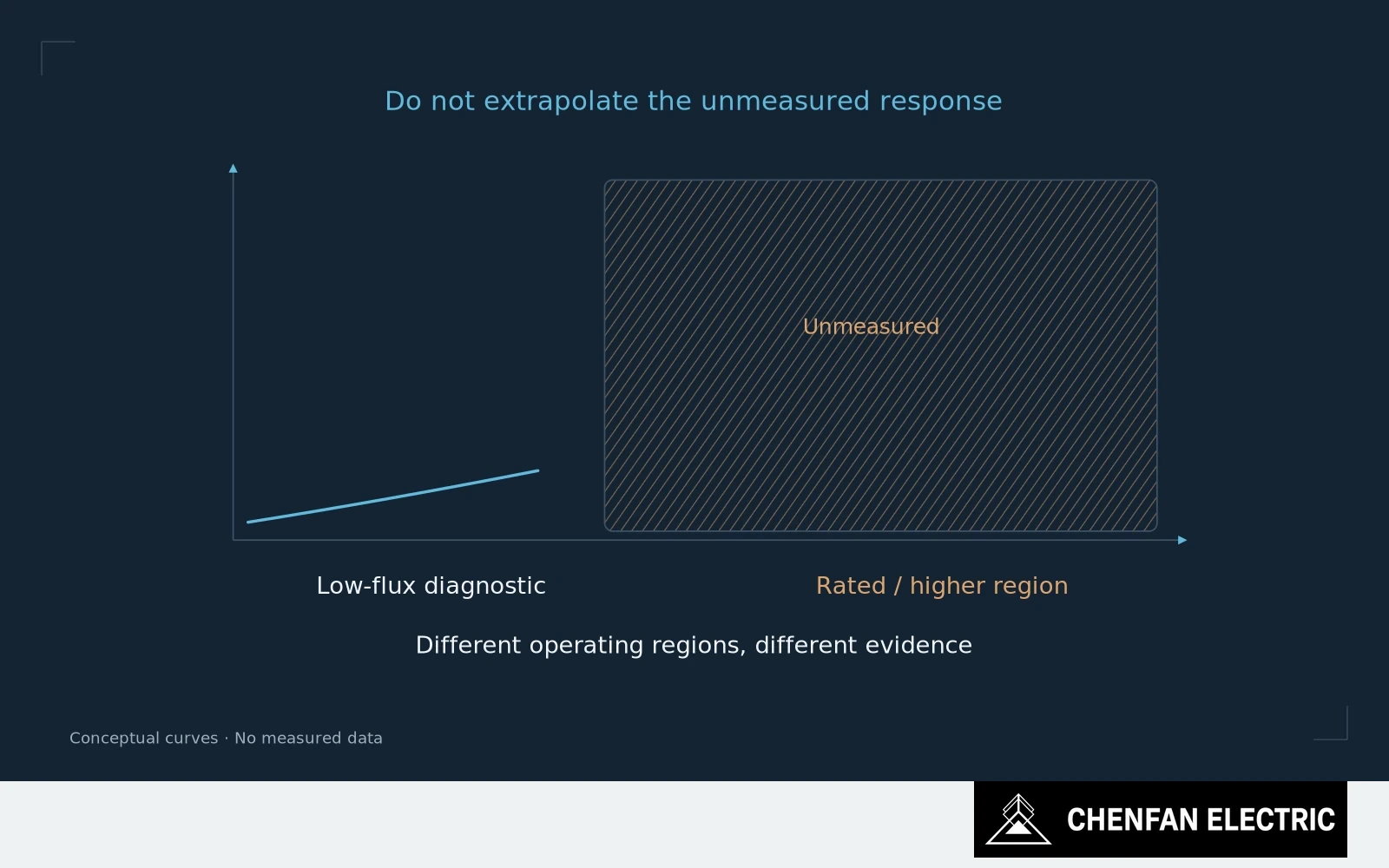
Distinguish diagnostic and production excitation
At a lower flux excursion, the magnetic circuit operates in a different part of its characteristic. A repeatable current response can provide a comparison point for the same assembly, winding connection and test method without establishing what happens near the design’s upper operating region.
This distinction is particularly important when comparing a portable diagnostic instrument with a production core-test setup. The applied voltage, frequency, energized winding and resulting volts per turn may be very different. The presence of an “excitation current” field on both reports does not make the measurements equivalent.
Lower-excitation measurements can help examine whether an observed difference is already present away from the high-flux region. If comparable cores agree at lower points but diverge higher up, that pattern directs attention differently from a discrepancy across the whole range. It remains a diagnostic clue, not a unique defect signature.
Account for small signals and actual test voltage
Small signals also put greater demands on the measurement’s usable range. Resolution, offsets, noise and connection repeatability can become significant relative to the reading. A percentage difference can look dramatic when the absolute signal is close to the instrument’s practical uncertainty.
Record the actual excitation rather than assuming the instrument always applies the same value. Some diagnostic equipment selects among test voltages according to its operating conditions. Comparing results without that information can attribute a test-method change to the core.
Keep the magnetic preparation and test sequence consistent where the method requires it. The procedure should define the relevant initial condition rather than leave each operator to choose a different route to the measurement point.
Use lower-level evidence without extrapolating rated loss
The engineering value comes from combining appropriately controlled observations. Lower points describe one region of response; rated and authorized elevated points describe others. Do not extrapolate a loss curve into an unmeasured nonlinear region merely because the low-level data are smooth.
For supplier qualification, specify which data support acceptance and which are diagnostic. That separation prevents a convenient test from being promoted beyond its demonstrated purpose.
Use low-flux evidence to ask a better next question. Do not make it carry a rated-performance guarantee that the test never measured.
Practical takeaway
Two reports labelled excitation current may concern fundamentally different magnetic operating regions.
Chenfan Electric manufactures custom transformer cores according to customer drawings. Where applicable to the specified material and core design, agreed process controls include burr height below 0.02 mm and stacking factor above 97%. Measurement methods and acceptance conditions are defined for each order.