

Storage qualification for laser-scribed GOES must represent the packaging and moisture exposure being purchased. Separate constant-humidity deterioration from condensation as cold steel enters warm, moist air.
Choose the moisture mechanism
The public description of IEC 60068-2-78 identifies steady damp heat at constant temperature without condensation. That scope is useful when selecting a test family. It does not provide, through the catalogue alone, the severity, duration or acceptance requirements for a GOES storage trial. [1]
If the concern is condensation, define that exposure separately and record the conditions at the steel surface, not merely the room setpoint. Packaging can change moisture access and drying. A trial must distinguish a deliberately exposed surface from the condition inside the intended package.
Use controls that answer different questions
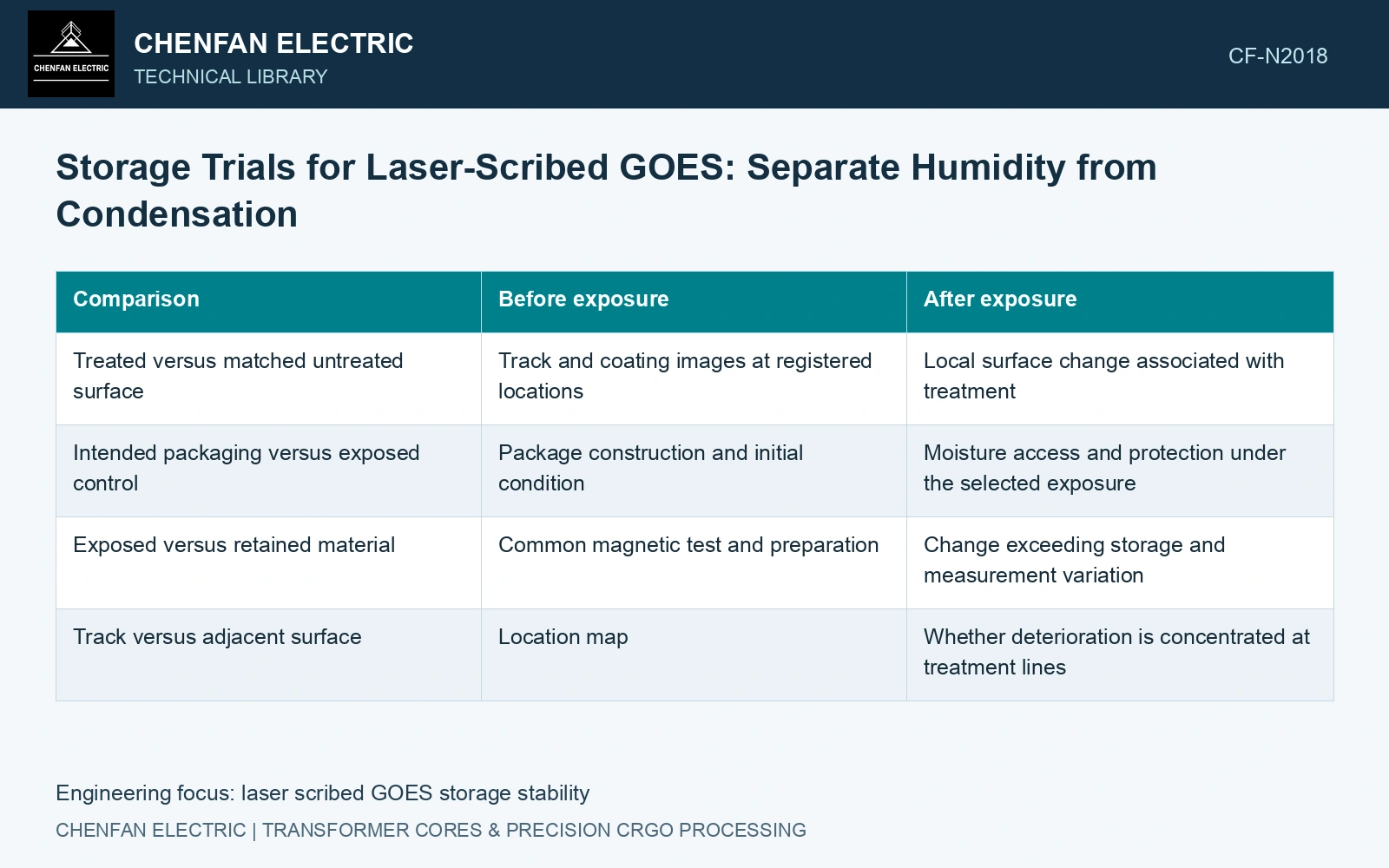
| Comparison | Before exposure | After exposure |
|---|---|---|
| Treated versus matched untreated surface | Track and coating images at registered locations | Local surface change associated with treatment |
| Intended packaging versus exposed control | Package construction and initial condition | Moisture access and protection under the selected exposure |
| Exposed versus retained material | Common magnetic test and preparation | Change exceeding storage and measurement variation |
| Track versus adjacent surface | Location map | Whether deterioration is concentrated at treatment lines |
Retain a non-exposed control for the same elapsed period. Use specimens that have not already been altered by destructive microscopy or a preceding electrical test. Record handling contamination, cut edges and package damage; these can create a pathway unrelated to the laser track.
Pair surface inspection with functional retesting
Inspect registered coating features and corrosion products consistently. Where electrical insulation is part of acceptance, select and document an appropriate surface-insulation method; IEC 60404-11 concerns such measurements [2]. Match contact/conditioning states. Staining alone does not quantify electrical behaviour.
Repeat magnetic testing at the specified induction and frequency after a defined conditioning state. Moisture, temperature and specimen preparation must be comparable. Do not introduce a thermal treatment that could alter the laser-refined state while preparing the stored specimen for retesting.
Laser research shows coating damage under some treatment settings [3], supporting registered track inspection. It does not demonstrate that a particular commercial product will fail in storage or establish an accelerated-life conversion.
For a storage witness, catalogue gauge 0.23 mm and density 7,650 kg/m³ give 0.17595 kg for an assumed 0.10 m² sheet. [4] Assume steel heat capacity 460 J/(kg·K): its thermal capacitance is 80.94 J/K. In an assumed chamber transfer, sheet surface is 10 °C and ambient dew point is 12 °C, leaving a −2 K condensation margin. Even a 100 J net heat gain raises this isolated-sheet estimate by only 1.24 K, still short of that dew point. Record actual surface temperature through transfer and separate this condensation exposure from a specified non-condensing damp-heat trial.
Packaging, thermal soak, laser-track condition and coating continuity govern the exposed storage state. Preserve a matched untreated witness and the same cutting history so a moisture effect is not confused with a different surface process.
Report the tested exposure, package state and measured changes. Predict warehouse or shipping duration with a validated acceleration model that preserves the observed deterioration mechanism.
References
- IEC, IEC 60068-2-78:2025, Environmental testing — Part 2-78: Tests — Test Cab: Damp heat, steady state.
- IEC, IEC 60404-11:2021, Magnetic materials — Part 11: Methods of measurement of the surface insulation resistance of electrical steel strip and sheet.
- P. Rauscher et al., The influence of laser scribing on magnetic domain formation in grain oriented electrical steel visualized by directional neutron dark-field imaging, Scientific Reports 6, 38307, 2016, Table 1. DOI: 10.1038/srep38307.
- Nippon Steel Corporation, Grain-Oriented Electrical Steel Sheets, catalogue D004je, April 2020, specification and typical-property tables.