

An island resort supplied by diesel generation, solar and possibly storage needs a transformer review for each permitted source combination. The same load can behave differently when source strength and controls change. Transformer current, voltage regulation, grounding and energization should therefore be assessed against operating states, not only the resort’s peak kilowatts.
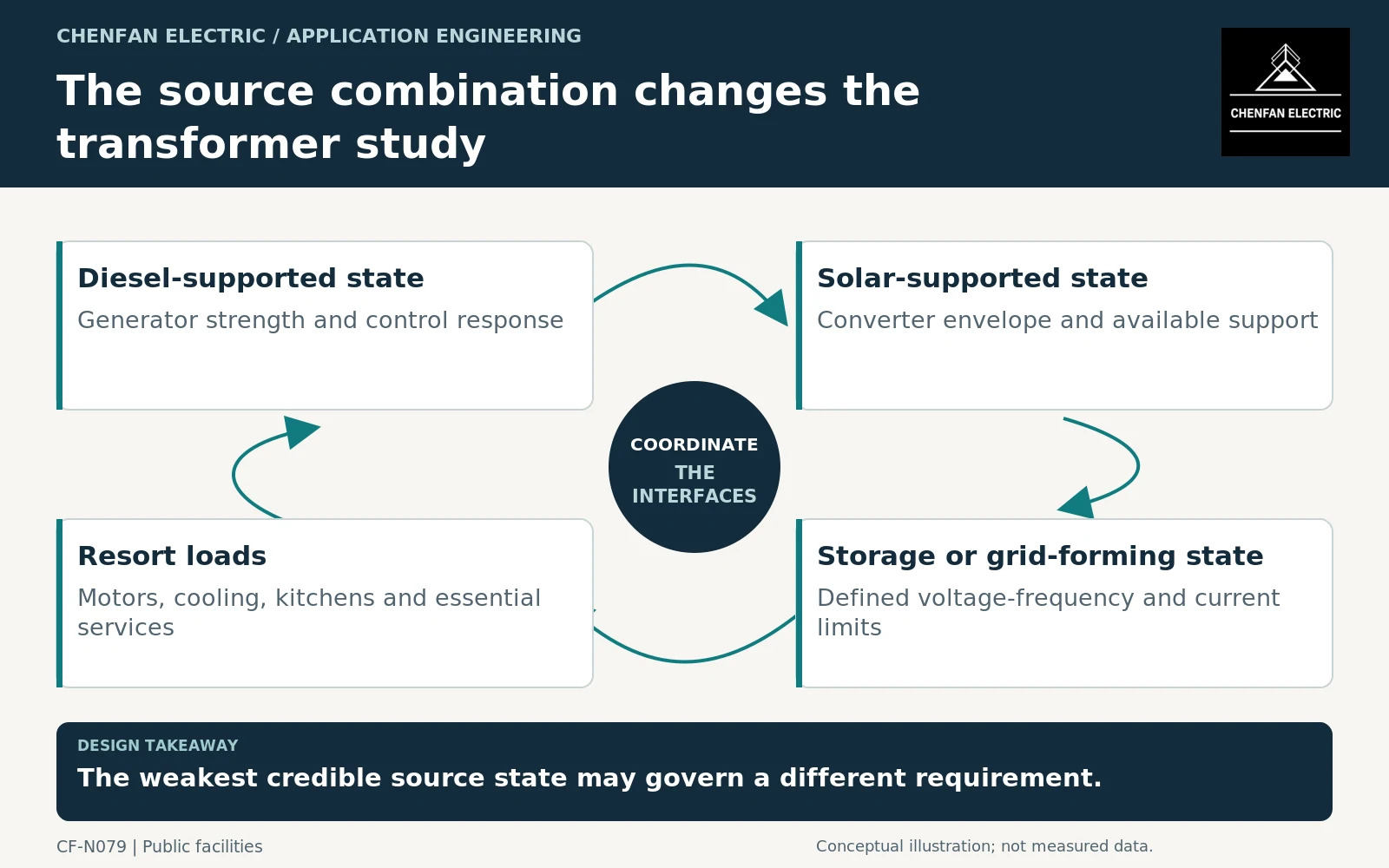
Define who establishes the electrical reference
The single-line diagram and control philosophy should identify which source establishes voltage and frequency in each state. A grid-connected solar inverter capability is not automatically an island-forming capability.
Grid-forming research treats control, protection and system interaction as coordinated topics. It does not certify a particular resort microgrid or prove that any converter can energize its transformer. [1]
Record whether the intended states include diesel-only operation, mixed diesel and solar, storage-supported operation or another arrangement. Identify transitions and any states deliberately prohibited by the control system.
Review transformer duty under each source condition
General transformer application guidance addresses voltage variation, ratings and connections. The project must supply the source models and operating cases that make those principles usable. [2]
The review should include winding current, reactive demand, tap assumptions and relevant waveform data. A weak-source condition may govern voltage response, while a different high-load condition governs heating. Do not assume that one case controls every requirement.
Transformer energization is a separate event from supporting an established island. CIGRE’s energization study-guide summary identifies possible voltage dips and temporary overvoltages, reinforcing the need to include the source and network model. [3]
Grounding and protection must be coordinated for each permitted source state. This article does not prescribe neutral switching, relay settings or islanding procedures; those depend on the actual installation and approved design.
Include resort load pickup and operating priorities
Cooling compressors, pumps, kitchens, laundry and other services can create different coincidence and starting cases. The essential-load schedule should identify what remains supported when generation is limited and what can be deferred or shed.
Motor-starting tools explicitly represent starting devices and dynamic source interaction. A transformer rating alone cannot demonstrate that every pump or compressor can start on the smallest generator combination. [4]
A useful matrix links each source state to permitted load blocks, starting events, reactive support and recovery conditions. Keep the operating restrictions compatible with the resort’s service requirements rather than assuming all discretionary loads can always be removed.
Preserve the operating envelope through future changes
The transformer enquiry should include the source-state matrix, load list, converter data, generator models and environmental conditions. Ask for the parameters needed by the coordinated study and confirmation of the resulting equipment duty.
Acceptance should distinguish component tests from integrated microgrid demonstrations. A transformer factory test does not validate source-transition controls, and a solar inverter certificate does not prove diesel-sharing behavior.
Adding battery storage, enabling a new grid-forming mode or reducing the minimum online diesel capacity can alter the electrical system without changing resort peak demand. Those changes should trigger review of the transformer and its surrounding interfaces.
The practical result is a transformer specification tied to the island’s supported operating states. It explains which sources and loads can operate together, rather than assuming that a mixed-energy label guarantees compatibility across every possible combination.
Core procurement checkpoint: Retain the core design basis across source changes
A diesel-and-solar island system can expose a transformer to different operating conditions. Ask the responsible designer to release one core design for the approved voltage-frequency cases or clearly identify separate variants. Core material and manufacturing records do not demonstrate stable source transitions or island operation; model validation and commissioning remain with the equipment and system teams.
For the core enquiry: Approved source-mode envelope; core drawing revision; material/test conditions; model-data responsibility; change-control reference.