

An interphase reactor connects defined bridge outputs and helps accommodate their relationship. If their currents become unequal, the magnetic duty depends on the winding connection and turn signs. The sum delivered to the load does not fully describe the reactor flux. [1]
For two bridge currents, define ic = (i1 + i2)/2 and id = (i1 − i2)/2. Both are amperes. These coordinates separate shared load from imbalance, but which one drives net ampere-turns must be derived from the actual winding polarities.
Check the magnetic connection first
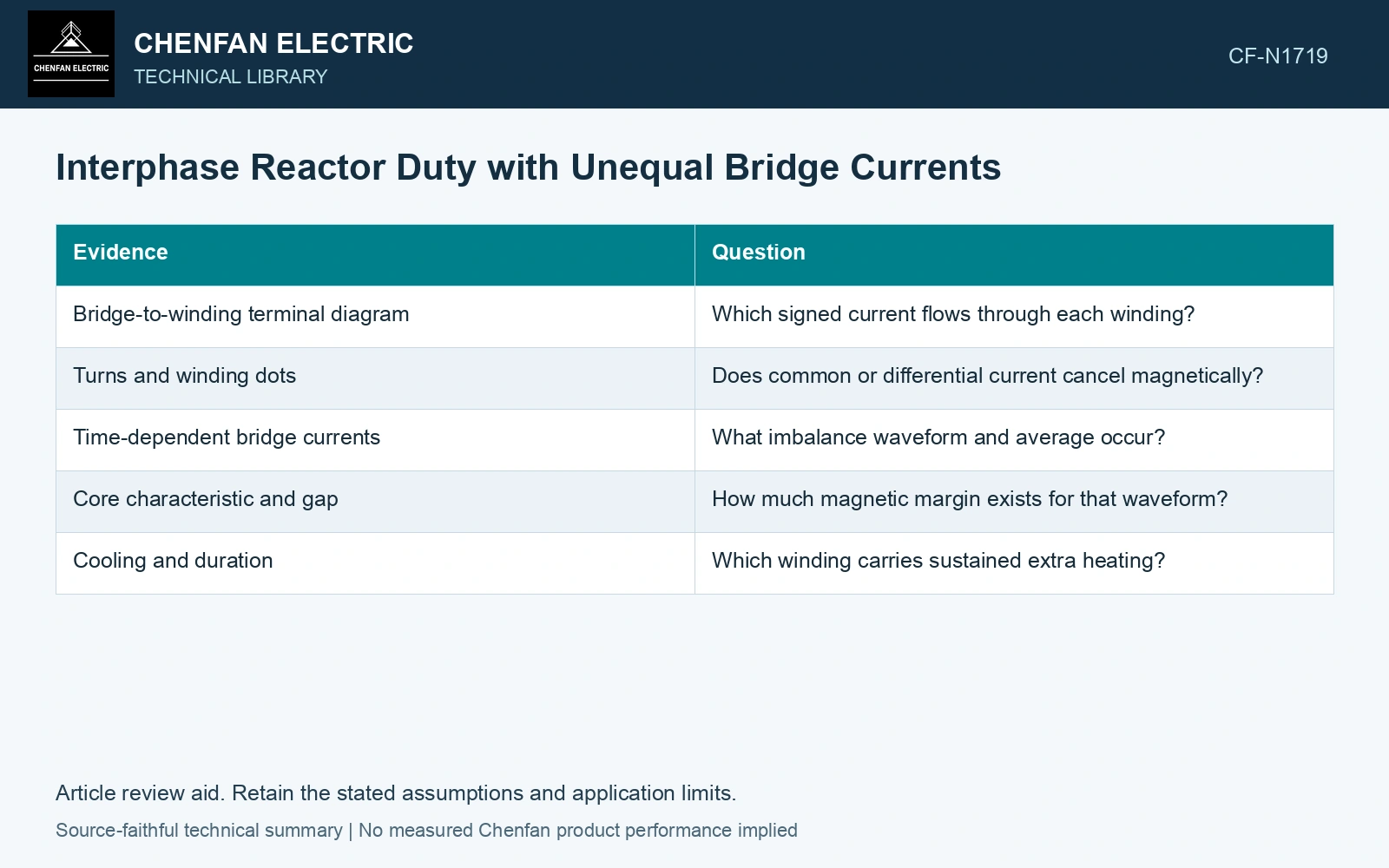
| Evidence | Question |
|---|---|
| Bridge-to-winding terminal diagram | Which signed current flows through each winding? |
| Turns and winding dots | Does common or differential current cancel magnetically? |
| Time-dependent bridge currents | What imbalance waveform and average occur? |
| Core characteristic and gap | How much magnetic margin exists for that waveform? |
| Cooling and duration | Which winding carries sustained extra heating? |
A symmetric cancellation example
If equal-turn windings are connected so their currents oppose magnetically, net magnetomotive force is N(i1 − i2) = 2Nid. Here N is turn count and the magnetomotive force is in ampere-turns. The common current cancels in this ideal sum. Unequal turns or another connection changes that result. Local leakage fields can remain even when the global sum cancels.
Calculate both the mean imbalance and its alternating part over a stated window. A DC component can shift the core operating trajectory; an AC component can cause a cyclic excursion. Their effects cannot be summarized by total load current alone.
The Siemens application explains that reducing the interphase-transformer air gap increases sensitivity to saturation when converter halves operate unbalanced [1]. IEC 60076-6 covers reactor categories and their duties [2]; its public scope alone does not determine this unit’s flux trajectory.
Calculate unequal-bridge ampere-turns
Assume instantaneous bridge currents of 1,100 A and 900 A through equal 20-turn windings connected to oppose. Common current is 1,000 A, differential current 100 A and net magnetomotive force 4,000 A·turn. Equal total DC load does not establish cancellation. Evaluate core bias, ripple and copper duty using the actual winding polarity and current trajectories.
For an independent steady-current copper comparison, assume each winding has 1 mΩ resistance at the same operating temperature. Unequal currents produce (1,100² + 900²) × 0.001 = 2,020 W, versus 2,000 W at 1,000 A each: 1% more total copper loss, with 1,210 W in the heavier winding. A small total increase can coexist with a 21% increase in that winding’s loss; check its thermal margin separately.
References
- Siemens, SINAMICS DCM: DC converter application—12-pulse parallel connection with decoupled interphase transformer, application example 109822408, V2.0, July 2023.
- IEC, IEC 60076-6:2007, Power transformers — Part 6: Reactors.