

High-altitude transformer enquiries should separate thermal performance from insulation coordination. Reduced air density can affect air-based cooling and external dielectric behavior, but those are different design questions. A single altitude derating percentage cannot establish both. Provide the actual site elevation, installation arrangement and electrical duty so each affected boundary can be assessed explicitly.
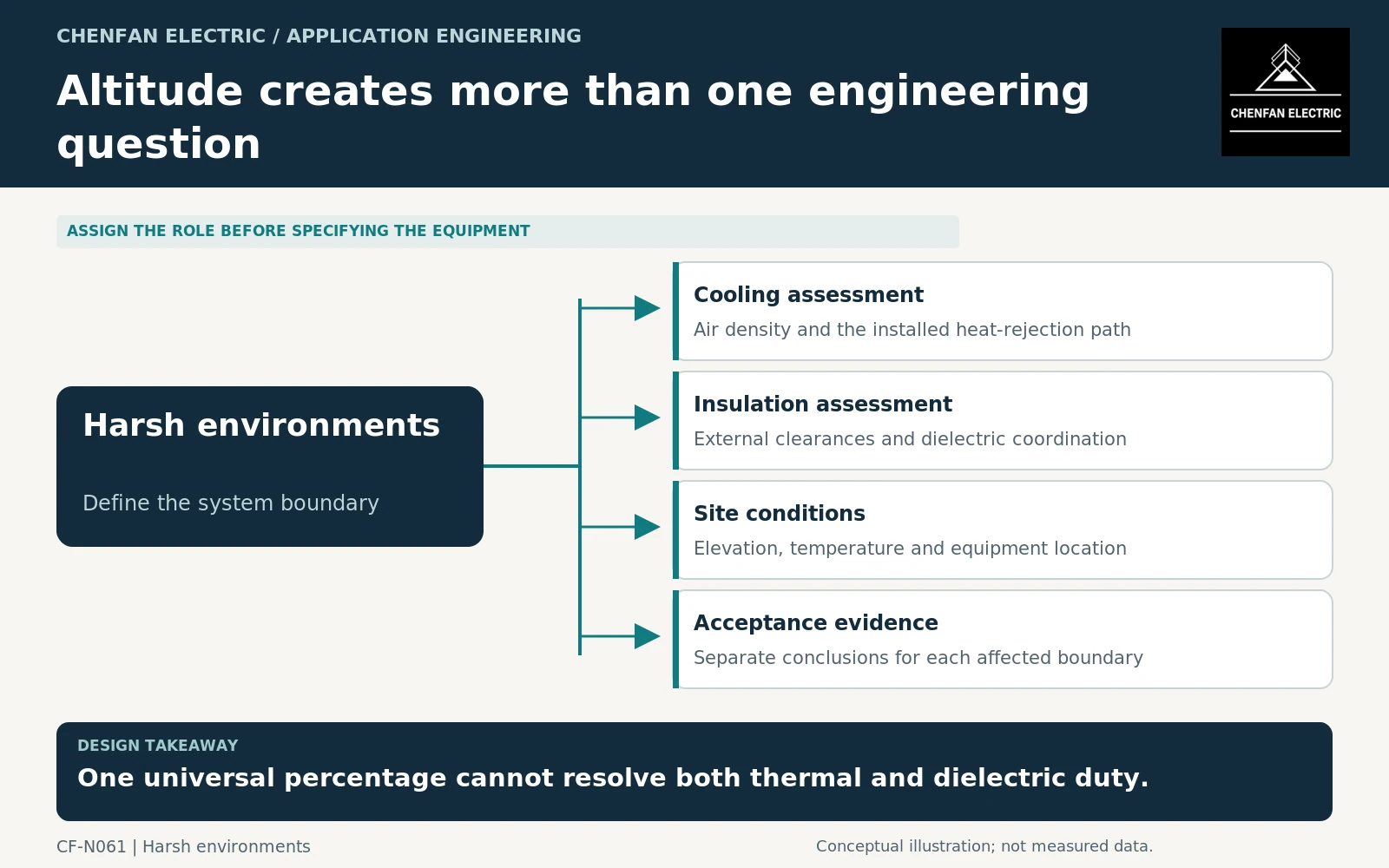
Give the designer a site condition, not a country label
State the operating elevation and the transformer’s exact location: outdoors, in a ventilated room, within a container or inside another machine. Include the temperature range and the cooling conditions at the equipment interface. A regional climate description is not a substitute for site data.
General transformer requirements distinguish normal and special service conditions. Unusual conditions must be communicated and agreed rather than silently assumed to fit a catalogue rating. [1]
For a dry-type transformer, the surrounding air can be directly involved in both cooling and external insulation performance. For a liquid-immersed transformer, internal insulation and external bushings or air clearances have different boundaries. Avoid treating the entire assembly as though every part responds identically to elevation.
A useful enquiry sentence is: “Confirm the proposed assembly for the stated elevation and installation conditions, identifying separate thermal and external-insulation assumptions.” That asks for a bounded assessment without prescribing an unsupported correction factor.
Review the heat path and dielectric path independently
The thermal review should identify how heat leaves the transformer and what air or liquid conditions are supplied. If fans, radiators or a room ventilation system are involved, the complete path matters. A component selected at one reference condition does not automatically provide the same system performance at another elevation.
The dielectric review should identify relevant external insulation, terminals and clearances, together with the specified electrical test and coordination basis. IEC 60076-3 addresses transformer insulation requirements and dielectric tests within its scope. Its publication history includes amendments, so the contractual edition should be explicit. [2]
Do not convert nominal system voltage into a complete clearance requirement. Highest voltage for equipment, insulation coordination, pollution and the actual assembly geometry may all be relevant to the responsible design. Likewise, a passing factory test under its stated conditions should not be presented as proof of every unassessed site condition.
These two reviews can lead to different changes. A cooling adjustment does not automatically solve an external-insulation issue, and a larger terminal clearance does not restore an inadequate heat-rejection path.
Require two conclusions and one coordinated installation record
The supplier’s response should state the supported current duty and cooling assumptions, then separately state the external-insulation basis. Any limits should be linked to the actual equipment configuration. For dry-type equipment, use its applicable standard and loading framework rather than importing a mineral-oil model. [3] [4]
The installation record should preserve enclosure details, inlet conditions, terminal arrangement and site elevation. A later enclosure change or relocation to another elevation can invalidate an assumption even if the transformer nameplate remains unchanged.
Compare offers only after these boundaries are aligned. One supplier may include a complete altitude-specific assembly while another quotes a standard unit with a thermal restriction and no external-insulation review. The same MVA and voltage labels do not make those offers equivalent.
The practical output is a two-part altitude assessment supported by the final installation drawing. It replaces an ambiguous “suitable for high altitude” statement with explicit evidence about what the transformer can carry and how its exposed insulation interfaces are addressed.
Core procurement checkpoint: Do not promise an altitude correction through steel selection
High-altitude cooling and insulation requirements must be resolved in the complete transformer design. The core procurement package should contain the resulting geometry and interfaces, with any special dimensional constraints explicitly identified. A different CRGO grade or an unchanged core outline does not establish that external clearances, cooling performance or the completed equipment’s altitude rating are acceptable.
For the core enquiry: Approved altitude-related equipment design; core drawing; keep-clear dimensions; material specification; complete-equipment acceptance responsibility.