

A transformer supplying grid-scale heat pumps should be specified from the equipment’s electrical input over its operating range, not from thermal output alone. Compressor modulation, auxiliary systems and special operating modes can change current and waveform. The seasonal duty should show how long those states persist and which combinations are permitted.
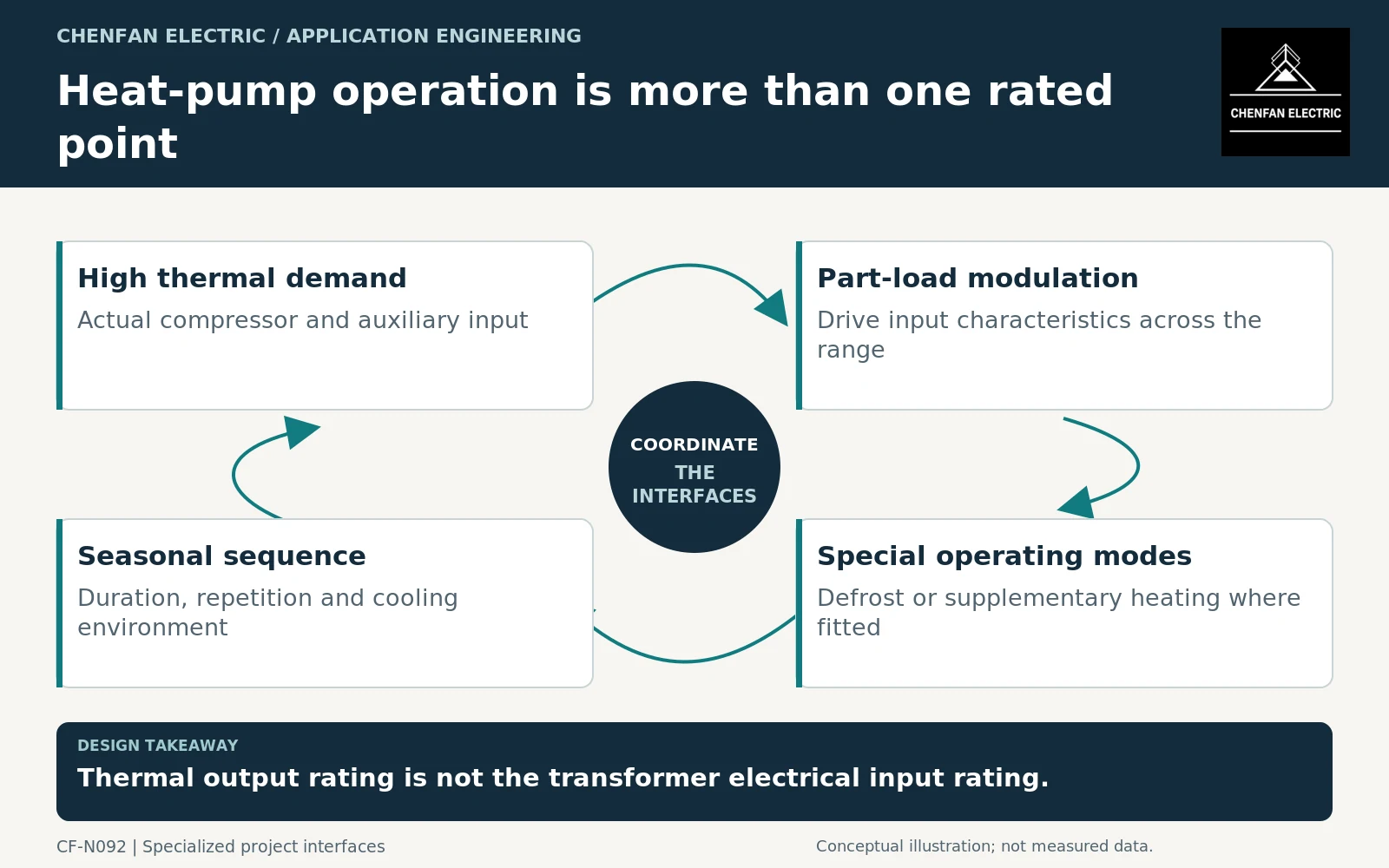
Translate thermal service into electrical input
The heat-pump supplier should provide electrical input current or P-Q data at the relevant operating conditions. Thermal output and electrical input are different quantities, and their relationship changes with the specified operating point.
Identify compressor-drive topology, pumps, fans, controls and any supplementary heating actually included. Do not assume every heat-pump installation has the same auxiliary equipment or operating modes.
General transformer application guidance addresses ratings and operating conditions. Where specialized converter arrangements are used, converter-transformer application guidance may also be relevant. [1] [2]
The purchasing boundary should state whether the supplied electrical data cover one unit, a complete heat-pump train or the entire plant. Additional site pumping should not be omitted or counted twice.
Request input data across modulation states
A variable-speed compressor’s input duty is determined through its drive. Motor output frequency and current should not be assigned directly to the upstream transformer. Obtain the drive’s alternating current (AC) input envelope and relevant harmonic evidence.
High thermal demand, part-load operation and transitions may have different input characteristics. A single full-load power-factor or harmonic figure does not establish every state. ABB’s harmonic guidance supports treating nonlinear-load behavior as a system question with operating-point data. [3]
If defrost, supplementary electric heating or another special mode is fitted, identify whether it overlaps with compressor and pumping demand. The existence and sequence of those modes should come from the purchased equipment, not a generic assumption about heat pumps.
A useful operating schedule names each mode, AC input, duration, permitted overlap and evidence source. It gives the transformer designer a reproducible duty rather than a thermal brochure rating.
Preserve seasonal and repeated loading
A plant providing sustained district or industrial heat may operate for long intervals without the recovery periods assumed for intermittent equipment. Conversely, seasonal changes may reduce one load while increasing another auxiliary requirement.
The thermal assessment should use chronological electrical loading and the actual transformer cooling environment. Mineral-oil loading guidance provides one equipment-specific framework and should not be treated as a universal heat-pump sizing rule. [4]
Motor or drive restart cases should be considered separately from sustained running. The transformer can satisfy a continuous thermal duty while the source network still requires a voltage-response review for a particular restoration sequence.
Define the expansion and control boundaries
Several heat-pump units may share a transformer under staged operation. Identify which combinations are allowed and whether central controls enforce an aggregate limit. A future unit addition should not consume capacity already reserved for a cold-weather operating case.
The enquiry should include unit input envelopes, auxiliary loads, seasonal schedules, special modes and source configurations. Ask the supplier to state the governing cases and any restriction that supports its proposed rating.
Acceptance should preserve the implemented staging and operating limits used in the assessment. Changing the process temperature requirement or supplementary-heating policy can change electrical duty without altering the published thermal capacity.
The practical result is a transformer specification tied to the heat-pump plant’s actual electrical behavior. It avoids equating thermal megawatts with electrical MVA or assuming that smooth compressor modulation makes all other duty questions disappear.
Core procurement checkpoint: Keep compressor modulation at the equipment boundary
A heat-pump compressor’s modulation profile informs the transformer’s loading assessment, while the magnetic design requires the relevant terminal voltage and frequency conditions. Order the core against the manufacturer’s approved geometry and material specification. Do not equate low mechanical load with an unenergized core or present a material-loss certificate as the whole heat-pump installation’s part-load efficiency.
For the core enquiry: Approved equipment design; voltage-frequency basis; core drawing; material specification; loss-test boundary and energized-state assumptions.