

Calculate fault heating from the actual winding-section current and its starting temperature. A hotter copper conductor has both less temperature headroom and higher resistance. Include that resistance change before comparing cold and hot fault duties.
Map the fault waveform to one conductor section
For a symmetrical zigzag carrying pure zero sequence, each phase path carries one third of the neutral current; both series sections carry that phase-path current. [1] Combined auxiliary or unbalanced duty needs its own section waveform. Identify the earthing-transformer test connection separately. [2]
Use ∫i²dt for the selected section, including any offset or distortion. The adiabatic model m cp dθ/dt = i²R(θ) gives a mean conductor temperature, with local joints and stray losses assessed separately.
Carry the copper resistance relation through the pulse
USBR gives R(θ)/R(θref) = (234.5+θ)/(234.5+θref) for copper, with temperatures in °C. [3] Assume the model uses that linear relation and constant heat capacity throughout the pulse. Integration gives θend = (234.5+θstart) exp[Rref∫i²dt/{m cp(234.5+θref)}] − 234.5.
Assumptions: sinusoidal 50 Hz section current 200 A RMS for 5 s; copper mass 10 kg; cp = 385 J/(kg·K); R70 = 0.100 Ω; no cooling during the pulse and no additional AC or stray loss. The current-time integral is 200,000 A²·s and heat capacity is 3,850 J/K.
| Initial conductor temperature | Initial resistance | Integrated final temperature | Calculated increment |
|---|---|---|---|
| 70 °C | 0.10000 Ω | 75.24 °C | 5.24 K |
| 100 °C | 0.10985 Ω | 105.76 °C | 5.76 K |
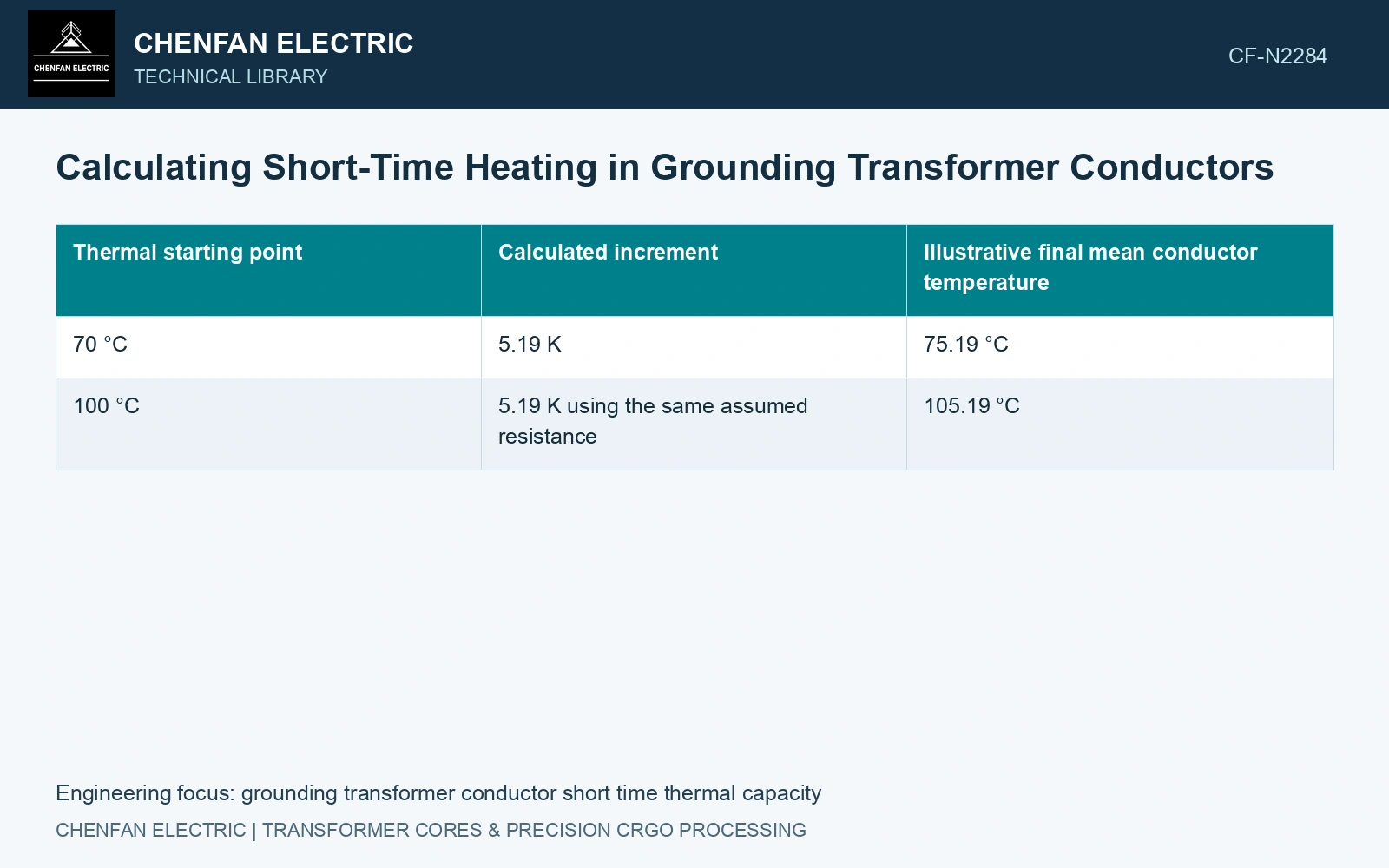
Keeping 0.100 Ω in both cases gives a constant-resistance increment of only 5.195 K. The hotter start therefore gains about 0.56 K more rise than that shortcut predicts.
Use the hot-start result in the duty decision
Assume the project allocates a 105.5 °C mean-conductor ceiling for this screen. The cold-start case remains below it; the hot-start case exceeds it. Reduce the proposed duty or obtain a more complete thermal assessment before accepting that hot-start case. The assumed ceiling is a project input, not a standard limit.
Use the relevant conductor temperature and actual resistance reference, then add local joint, hotspot and waveform effects. Credit cooling only when the event duration and identified thermal response justify it. A low bulk-oil temperature does not establish a cold conductor.
References
- D. De Ronde, R. VanHatten and A. Wade, Loss of Effective System Grounding — Best Practices, Protection Challenges, and Solutions, Schweitzer Engineering Laboratories, 2015.
- IEC, IEC 60076-6:2007, Power transformers — Part 6: Reactors.
- U.S. Bureau of Reclamation, FIST Volume 3-31, Transformer Diagnostics, June 2003, section 15.1.