

A model may apply one correction for temperature and another for stress. Multiplying them assumes that the combined response follows a separable relationship. That assumption needs testing. The material at higher temperature and under restraint may not respond as two independent adjustments predict.
First define permeability. An amplitude ratio, an incremental response around an operating point and a differential slope are different quantities. The test and model must use the same definition, magnetic direction and excitation history.
Cross the two variables
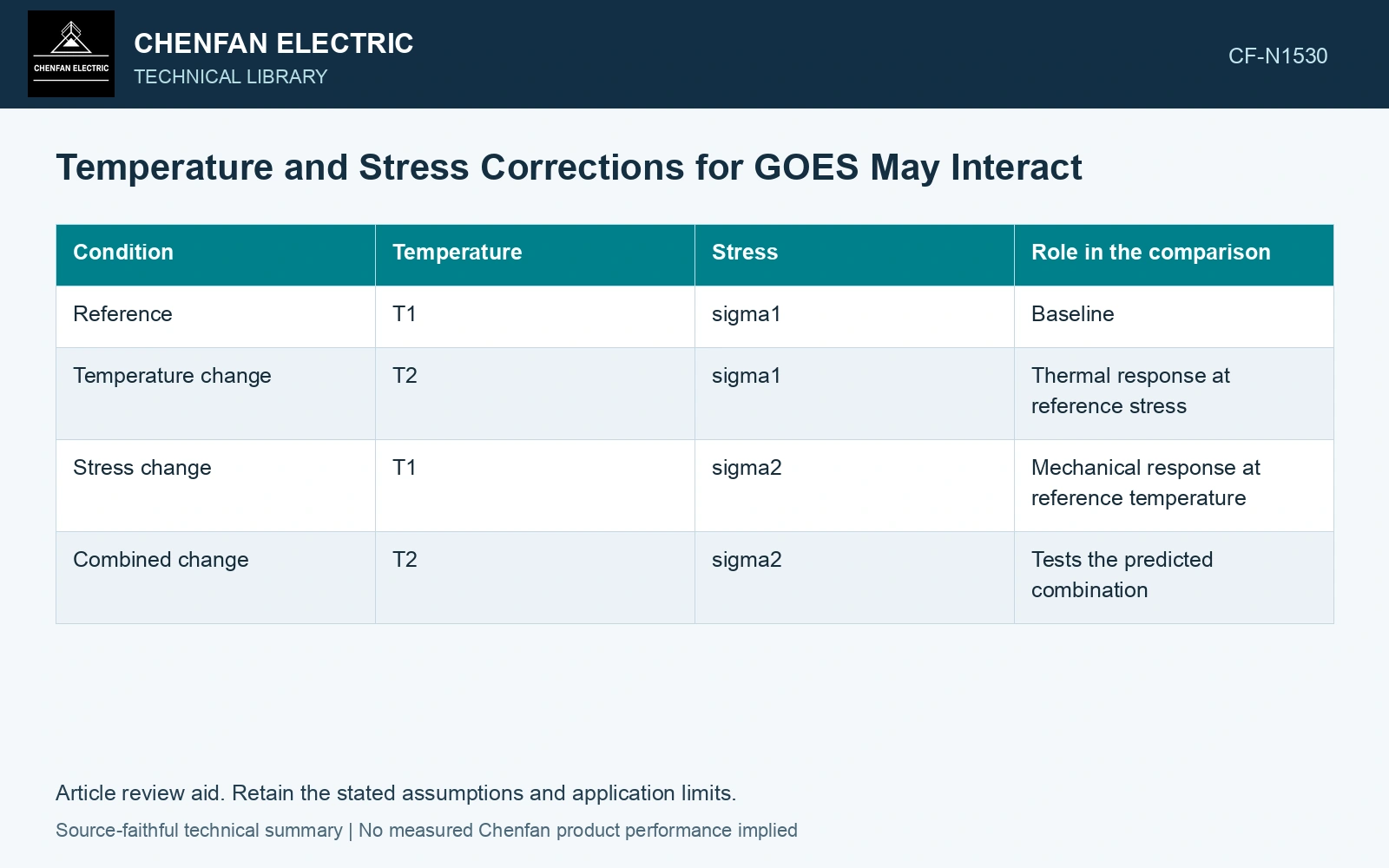
Select two temperature states and two stress states relevant to the proposed use, then measure all four combinations. Include repeated reference observations and, where useful, intermediate states. Actual specimen temperature and actual stress in the useful region are the relevant inputs.
| Condition | Temperature | Stress | Role in the comparison |
|---|---|---|---|
| Reference | T1 | sigma1 | Baseline |
| Temperature change | T2 | sigma1 | Thermal response at reference stress |
| Stress change | T1 | sigma2 | Mechanical response at reference temperature |
| Combined change | T2 | sigma2 | Tests the predicted combination |
Changing temperature can alter fixture expansion and specimen restraint. Verify stress at each thermal state rather than assuming an unchanged machine setting holds it constant.
Use an interaction contrast carefully
For an additive local comparison, let m denote the precisely defined measured permeability response. The contrast I = m(T2,sigma2) − m(T2,sigma1) − m(T1,sigma2) + m(T1,sigma1) tests whether the change associated with one variable depends on the other over these selected levels. I has the same units as m.
A nonzero contrast beyond measurement uncertainty challenges an additive description over that region. A multiplicative separability hypothesis needs its corresponding ratio or logarithmic comparison, provided the response values make that operation meaningful. Do not use an additive contrast to claim that every possible model form has been rejected.
Keep the operating point comparable
Permeability depends on where and how it is measured on the magnetic response. Hold the selected operating point and waveform definition consistent. If stress or temperature shifts the specimen’s response, verify that the test still evaluates the intended magnetic state.
Control magnetic preparation and test order. A sequence that always measures the combined hot-loaded condition last can confuse interaction with progressive heating, instrument drift or mechanical conditioning. Repeated and reordered observations help identify those contributions.
Extend only where the model will be used
If the simple correction fails, measure additional combinations where sensitivity matters most. A response surface should preserve the demonstrated directional, temperature and stress boundaries. It should not conceal missing data behind a smooth interpolation.
If the four-condition comparison supports separability within uncertainty, state the tested region and detection capability. That is a useful simplification for the model. It remains a local result, not proof that all GOES temperatures, stresses and excitation conditions can be represented by multiplying two independent correction factors.
Technical references
- Materials / MDPI. Magnetostrictive Properties of the Grain-Oriented Silicon Steel Sheet under DC-Biased and Multisinusoidal Magnetizations.
- NIST. NCAL: Diffraction Stress Measurement Under Applied Load.